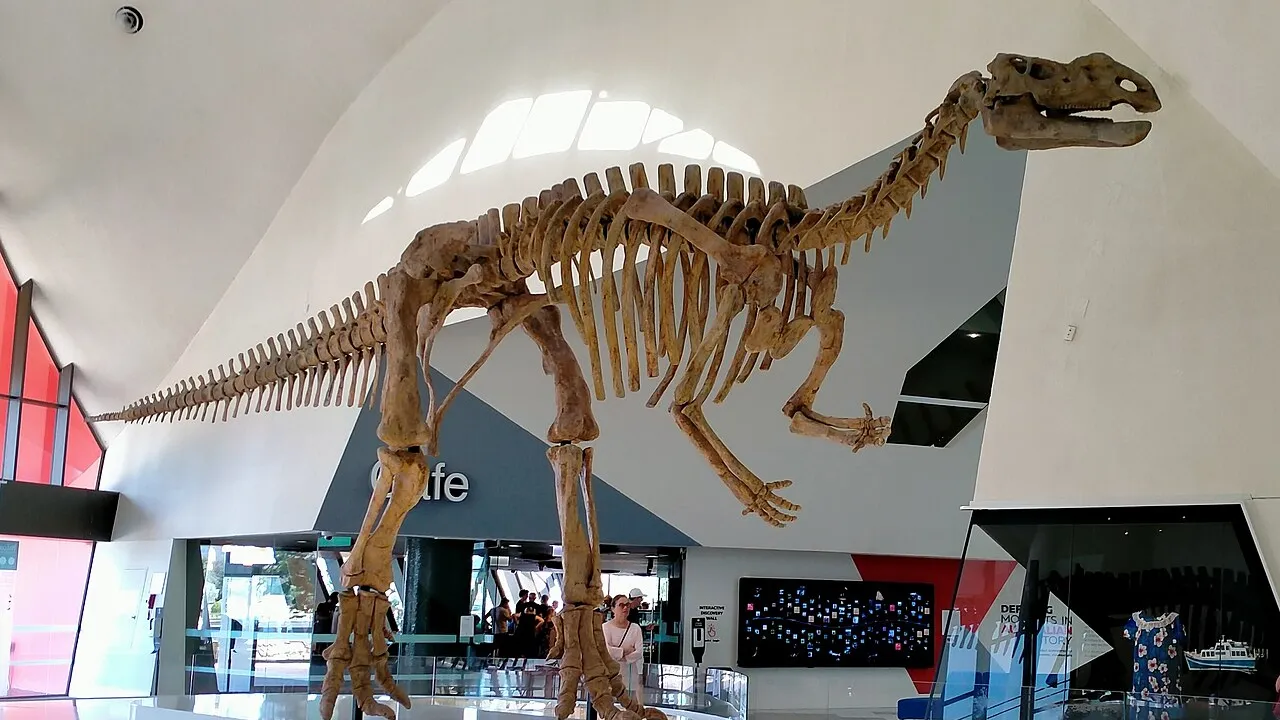
1. What special shape grew on top of the nose of Muttaburrasaurus?
2. How did the teeth of Muttaburrasaurus cut tough plants?
🤯 Mind-Blowing Fact • Grade 2
Muttaburrasaurus was the very first Australian dinosaur ever reconstructed as a complete mounted skeleton!
✨ Word Sparks (Grade 2 Glossary)
Tap 🔊 to hear
inland
located inside a continent away from oceans
chamber
an enclosed hollow room or space
cycad
a palm-like ancient plant with tough leaves
🪝
How did fossil bones from a dry Australian riverbed end up beside ancient seashells?
1
When the Outback Was a Sea
Splash! One hundred million years ago, a cool sea covered much of central Australia. Muttaburrasaurus lived in shady forests along the shore. After one individual died, river currents carried its body out to sea, where it sank beside ammonite shells!
2
Built-In Trumpet Nose
Right in front of its eyes rose a swollen, hollow dome of thin bone. Scientists think air rushing through that created loud honks to call herd members through thick fog and trees.
3
Crunching Tough Cycads
Powerful jaw muscles filled the back of its wide skull. Paired with scissor-like teeth, those jaws easily chopped spiky , ferns, and pine cones.
1. Why was the skeleton of Muttaburrasaurus found mixed with ancient sea shells?
2. Who discovered the first Muttaburrasaurus fossils in 1963?
🤯 Mind-Blowing Fact • Grade 3
Townspeople in Muttaburra returned fossil pieces from their porches and gardens so scientists could reassemble the famous dinosaur!
✨ Word Sparks (Grade 3 Glossary)
Tap 🔊 to hear
ornithopod
a two- or four-legged plant-eating dinosaur group
bulla
a rounded, bubble-like hollow bone structure
shear
to cut cleanly with sliding sharp edges
🪝
Why did dozens of cattle stampede over a fossil before scientists realized it was an Australian treasure?
1
Rescued from the Outback
Picture dusty cattle kicking up stones beside the Thomson River near Muttaburra, Queensland, in 1963! Grazier Doug Langdon noticed curious gray bones poking out of limestone and alerted museum scientists. When locals saw that souvenirs had gone missing from the site, town residents kindly returned collected bone pieces so paleontologists could puzzle the skeleton back together!
2
Mystery of the Nasal Bulla
Named Muttaburrasaurus langdoni in 1981, this twenty-six-foot immediately stood out for its bulbous snout chamber, called a nasal . This hollow bony dome may have acted as an echo chamber for booming calls or housed extra scent-detecting tissue.
3
Shearing Instead of Grinding
Unlike northern duck-bills that ground leaves flat, Muttaburrasaurus packed broad, ridged teeth alongside enormous jaw muscles. Its jaws sliced up and down like heavy , chopping fibrous cycads and podocarp conifers.
4
Cool Southern Forests
During the Early Cretaceous, Australia sat much closer to the South Pole, meaning Muttaburrasaurus thrived in cool, misty forests with chilly winter nights.
1. How did local residents help save the original Muttaburrasaurus skeleton?
2. What was the climate like in Australia when Muttaburrasaurus lived there?
🤯 Mind-Blowing Fact • Grade 4
Enlarged muscle openings at the back of the Muttaburrasaurus skull gave it one of the strongest vertical bites of any medium-sized ornithopod!
✨ Word Sparks (Grade 4 Glossary)
Tap 🔊 to hear
adductor
a strong muscle that pulls jaws shut
carcass
the body of an animal after death
frond
a large divided leaf of ferns or cycads
🪝
Why did Australia's most famous herbivorous dinosaur evolve giant jaw muscles and shearing blades instead of grinding molars?
1
Coastal Forests of the Eromanga Sea
Step back 103 million years to Early Cretaceous Queensland, where waves of the vast Eromanga Sea lap against cool, fern-carpeted headlands. Along these wooded shores strides Muttaburrasaurus langdoni, a bulky twenty-six-foot ornithopod weighing nearly three tons. After dying near the coast, the type specimen drifted seaward until its bloated settled onto marine muds of the Mackunda Formation alongside ammonites and bivalves.
2
A Skull Built for Slicing Power
CT scans and skull reconstructions show that the back of the Muttaburrasaurus cranium flared remarkably wide to anchor massive jaw muscles. Rather than sliding its jaws sideways like northern iguanodontians, it drove ridged maxillary and dentary teeth straight past one another like industrial hedge clippers. That powerful vertical bite let it slice tough seed cones, woody Araucaria twigs, and leathery cycad .
3
The Hollow Snout Chamber
Equally striking is its inflated nasal bulla—a thin-walled, arched dome rising between the nostrils and eye sockets. Whether supporting fleshy display pads, amplifying low-pitched calls across dense woodland, or warming chilly polar air before it reached the lungs, the chamber gave Muttaburrasaurus an unmistakable profile.
4
Southern Gondwanan Lineage
Once grouped with northern Iguanodon, modern studies link Muttaburrasaurus to rhabdodontomorphs—an ancient lineage of tough-biting ornithopods that flourished in southern Gondwana and island Europe.
1. Why was the back of the Muttaburrasaurus skull unusually wide?
2. Which group of dinosaurs do modern scientists link closely to Muttaburrasaurus?
🤯 Mind-Blowing Fact • Grade 5
Later fossil skulls found in older Queensland rocks at Dunluce Station show that earlier relatives of Muttaburrasaurus had slightly different snout chambers, capturing evolution in action across millions of years!
✨ Word Sparks (Grade 5 Glossary)
Tap 🔊 to hear
rostrum
the projecting snout region of a skull
phylogenetic
relating to evolutionary family tree relationships
concretion
hard mineral rock formed around a fossil
🪝
What does Muttaburrasaurus reveal about isolated dinosaur evolution near the Cretaceous South Pole?
1
An Outback Discovery With a Marine Twist
When cattle grazier Doug Langdon spotted weathered vertebrae in calcareous beside Queensland's Thomson River in 1963, Australian dinosaur fossils were exceedingly scarce. Paleontologists Alan Bartholomai and Ralph Molnar formally named Muttaburrasaurus langdoni in 1981 from this remarkably complete skeleton recovered from Albian marine sediments of the Mackunda Formation. Washed out into the shallow Eromanga Sea roughly 103 million years ago, the eight-meter herbivore became an enduring icon of Australian paleontology.
2
Cranial Biomechanics and Shearing Dentition
Early reconstructions cast Muttaburrasaurus as a southern cousin of European Iguanodon, complete with grinding jaws and sharp thumb spikes. Closer anatomical inspection overturned both assumptions. Enlarged supratemporal fenestrae housed hypertrophied jaw musculature, while the enameled tooth crowns formed continuous vertical shearing blades rather than horizontal grinding pavements. Instead of chewing with pleurokinetic sideways motion, Muttaburrasaurus operated its jaws like high-leverage shears—possibly tackling tough gymnosperm cones, fibrous cycadophytes, or occasional carrion.
3
Functional Hypotheses for the Nasal Bulla
Dominating the is a thin-walled, laterally compressed hollow chamber termed the nasal bulla. Comparative anatomists have proposed three complementary roles: an acoustic resonating chamber for low-frequency social calls, a visual species-recognition crest, or a vascularized heat-exchange cavity warming cold subpolar air.
4
Forelimb Posture and Gondwanan Roots
Reassessment of the forelimb suggests a sturdy five-fingered hand weighted across the middle three digits rather than an oversized defensive thumb dagger. analyses place Muttaburrasaurus among Rhabdodontomorpha, demonstrating how isolated Gondwanan ornithopods retained archaic lineages while evolving specialized adaptations.
5
Thriving in High-Latitude Gondwana
Living when eastern Australia lay between fifty and sixty degrees south latitude, Muttaburrasaurus navigated cool seasonal woodlands alongside giant pliosaurs offshore and megaraptoran predators like Australovenator inland.