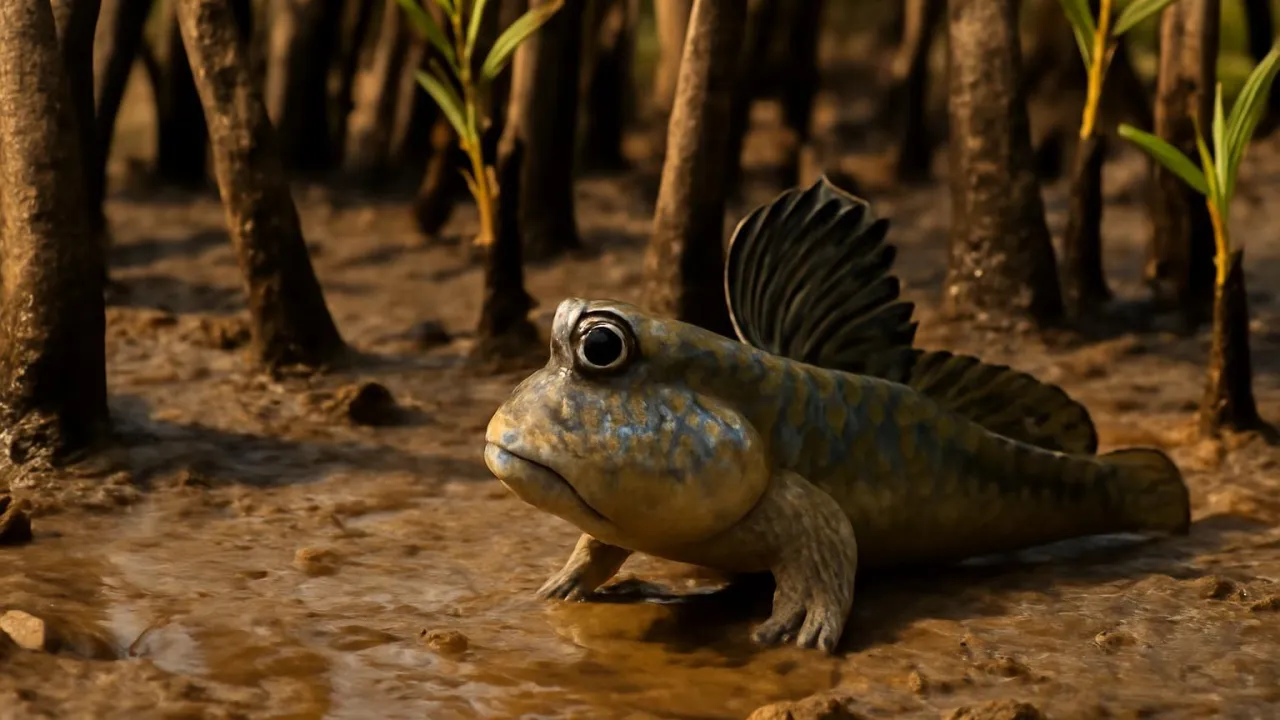
Mudskippers can breathe air and use their fins to walk on land!
✨ Word Sparks (Grade 2 Glossary)
Tap 🔊 to hear
mangrove
Trees that grow in salty water near the sea
tidal
Related to the rise and fall of ocean water
balance
Staying steady without falling over
🪝
Can a fish really walk and breathe outside water?
1
Walking Fish
Mudskippers use their strong fins to walk on muddy land. They move slowly but well. These fish can leave water for a while. Their fins help them and crawl.
2
Where They Live
Mudskippers live in warm swamps and mudflats. They hide in holes in the mud. These places are wet and full of food. Mudskippers stay close to water but explore land.
3
Special Features
Mudskippers can breathe air through their skin and mouth lining. They have big eyes on top of their heads. These eyes help them see above water well. Their breathing helps them survive on land.
Mudskippers can breathe air through their skin and mouth lining to live on land!
✨ Word Sparks (Grade 3 Glossary)
Tap 🔊 to hear
adaptation
A change that helps an animal survive better
camouflage
Colors or shapes that help hide from danger
ecosystem
All living things and their home together
🪝
How does a fish survive both in water and on land?
1
Amazing Walking Ability
Mudskippers have adapted fins that act like legs for walking on mudflats. This helps them escape predators and find food on land. Their fins also allow them to climb roots and rocks. This unique movement is rare among fishes.
2
Breathing Air on Land
Mudskippers can breathe air through their skin and the lining of their mouth and throat. This ability is called cutaneous respiration. It allows them to survive outside water for hours. They must keep their skin moist to breathe properly.
3
Habitat and Camouflage
Mudskippers live in mangrove swamps and tidal mudflats where water meets land. Their brown and green colors help them in muddy environments. This camouflage protects them from predators. They also build burrows to hide and stay safe.
4
Role in the Ecosystem
Mudskippers help control insect populations by eating bugs and small crustaceans. They are prey for birds and larger fish, fitting into the food web. Their burrows aerate the mud, helping plants grow. This symbiotic role supports healthy mangrove .
Mudskippers are one of the few fish that can walk, breathe air, and live on land!
✨ Word Sparks (Grade 4 Glossary)
Tap 🔊 to hear
amphibious
Can live both in water and on land
symbiotic
Living closely and helping each other
pollution
Harmful waste that hurts nature
🪝
What makes mudskippers unique in the fish world’s ecosystem?
1
Unique Movement and Survival
Mudskippers have evolved strong pectoral fins that allow them to walk and climb on muddy surfaces and roots. This adaptation helps them avoid aquatic predators and exploit food sources on land. Their ability to breathe air through their skin and mouth lining enables them to survive extended periods outside water. These combined traits make mudskippers one of the few fish species.
2
Habitat and Geographic Range
Mudskippers inhabit tropical and subtropical mangrove swamps and tidal mudflats across the Indo-Pacific region. These habitats experience daily tides that expose mudflats for foraging. Mangrove ecosystems provide shelter and breeding grounds for mudskippers. Human activities like coastal development threaten these critical habitats.
3
Ecological Roles and Relationships
Mudskippers play an important role in food webs by consuming insects, small crustaceans, and algae, controlling their populations. They serve as prey for birds and larger aquatic predators, linking terrestrial and aquatic ecosystems. Their burrowing aerates the mud, improving oxygen flow and benefiting mangrove plants. This relationship supports ecosystem health and biodiversity.
4
Human Impact and Conservation
Coastal development and threaten mudskipper habitats, reducing their populations. Conservation efforts focus on protecting mangrove forests and tidal wetlands essential for their survival. Educating communities about mudskippers’ ecological importance helps promote habitat preservation. Protecting mudskippers also supports overall coastal ecosystem resilience.
Mudskippers are rare fish that walk, breathe air, and live both in water and on land!
✨ Word Sparks (Grade 5 Glossary)
Tap 🔊 to hear
cutaneous respiration
Breathing through skin to get oxygen
buccopharyngeal cavity
Mouth area that helps with breathing air
intertidal zone
Land between high and low ocean tides
🪝
How do mudskippers challenge what we know about fish and land animals?
1
Taxonomy and Scientific Context
Mudskippers belong to the family Gobiidae and genus Periophthalmus, which includes several species adapted to amphibious lifestyles. Their evolutionary adaptations bridge aquatic and terrestrial environments, making them unique among ray-finned fishes. Scientists study mudskippers to understand vertebrate transition from water to land. Their specialized morphology provides insight into evolutionary biology.
2
Physiological Mechanics of Movement and Breathing
Mudskippers use modified pectoral fins with strong muscles to walk and climb on muddy surfaces and roots. Their skin and allow , enabling oxygen absorption outside water. Their large, protruding eyes provide a wide field of vision above water, aiding predator detection and prey hunting. These physiological traits allow them to exploit inaccessible to most fish.
3
Ecological Importance and Conservation Challenges
Mudskippers contribute to mangrove ecosystem health by controlling insect and crustacean populations and aerating sediment through burrowing. However, coastal habitat loss due to urbanization, pollution, and climate change threatens their populations. Conservation programs emphasize mangrove restoration and pollution reduction to protect mudskipper habitats. Preserving mudskippers supports biodiversity and coastal resilience.
4
Botanical and Zoological Surprises
Mudskippers’ burrows influence mangrove seedling growth by improving soil aeration and nutrient cycling. Their diet includes algae, which they scrape from surfaces, showing an omnivorous feeding strategy. Unlike typical fish, mudskippers exhibit behaviors similar to amphibians, such as territorial displays and parental care. These complex interactions highlight their ecological versatility.
5
Quantitative Comparisons and Adaptation Limits
Mudskippers can remain out of water for up to several hours while breathing air through their skin and mouth lining, provided their skin remains moist. They reach lengths of up to 25 centimeters and move on land at speeds slower than swimming but sufficient to evade predators. Their intertidal habitat temperatures can range from 20 to 35 degrees Celsius, requiring thermal tolerance. These quantitative traits define their niche and survival strategies.