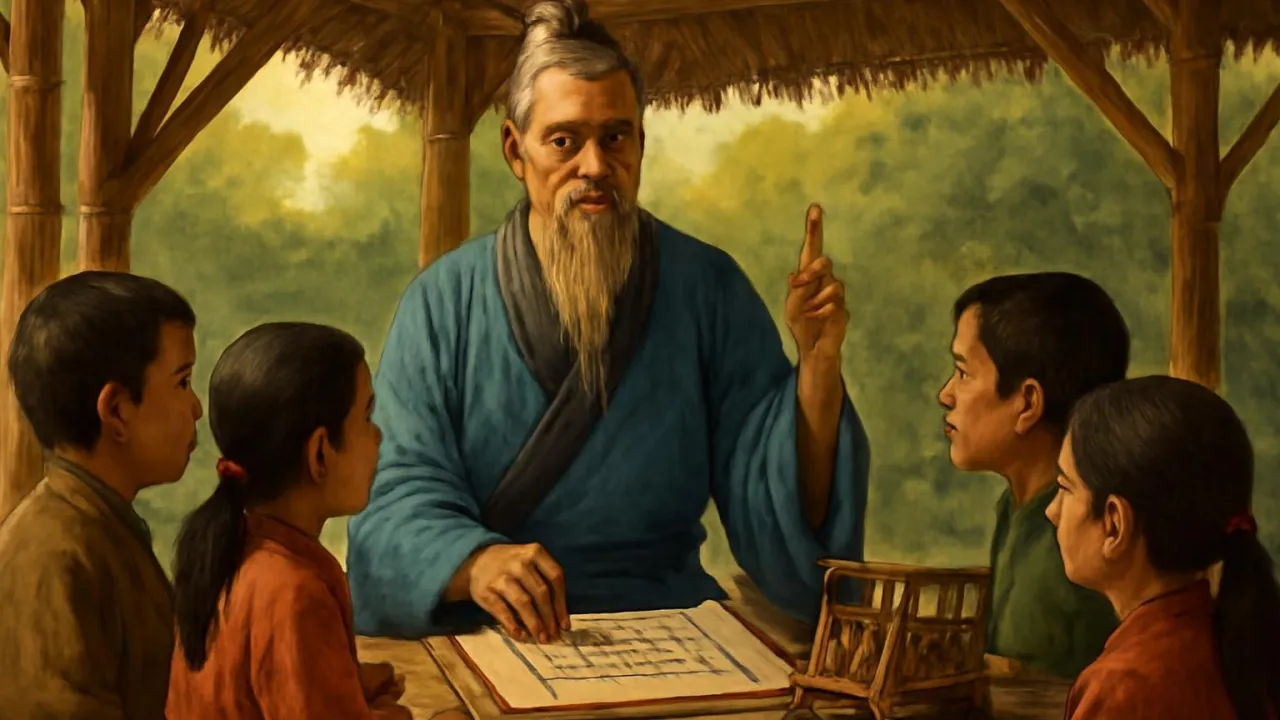
Mozi’s students helped build machines to protect cities from danger.
✨ Word Sparks (Grade 2 Glossary)
Tap 🔊 to hear
fairness
Treating everyone the same way
universal
Something for everyone, everywhere
tools
Things people use to build or fix
🪝
Have you ever wondered how kindness can change the world?
1
Thinking of Everyone
Mozi loved asking questions about life and . He believed people should care for everyone, not just their own families. He wanted to make the world a kinder place.
2
Learning and Building
As a boy, Mozi watched workers build things and learned from them. He liked making clever wooden and shared his ideas with others. He taught people how to use these tools to help everyone.
3
A Big New Idea
Mozi’s biggest idea was called ‘ love.’ He traveled to many towns to teach this idea. People listened to Mozi and tried to be kinder to others.
Mozi’s inventions included early catapults and defensive walls to protect cities.
✨ Word Sparks (Grade 3 Glossary)
Tap 🔊 to hear
philosopher
Someone who thinks about life’s big questions
invention
A new thing someone creates
universal love
Caring for everyone, not just friends
🪝
Can one person’s idea about kindness shape a whole country?
1
A Boy with Big Questions
Mozi grew up in ancient China, always wondering how people could live better together. He asked, 'Why should we only care for our own families?' Mozi believed everyone deserved kindness and respect. His questions made him a true .
2
Inventing for Peace
Mozi learned from builders and inventors, watching them make tools and machines. He used his hands and mind to create wooden models that could protect cities. These helped towns stay safe during times of trouble. Mozi shared his knowledge with eager students.
3
Teaching Universal Love
Mozi’s most important lesson was called ',' or caring for all people equally. He traveled from village to village, teaching that kindness should not have limits. Many people were inspired by his words and tried to follow his teachings. Mozi’s ideas were very different from others at the time.
4
Changing Ancient China
Mozi’s teachings challenged old ways and made leaders think about fairness. Some rulers listened and tried to make their cities kinder and safer. Mozi’s students spread his ideas far and wide. Even today, people remember Mozi as a great thinker who wanted a peaceful world.
Mozi’s followers, the Mohists, became famous for defending cities with clever inventions and peaceful ideas.
✨ Word Sparks (Grade 4 Glossary)
Tap 🔊 to hear
Warring States
A time when many Chinese kingdoms fought
engineer
Someone who designs and builds useful things
legacy
The ideas or work someone leaves behind
🪝
What happens when someone challenges the rules to make the world fairer?
1
Curiosity in a Time of Conflict
During the period, Mozi grew up watching people struggle and fight. He often wondered why people cared only for their own families or groups. Mozi believed that everyone deserved kindness, no matter where they came from. His curiosity led him to become a philosopher who questioned the rules of his day.
2
Inventing for Defense and Peace
Mozi was not only a thinker but also a skilled who designed early defensive machines. He created wooden models of catapults and walls, teaching his students how to use them to protect cities. These inventions helped towns defend themselves without attacking others. Mozi’s goal was always to save lives and prevent harm.
3
Spreading the Message of Universal Love
Mozi’s greatest teaching was called 'universal love,' which meant caring for all people equally. He traveled across ancient China, speaking to rulers and villagers about fairness and kindness. Many people were inspired by his message, and some leaders even changed their laws. Mozi’s ideas were very different from other philosophers, who thought people should care most about their families.
4
A Lasting Legacy
Mozi’s students, called Mohists, continued to teach his lessons long after he was gone. His ideas challenged powerful traditions and made people think about peace and justice. Today, historians remember Mozi as a bold reformer who dreamed of a world where everyone was treated with respect. His still inspires people to care for others beyond their own circles.
2. What made Mozi’s teachings different from others?
🤯 Mind-Blowing Fact • Grade 5
Mozi’s school, Mohism, was once as influential as Confucianism, shaping ancient Chinese science, ethics, and government.
✨ Word Sparks (Grade 5 Glossary)
Tap 🔊 to hear
Mohism
Mozi’s philosophy of universal care and fairness
merit-based
Choosing people for skill, not family
compassion
Caring deeply about others’ feelings and needs
🪝
How can one philosopher’s vision for universal care influence an entire civilization—and the world beyond?
1
A Childhood of Curiosity and Compassion
In the bustling towns of ancient China’s Warring States era, Mozi grew up questioning why people cared only for their own families or clans. He observed suffering and conflict all around him, which sparked a deep desire to find a better way for people to live together. Unlike many of his peers, young Mozi was fascinated by both hands-on craftsmanship and big philosophical questions. He learned from artisans, watched builders at work, and began to imagine a society where kindness and fairness extended to everyone, not just a chosen few. This early curiosity shaped his lifelong mission to challenge the rules of his time. Even as a child, Mozi believed that every person deserved respect and care.
2
Inventor, Engineer, and Practical Reformer
Mozi’s unique blend of philosophy and engineering set him apart from other thinkers of his era. He designed defensive machines, such as early catapults and fortified barriers, which helped cities protect themselves during frequent wars. These inventions were not meant for conquest, but for defending innocent people from harm. Mozi trained his students—who became known as Mohists—in the art of building and using these devices. He believed that practical skills and scientific thinking could save lives and promote peace. Mozi’s approach combined hands-on engineering with a deep moral purpose, making him one of ancient China’s most innovative reformers.
3
The Radical Philosophy of Universal Love
Mozi’s most famous teaching, 'jian ai,' or universal love, challenged the traditional Confucian idea of caring mainly for one’s family. He argued that society would be more peaceful and just if everyone treated each other with equal kindness and respect. Mozi traveled from state to state, debating other philosophers and advising rulers to adopt policies based on fairness, merit, and . His message was revolutionary: he insisted that favoritism and selfishness led to conflict, while universal care could build lasting peace. Many rulers and ordinary people were inspired by Mozi’s words, and his school of thought quickly spread across China.
4
Lasting Impact and the Mohist Movement
Mozi’s followers, the Mohists, became famous for their skills in both philosophy and engineering. They were often called upon to help defend cities under attack, using Mozi’s inventions and strategies to save lives without resorting to aggression. The Mohists also promoted ideas like government, opposition to offensive wars, and the importance of practical knowledge. Although eventually declined as other philosophies became more popular, Mozi’s teachings left a lasting mark on Chinese history. His ideas about equality, peace, and scientific thinking influenced later generations of thinkers and reformers.
5
A Legacy of Compassion and Innovation
Today, Mozi is remembered as a courageous philosopher who dared to imagine a more caring world. His belief in universal love, practical invention, and social justice continues to inspire people seeking fairness and peace. Historians recognize Mozi as one of the earliest advocates for equal treatment and the use of technology for the common good. His life teaches us that questioning old ways and standing up for kindness can change history. Mozi’s vision reminds us that true greatness comes from caring for all people, not just those closest to us. His legacy lives on in every act of and every new idea for a better world.