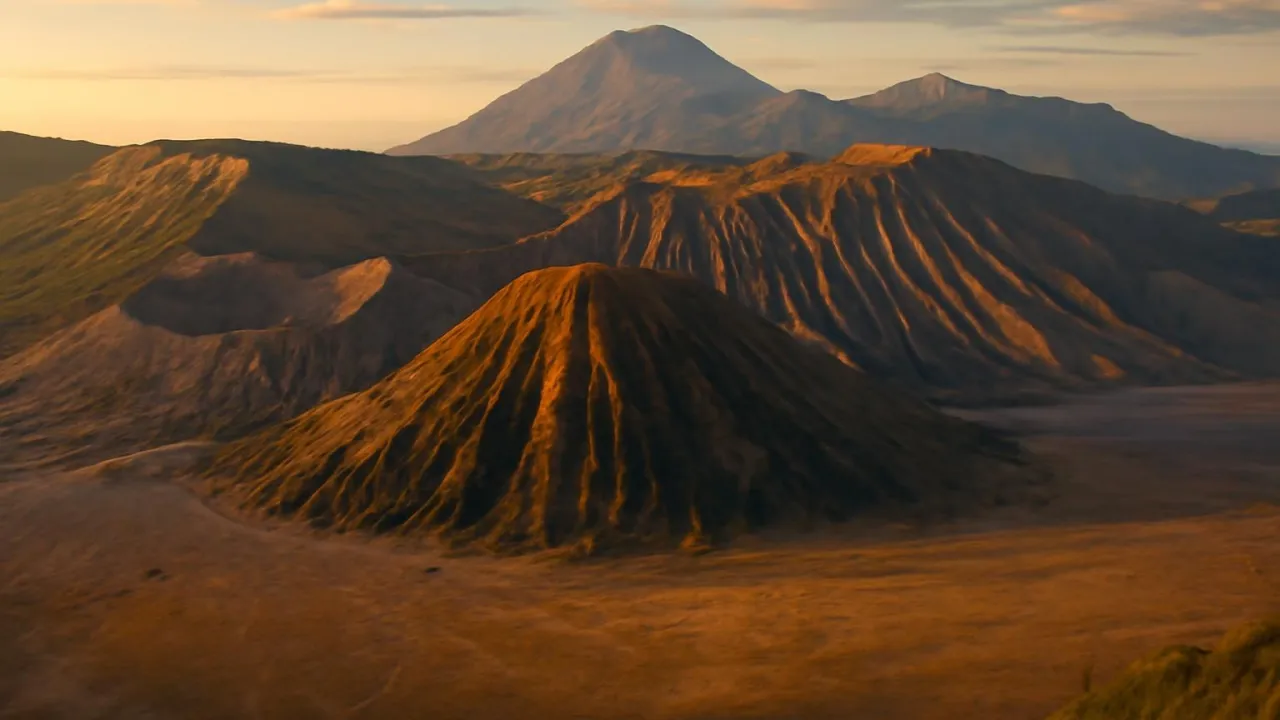
Mount Bromo’s name comes from Brahma, a Hindu god.
✨ Word Sparks (Grade 2 Glossary)
Tap 🔊 to hear
eruption
When a volcano shoots out lava
trail
A path people walk on
gases
Air that comes from the volcano
🪝
What if you could stand by a crater and feel the earth rumble beneath your feet?
1
The Steaming Volcano
Mount Bromo is always blowing out steam and smoke. Its crater is wide and round like a giant bowl. Many people come to see the volcano every year.
2
Sunrise Adventure
Visitors wake up early to watch the sunrise over the crater. The sky turns orange, pink, and gold as the sun rises. The volcano looks magical in the morning light.
3
A Path to the Top
People hike sandy to get close to the crater. The air feels warm and smells like eggs from the volcano’s . Sometimes, you can hear a soft rumbling sound from deep inside.
Mount Bromo sits inside a giant ancient caldera called the Tengger Sand Sea.
✨ Word Sparks (Grade 3 Glossary)
Tap 🔊 to hear
stratovolcano
A tall, cone-shaped volcano
sulfur
A yellow mineral that smells strong
caldera
A huge bowl-shaped landform
🪝
Have you ever wondered what it feels like to stand on the rim of a steaming volcano?
1
The Living Volcano
Mount Bromo is an active that often releases steam and volcanic gases. Its crater, shaped by powerful eruptions, is nearly 700 meters wide. The ground sometimes vibrates from deep rumbles inside the earth. People from all over the world come to see this natural wonder.
2
A Spectacular Sunrise
At dawn, the sky above Mount Bromo glows with brilliant colors. Visitors climb up before sunrise to watch the crater surrounded by pink and orange light. The volcano’s smoke drifts through the air, creating a magical scene. Many photographers love to capture this breathtaking moment.
3
Journey to the Crater
To reach the crater, people hike across a vast sea of volcanic sand. The air is filled with the smell of , a sign of volcanic activity. As they get closer, the sound of the volcano’s rumbling grows louder. The crater’s steep walls show layers built by ancient eruptions.
4
Why Does Bromo Smoke?
Inside the crater, hot magma heats underground water, turning it into steam. This steam escapes through cracks, creating constant clouds above the volcano. The process is called volcanic venting, and it keeps Mount Bromo alive. Scientists study these signs to predict future eruptions.
1. What causes the ground to vibrate at Mount Bromo?
2. What is volcanic venting?
🤯 Mind-Blowing Fact • Grade 4
Each year, the Tenggerese celebrate the Yadnya Kasada festival by tossing offerings into Bromo’s crater.
✨ Word Sparks (Grade 4 Glossary)
Tap 🔊 to hear
vent
An opening where steam escapes
eruption
When a volcano explodes with lava
sacred
Very special and important to people
🪝
Imagine hearing a distant roar and seeing white steam swirl from a crater as the sun rises—what mysteries lie inside Mount Bromo?
1
A Volcanic Marvel in Java
Mount Bromo is one of Indonesia’s most famous active volcanoes, located within the vast Tengger Caldera. Its steep crater rises 2,329 meters above sea level, surrounded by a sea of volcanic sand. The volcano’s frequent have shaped its wide, bowl-like crater over thousands of years. Today, it is a protected site and a major destination for curious explorers.
2
The Science of Smoke and Sound
Mount Bromo constantly releases steam and volcanic gases through its main , creating a low, rumbling sound. This process, called volcanic venting, happens when underground magma heats water, turning it into steam that escapes through cracks. The strong smell of sulfur fills the air, signaling the volcano’s ongoing activity. Scientists monitor these signs to understand the volcano’s behavior and predict .
3
A Journey Across the Tengger Sand Sea
To reach the crater, visitors cross the Tengger Sand Sea, a vast plain formed by ancient . The landscape is covered in fine gray ash and volcanic rocks, making it look almost like the surface of the moon. Hikers climb a steep staircase to stand at the crater’s edge and watch steam rise from deep below. The view at sunrise is especially famous for its vibrant colors and dramatic shadows.
4
Bromo’s Cultural and Global Impact
Mount Bromo is to the local Tenggerese people, who hold ceremonies to honor the volcano each year. The crater’s dramatic scenery attracts tourists, scientists, and photographers from around the world. Its unique geology helps scientists learn about volcanic activity and earth’s natural processes. Mount Bromo’s beauty and power make it a symbol of Indonesia’s dynamic landscape.
1. Why do scientists study Mount Bromo’s steam and gases?
2. What makes the Tengger Sand Sea special?
🤯 Mind-Blowing Fact • Grade 5
Mount Bromo’s last major eruption in 2016 sent ash clouds over 10,000 feet (3,000 meters) into the sky.
✨ Word Sparks (Grade 5 Glossary)
Tap 🔊 to hear
seismograph
A tool that measures earth’s shaking
eruption cycle
The repeating pattern of volcano eruptions
conservation
Protecting nature and special places
🪝
What if you could measure the trembling earth and swirling gases at Mount Bromo—how would you decode the secrets of this ever-active volcano?
1
Mount Bromo: A Living Laboratory
Rising 2,329 meters above sea level, Mount Bromo forms part of the Tengger volcanic complex in East Java, Indonesia. Its crater, nearly 700 meters wide, is the result of repeated explosive eruptions that have shaped the landscape for tens of thousands of years. Mount Bromo’s activity is closely monitored by volcanologists, who use to detect ground vibrations and gas sensors to analyze emissions. The volcano’s constant venting of steam and sulfurous gases provides a unique window into the dynamic processes occurring beneath Earth’s crust. Bromo’s accessibility and regular activity make it one of the world’s most studied stratovolcanoes.
2
The Physics Behind the Crater’s Roar
The deep rumbling sounds heard at Mount Bromo are caused by vibrations generated as magma and volcanic gases move through underground chambers. These vibrations, called volcanic tremors, can be detected by sensitive instruments even when eruptions are not occurring. The crater’s steep, layered walls reveal a history of alternating ash and lava flows, which have built up over millennia. When rainwater seeps into the ground and meets hot magma, it instantly turns to steam, creating pressure that escapes through vents. This process not only produces the iconic white plumes but also helps scientists understand the mechanics of volcanic eruptions.
3
A Landscape Shaped by Erosion and Ash
The Tengger Sand Sea, surrounding Mount Bromo, is a vast plain of volcanic ash and rock fragments deposited by ancient eruptions. Erosion from wind and rain constantly reshapes this landscape, creating rippled dunes and exposing layers of past volcanic activity. The harsh, nutrient-poor soil supports only sparse grasses and hardy shrubs, giving the area a stark, otherworldly appearance. The region’s unique geology provides valuable clues about the cycle of eruption, deposition, and erosion that shapes volcanic landforms worldwide. Scientists use these clues to reconstruct the eruption history of Bromo and its neighboring volcanoes.
4
Cultural Significance and Global Influence
Mount Bromo holds deep spiritual meaning for the Tenggerese people, who believe the volcano is home to powerful spirits. Each year, during the Yadnya Kasada festival, villagers hike to the crater’s edge to toss offerings of food, flowers, and livestock into the steaming vent. The volcano’s dramatic scenery has inspired countless artists, filmmakers, and travelers, making it an iconic symbol of Indonesia’s volcanic heritage. Its ongoing activity attracts volcanologists from around the world, who collaborate to improve eruption forecasting and disaster preparedness. Mount Bromo’s influence extends far beyond Java, shaping both scientific understanding and cultural traditions.
5
The Future of Bromo: Science and Stewardship
As tourism grows, careful management is needed to protect Mount Bromo’s fragile environment and cultural significance. efforts focus on minimizing erosion, reducing pollution, and respecting local customs during festivals and visits. Advanced monitoring technologies, such as satellite thermal imaging and drone surveys, help scientists track changes in the volcano’s activity with greater accuracy. By studying Bromo’s emissions and eruptions, researchers gain insights into how similar volcanoes behave around the world. Mount Bromo stands as a living classroom, reminding us of the power, beauty, and responsibility that come with exploring Earth’s most dynamic landscapes.