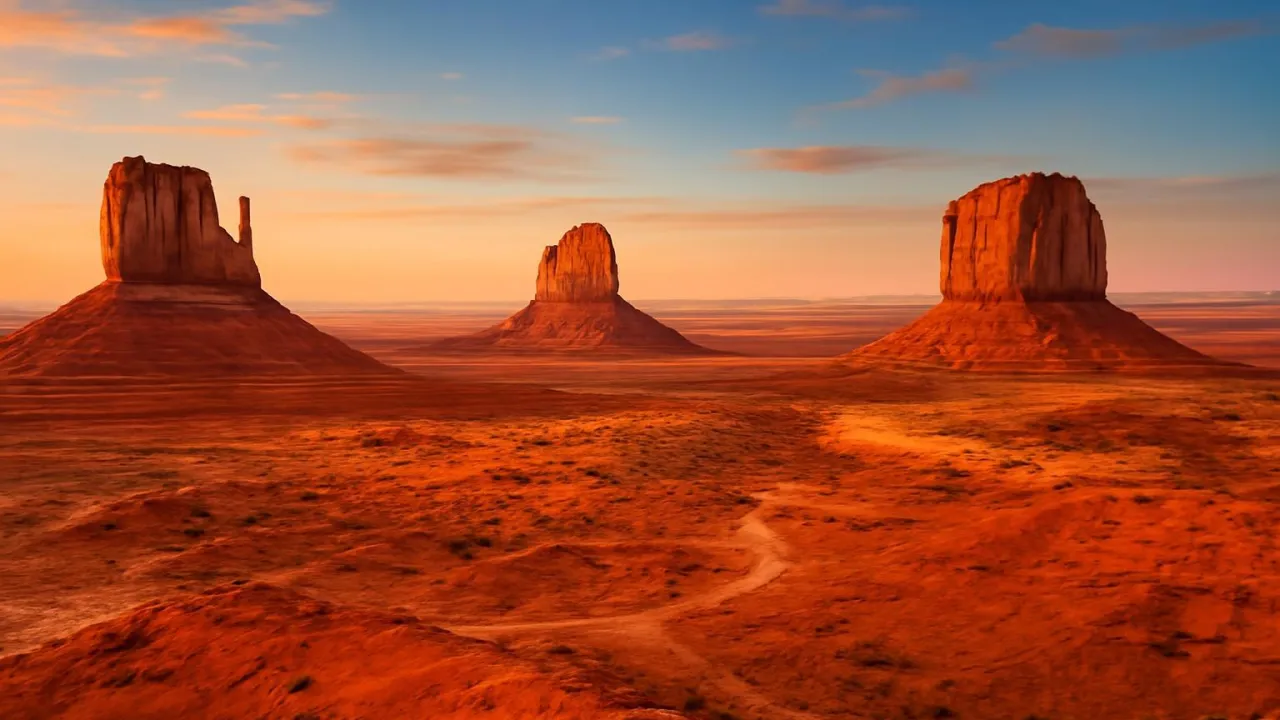
Can you imagine walking beside a giant stone table?
1
Flat Tops in the Desert
Monument mesas look like giant red tables. Their tops are flat, but their sides are steep. People come from far away to see them. The mesas stand high above the sandy ground.
2
Nature Builds Slowly
Wind and rain shape these rocks over many years. Water washes away soft dirt, but hard rock stays. This makes the flat tops and sharp sides. is nature's way of changing the land.
3
A Special Place
Monument is important to the people. Many animals, like lizards and birds, live near the mesas. Visitors can take tours and see the amazing views. The desert is hot, so bring water if you visit.
The mesas’ red color comes from rusted iron inside the rock!
✨ Word Sparks (Grade 3 Glossary)
Tap 🔊 to hear
erosion
Wind and water slowly wearing away rock
mesa
A flat-topped hill with steep sides
weathering
Breaking down rocks by wind or rain
🪝
What would it feel like to stand beside a giant red wall made by nature?
1
Red Giants of the Plateau
Monument Valley’s rise like huge stone tables from the desert floor. Their flat tops and steep sides make them easy to spot from far away. The bright red color comes from iron minerals in the rock. These mesas are famous symbols of the American Southwest.
2
How Mesas Are Made
form when wind and water erode softer rocks, leaving hard rock behind. Over millions of years, the top layer stays strong while the sides wear down. This process is called , and it shapes the land slowly. The mesas stand tall because their tops resist .
3
Wildlife and People
Many animals, like coyotes, hawks, and lizards, live near the . Monument Valley is also home to the Navajo Nation, who care for the land. Visitors come to hike, take photos, and learn about Navajo culture. The valley’s beauty draws people from all over the world.
4
A Desert Landmark
The can reach up to 1,000 feet high. Their flat tops are wider than football fields. Scientists study the layers of rock to learn about Earth’s history. Monument Valley’s mesas are natural monuments shaped by time and weather.
Some mesas are so large, you could fit several football fields on top!
✨ Word Sparks (Grade 4 Glossary)
Tap 🔊 to hear
caprock
The hard top layer of a mesa
sandstone
A rock made from pressed sand grains
plateau
A high, flat area of land
🪝
Have you ever wondered how giant stone tables appear in the middle of a desert?
1
Nature’s Stone Castles
Monument Valley’s mesas tower over the desert, their flat tops and steep sides forming dramatic shapes. These landforms are made of , which contains iron that gives them their famous red color. The mesas are part of the Colorado , a region known for its striking rock formations. Their impressive size and bright color make them stand out against the blue desert sky.
2
Erosion: The Sculptor of Mesas
Mesas are created by the slow process of erosion, where wind and water wear away softer rock layers. Over millions of years, only the hardest rock remains as the top layer, protecting the mesa from being worn down quickly. The sides of the mesas are steep because the softer material below erodes faster than the above. This natural process shapes the landscape, leaving behind these unique flat-topped towers.
3
A Living Desert
The mesas provide shelter and shade for many desert animals, such as jackrabbits, lizards, and golden eagles. Monument Valley is also the home of the Navajo Nation, who have lived in the region for centuries and consider the mesas sacred. Visitors can take guided tours to learn about Navajo history, geology, and the wildlife that thrives in the valley. The desert’s extreme heat and dryness make life challenging, but many species have adapted to survive.
4
A World-Famous Landmark
Some mesas in Monument Valley are nearly 1,000 feet tall and stretch wider than city blocks. Scientists study the rock layers to uncover clues about Earth’s ancient past, including the time of dinosaurs. Monument Valley’s mesas have appeared in movies, art, and photographs, making them symbols of the American West. Their striking beauty and fascinating formation continue to inspire curiosity and respect for nature’s power.
1. Why do the sides of mesas erode faster than the tops?
2. How do scientists learn about Earth's history from mesas?
🤯 Mind-Blowing Fact • Grade 5
West Mitten Butte’s summit is so broad, it could fit nearly eight Olympic swimming pools side by side!
✨ Word Sparks (Grade 5 Glossary)
Tap 🔊 to hear
differential erosion
When soft and hard rocks wear away at different speeds
caprock
A tough rock layer that protects the mesa top
strata
Layers of rock stacked over time
🪝
Imagine standing at sunrise, watching golden light spill over ancient red stone towers—how did these mesas come to be?
1
Geologic Wonders of the Colorado Plateau
Monument Valley’s mesas are iconic flat-topped landforms rising dramatically from the desert floor, sculpted over millions of years by geological forces. These mesas are primarily composed of hard sandstone, with iron oxide minerals giving them their vivid red hue. The region’s geologic history began in the Jurassic and Cretaceous periods, when layers of sand, silt, and clay accumulated and compressed into rock. Over time, tectonic uplift raised the Colorado Plateau, exposing these sedimentary layers to the elements. Today, Monument Valley’s mesas stand as powerful reminders of Earth’s dynamic past.
2
The Science of Erosion and Caprock Protection
Mesas form through a process called , where wind and water selectively wear away softer rock layers beneath a resistant . The hard caprock, often made of cemented sandstone, shields the mesa’s summit from rapid weathering. Meanwhile, the less durable layers below erode more quickly, creating sheer cliffs and steep sides. This process results in the classic mesa shape: a broad, flat top and vertical walls. Scientists use the term 'caprock' to describe the protective upper layer that preserves the mesa’s structure.
3
Cultural and Ecological Significance
For centuries, Monument Valley has been central to the Navajo Nation’s culture, history, and spiritual beliefs. The mesas are considered sacred and feature in many traditional stories and ceremonies. Ecologically, these landforms create unique habitats, offering shade, shelter, and nesting sites for desert wildlife such as golden eagles, kit foxes, and collared lizards. The valley’s extreme temperature swings and scarce rainfall require both people and animals to develop remarkable adaptations to survive.
4
Measuring Monumental Scale
Some of the largest mesas in Monument Valley soar nearly 1,000 feet (305 meters) above the valley floor and can measure over a mile (1.6 kilometers) across. The famous West Mitten Butte, for example, rises 1,000 feet and stretches 1,200 feet wide at its summit. Scientists analyze the rock exposed in the mesa walls to reconstruct ancient environments, track climate changes, and even find fossils from prehistoric times. These measurements help us understand the immense scale and history of the region.
5
Global Impact and Enduring Legacy
Monument Valley’s mesas have become global symbols of the American West, featured in countless films, paintings, and photographs. Their striking forms draw tourists, geologists, and artists from around the world, contributing to the local economy and inspiring awe. The ongoing processes of erosion and weathering ensure that the landscape continues to evolve, slowly reshaping the mesas over thousands of years. By studying these landforms, scientists gain valuable insights into Earth’s geological history and the power of natural forces to shape our planet.