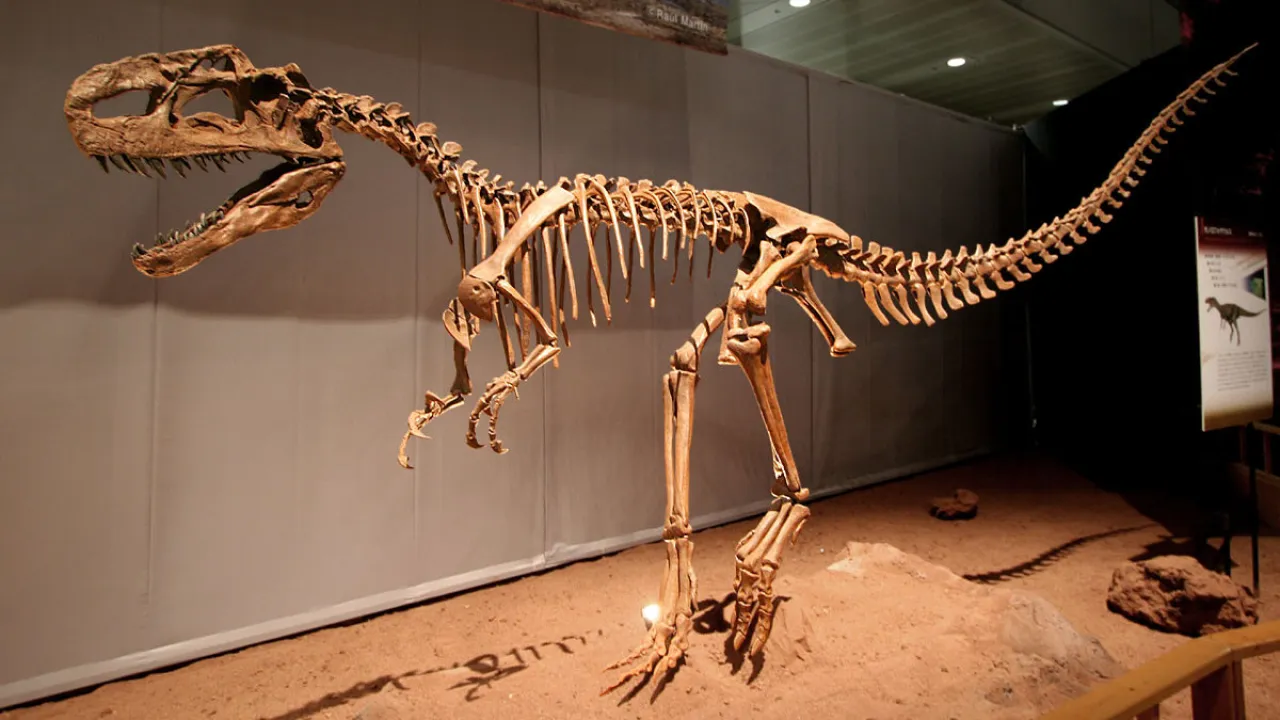
2. Why wasn't the big snout crest of Monolophosaurus heavy?
🤯 Mind-Blowing Fact • Grade 2
One fossilized bone quarry in Xinjiang holds seventeen young long-necked Bellusaurus dinosaurs that lived in the exact same lakeside habitat as Monolophosaurus!
✨ Word Sparks (Grade 2 Glossary)
Tap 🔊 to hear
marsh
wet, grassy low land beside water
scan
a special X-ray picture of insides
echo
a sound bouncing inside a hollow space
🪝
How did X-ray scans peek inside the hollow nose crest of Monolophosaurus?
1
Treasure From Xinjiang
Picture rocky desert hills in northwestern China where ancient once sparkled 166 million years ago! In 1981, oil-survey explorers and paleontologists discovered a nearly complete seventeen-foot predator skeleton there. Named Monolophosaurus jiangi, it kept every bone from nose tip to hip in amazing shape!
2
Air Tubes in the Snout
Hospital-style CT let scientists peer inside its long midline crest without breaking the fossil. Thin walls of bone enclosed wide air chambers connected straight to its nose! That means the crest kept its head light, flashed colorful displays, and possibly echoed deep calls.
3
Lakeside Hunter
Sharing lush Middle Jurassic wetlands with early horned cousins like Yinlong and long-necked Bellusaurus, Monolophosaurus patrolled muddy shorelines.
1. What did CT scans discover inside the snout crest of Monolophosaurus?
2. Where was Monolophosaurus discovered?
🤯 Mind-Blowing Fact • Grade 3
Healed tooth scratches spaced just like Monolophosaurus teeth along its own fossilized jaw prove two rivals once had a spirited snout-nipping match—and the dinosaur healed afterward!
✨ Word Sparks (Grade 3 Glossary)
Tap 🔊 to hear
territory
an area an animal guards as home
puncture
a small hole pressed by a point
basin
a wide bowl-shaped lowland surrounded by hills
🪝
What did healed tooth scratches on a Monolophosaurus jaw reveal about dinosaur arguments?
1
A Complete Middle Jurassic Predator
Middle Jurassic dinosaur skeletons are rare worldwide, making the 1981 discovery of Monolophosaurus jiangi in China's Junggar extra exciting! Described in 1993 by Zhao Xijin and Philip Currie, this eighteen-foot, thousand-pound carnivore preserved a crisp skull, flexible neck, and complete backbone.
2
How One Crest Stood Apart
While Dilophosaurus wore two twin ridges side by side, Monolophosaurus fused its nasal and upper snout bones into one bold, boxy ridge right down the middle. Covered in tough, likely colorful keratin during life, the hollow crest helped rivals recognize each other from afar without risking injury—most of the time!
3
Clues of Rival Nipping
When scientists inspected the fossilized skull closely, they spotted neat rows of healed tooth and gouges along the upper and lower jaws! Just like modern crocodiles and lions, rival Monolophosaurus occasionally engaged in non-lethal face-biting contests over .
4
Mid-Sized Specialist
Because giant thirty-foot Sinraptor ruled the largest prey nearby, sleek Monolophosaurus specialized in hunting agile small-to-medium herbivores along wooded streams.
1. How did the crest of Monolophosaurus differ from Dilophosaurus?
2. What do healed bite marks on the fossilized Monolophosaurus skull show?
🤯 Mind-Blowing Fact • Grade 4
Living right alongside Monolophosaurus in the Shishugou Formation was Guanlong—one of the earliest known crested ancestors of Tyrannosaurus rex!
✨ Word Sparks (Grade 4 Glossary)
Tap 🔊 to hear
niche
an animal's specific job and menu in nature
fenestra
a natural window-like opening inside skull bone
tetanuran
member of the stiff-tailed theropod dinosaur group
🪝
How did two different predatory dinosaurs share the same Chinese wetlands 166 million years ago without competing?
1
Wetlands Under Smoking Volcanoes
Imagine the Junggar Basin of northwestern China during the Bathonian-Callovian boundary 166 million years ago. Towering araucarian conifers and lush fern marshes bordered seasonal rivers fed by volcanic highlands. Preserved inside the famous Shishugou Formation, this vibrant ecosystem supported early horned Yinlong, tiny tyrannosauroid Guanlong, giant long-necked Mamenchisaurus, and a sleek five-meter hunter: Monolophosaurus jiangi.
2
Pneumatic Architecture of the Snout
Extending from just behind the nostrils to right between the eye sockets, the iconic midline crest incorporated the premaxilla, maxilla, nasal, and lacrimal bones. High-resolution CT tomography revealed huge internal pneumatic excavations linked directly to the nasal cavity via symmetrical openings called fenestrae. By filling the crest with air sacs, evolution maximized visual profile—and potential low-frequency vocal resonance—at minimal weight cost.
3
Niche Partitioning Among Predators
Ecologists call sharing a habitat by targeting different menus partitioning. While massive relatives like Sinraptor tackled multi-ton adult sauropods, lighter, nimbler Monolophosaurus pursued swift ornithopods, juvenile sauropods like Bellusaurus, and armored stegosaurs along marshy channels.
4
Stepping-Stone in Tetanuran Evolution
With a stiffened tail and ten-vertebral neck, Monolophosaurus sits right near the evolutionary base of Tetanurae—the stiff-tailed theropod clade leading to allosaurs, tyrannosaurs, and birds.
1. How did Monolophosaurus and larger predators share the Shishugou ecosystem?
2. Which major branch of theropods includes Monolophosaurus near its base?
🤯 Mind-Blowing Fact • Grade 5
The eighty-centimeter skull of Monolophosaurus was slightly flattened on one side during burial, so scientists digitally 'retro-deformed' 3D CT models to restore its exact symmetrical living shape!
✨ Word Sparks (Grade 5 Glossary)
Tap 🔊 to hear
paleopathology
study of ancient injuries healed in fossils
conspecific
another individual belonging to the same species
mesocarnivore
a mid-sized predator below giant apex hunters
🪝
Why does Monolophosaurus occupy such a critical position at the evolutionary dawn of stiff-tailed tetanuran theropods?
1
Discovery at Jiangjunmiao
Discovered in 1981 during geological reconnaissance near Jiangjunmiao in Xinjiang's Junggar Basin and excavated prior to the landmark Sino-Canadian Dinosaur Project, the holotype of Monolophosaurus jiangi (IVPP 84019) emerged from Middle Jurassic mudstones of the lower Shishugou Formation dated to approximately 166 million years ago. Formally described by Zhao Xijin and Philip Currie in 1993, the specimen preserved an articulated skull, complete presacral vertebral column, and pelvis of a five-to-five-and-a-half-meter predator.
2
Cranial Pneumaticity and Crest Mechanics
Dominating its eighty-centimeter cranium is an inflated parasagittal-fused midline crest formed primarily by the nasals and lacrimals with anterior contributions from the premaxillae and maxillae. Computed tomography published by Currie and Zhao demonstrated that paranasal air sinuses invaded and hollowed nearly the entire crest via paired lateral pneumatic foramina. Too thin-walled for high-impact combat, the keratin-sheathed ridge functioned as an extravagant visual signal and possible acoustic resonator.
3
Paleopathology of Intraspecific Bite Marks
In 2010, Darren Tanke and Philip Currie documented remodeled, healed puncture pits and parallel tooth scores across the holotype's maxilla, nasal crest base, and dentary. Spacing and curvature matched adult Monolophosaurus dentition, providing compelling paleopathological evidence of ritualized face-biting between .
4
Phylogenetic Hinge Within Basal Tetanurae
Cladistic studies authored by Stephen Brusatte, Roger Benson, and colleagues in 2010 resolved Monolophosaurus as one of the most informative basal tetanurans—positioned near megalosauroids or just outside Orionides (the split between Megalosauroidea and Avetheropoda)—illuminating how skull fenestration and axial stiffening assembled before Late Jurassic giants radiated.
5
Guild Dynamics of the Shishugou Biota
Hunting across volcanically influenced alluvial wetlands alongside basal ceratopsian Yinlong, proceratosaurid Guanlong, and juvenile eusauropod Bellusaurus, Monolophosaurus thrived as an agile .