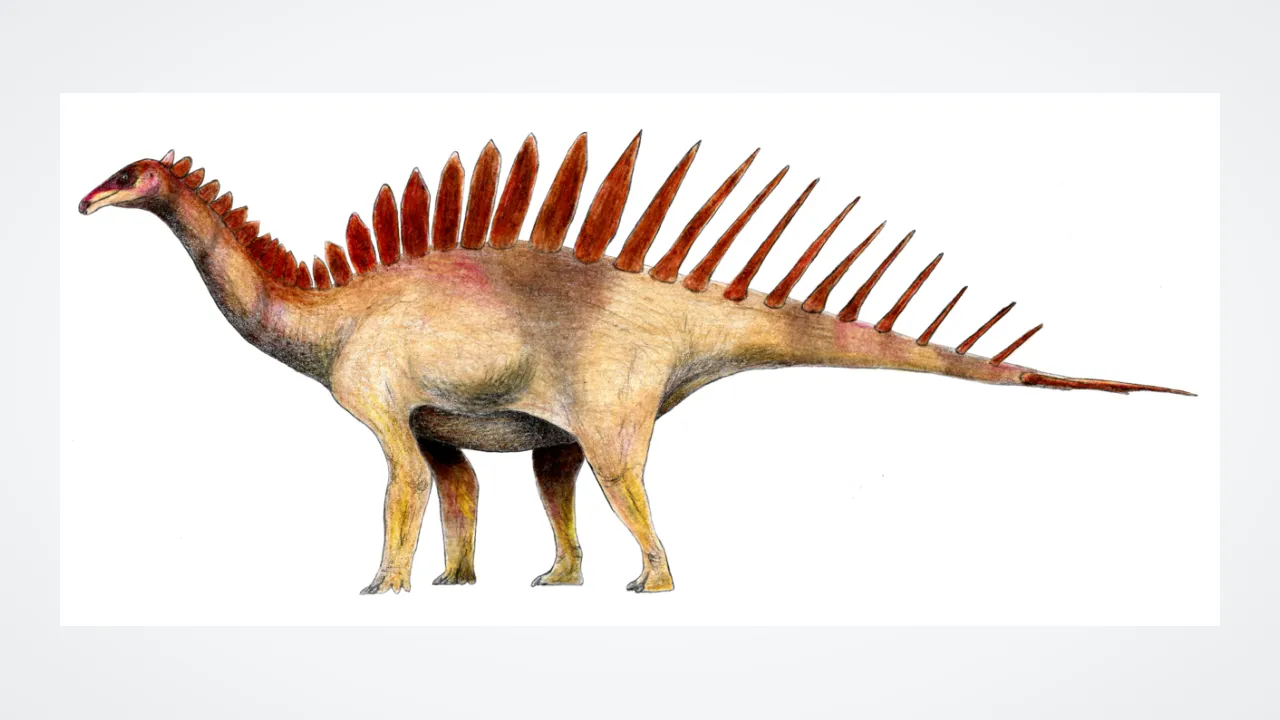
1. What made Miragaia different from every other known stegosaur?
2. In which European country were Miragaia's fossils discovered?
🤯 Mind-Blowing Fact • Grade 2
Miragaia's name means 'wonderful goddess of the Earth,' honoring both the Portuguese village where it was found and Gaia, the ancient Greek Earth goddess!
✨ Word Sparks (Grade 2 Glossary)
Tap 🔊 to hear
rulebook
expected patterns of how things usually work
impress
catch attention and make others admire you
coastal
located near where land meets the ocean
🪝
How did a spiky, plated stegosaur end up with more neck bones than almost any giant Brontosaurus cousin?
1
Breaking the Stegosaur Rulebook
Usually, telling Jurassic plant-eaters apart is easy: sauropods had giant long necks, while armored stegosaurs had short necks for eating low weeds. Then in 2009, scientists in Portugal unveiled Miragaia—a twenty-foot stegosaur sporting a six-foot swan-like neck!
2
Counting Seventeen Neck Bones
Humans and giraffes have seven neck bones, and regular stegosaurs had about twelve. Miragaia packed at least seventeen vertebrae into its neck—more than Diplodocus or Apatosaurus!
3
Showing Off Twin Plate Rows
Two rows of triangular plates ran right up that long neck, helping Miragaia reach higher bushes and friends!
1. How many neck vertebrae did Miragaia have compared with a regular stegosaur's twelve?
2. What two jobs could Miragaia's long, plate-lined neck help it do?
🤯 Mind-Blowing Fact • Grade 3
Miragaia stretched its neck using the exact same trick swans and giant sauropods used—turning front backbones into extra neck vertebrae!
✨ Word Sparks (Grade 3 Glossary)
Tap 🔊 to hear
longicollum
Latin species name meaning having a long neck
convert
change something from one job into another
niche
an animal's special role and food level
🪝
How did nature build a long-necked stegosaur using the exact same bone tricks as giant sauropods?
1
A Roadside Treasure in Portugal
When road crews widened a country lane near the village of Miragaia in Lourinhã, Portugal, paleontologist Octávio Mateus spotted dinosaur bones gleaming in the cut! Excavated between 1998 and 2001, the front half of a stegosaur emerged—complete with the first stegosaur snout ever found in Europe.
2
Keep Digging—More Neck Bones!
As preparators cleaned the neck in the lab, they expected twelve vertebrae—then counted fourteen, fifteen, sixteen, seventeen! Measuring nearly six feet long, the neck alone made up almost a third of Miragaia 's twenty-foot body!
3
Three Tricks for Stretching a Neck
Studying the bones showed Miragaia lengthened its neck in three clever ways: stretching each vertebra longer, growing an extra bone, and converting two front backbones into rib-free neck bones!
4
Giraffe of the Armored Dinosaurs
Just like modern giraffes use long necks both to browse higher leaves and win mates, Miragaia carved out a unique in Late Jurassic Europe.
1. Which three evolutionary steps combined to build Miragaia's super-long neck?
2. Roughly how much of Miragaia's whole twenty-foot body length was its neck?
🤯 Mind-Blowing Fact • Grade 4
Miragaia packed 17 vertebrae into its neck, beating iconic giant sauropods like Brachiosaurus (13), Camarasaurus (12), and Apatosaurus (15)!
✨ Word Sparks (Grade 4 Glossary)
Tap 🔊 to hear
thyreophoran
shield-bearing armored dinosaur group including stegosaurs
sexual selection
evolving striking traits that help attract mates
cervicals
individual vertebrae that form an animal's neck
🪝
Did Miragaia evolve its swan-like neck to reach taller Jurassic bushes—or to dazzle rivals in courtship displays?
1
Lush Islands of Jurassic Europe
One hundred fifty million years ago during the Late Jurassic, rising seas split Europe into warm subtropical islands while Portugal's Lourinhã basin still shared recent land connections with North America. Sharing fern glades with predators like Torvosaurus gurneyi walked Miragaia longicollum—an evolutionary rebel among armored ornithischians.
2
Convergent Evolution With Sauropods
Virtually all ('shield-bearing') dinosaurs—ankylosaurs and stegosaurs alike—remained squat, short-necked ground croppers for 130 million years. Miragaia shattered that rule when Octávio Mateus, Susannah Maidment, and Nicolai Christiansen announced its seventeen-cervical neck in 2009. Even giants like Apatosaurus (15 ) and Giraffatitan (13 cervicals) had fewer neck bones!
3
Browsing Versus Sexual Selection
Why grow a 1.8-meter neck? Two compelling hypotheses work hand in hand. First, slightly longer forelimbs than American Stegosaurus plus an elongated neck let Miragaia harvest mid-height cycadophytes one to two meters up without competing against ground-hugging herbivores. Second, just as Darwinian drove bull giraffe necks, flaunting seventeen pairs of keratin-sheathed neck plates created an unmistakable billboard for mates.
4
Second Skeleton Confirms the Tail
In 2019, paleontologist Francisco Costa and Mateus described a second, rear-body skeleton from Gondomar, Portugal—filling in Miragaia's missing hips, muscular tail, and distinctive rear spines for science!
1. How did Miragaia's 17 neck bones compare with giant sauropods like Giraffatitan (13) and Apatosaurus (15)?
2. How did the 2019 discovery of a second Miragaia skeleton at Gondomar advance science?
🤯 Mind-Blowing Fact • Grade 5
Genetic 'address switches' called Hox genes shifted backward along Miragaia's growing embryo spine, telling former rib-bearing back vertebrae to transform into sleek neck vertebrae instead!
✨ Word Sparks (Grade 5 Glossary)
Tap 🔊 to hear
cervicalization
evolutionary conversion of front backbones into neck bones
Hox genes
master blueprint genes assigning each body segment's identity
dacentrurine
European branch of long-spined Late Jurassic stegosaurs
🪝
How did Hox-gene homeotic shifts turn thoracic ribs into seventeen cervical vertebrae in Portugal's Miragaia longicollum?
1
Discovery in the Lourinhã Formation
Unearthed from late Kimmeridgian–early Tithonian (~150 MYA) fluvial mudstones near Miragaia in Portugal's Lourinhã Municipality and described in Proceedings of the Royal Society B in 2009 by Octávio Mateus, Susannah Maidment, and Nicolai Christiansen, holotype ML 433 preserved an articulated anterior skeleton including Europe's first stegosaur rostrum, shoulder girdles, forelimbs, paired triangular cervical plates, and an astonishing 17-vertebra neck.
2
Developmental Genetics of Cervicalization
Basal ornithischians possessed just nine cervical vertebrae, and typical stegosaurs such as Huayangosaurus and Stegosaurus carried twelve to thirteen. How did Miragaia achieve seventeen—exceeding nearly all sauropods outside East Asian Mamenchisauridae and Omeisauridae? Mateus and colleagues identified three developmental mechanisms operating together: homeotic anterior shifts in Hox gene expression that 'cervicalized' anterior dorsal vertebrae (suppressing thoracic rib attachment), addition of new somites (meristic count increase), and anteroposterior elongation of individual centra.
3
Testing Dacentrurine Systematics With MG 4863
After 2009, some researchers debated whether Miragaia might simply represent the missing front end of another European stegosaur, Dacentrurus armatus. In 2019, Francisco Costa and Mateus resolved the controversy by describing skeleton MG 4863 from Gondomar—the most complete stegosaur ever found in Europe—preserving both diagnostic Miragaia cervical traits AND pelvic/caudal bones that differed cleanly from Dacentrurus in spine curvature and ischial shape.
4
Biomechanics of High-Necked Ornithischian Foraging
Paired with relatively long forelimbs (radius-to-humerus and forelimb-to-hindlimb ratios higher than Stegosaurus) and fused anterior snout bones forming a U-shaped keratinous bill, Miragaia browsed mid-story bennettitaleans and conifers 1.5 to 2 meters off the ground.
5
Macroevolutionary Lesson in Ecological Plasticity
Whether initiated by niche partitioning alongside Iberian sauropods like Lusotitan or amplified via runaway mate-choice signaling along its plate-fringed neck, Miragaia proved even heavily armored thyreophorans retained remarkable evolutionary flexibility.