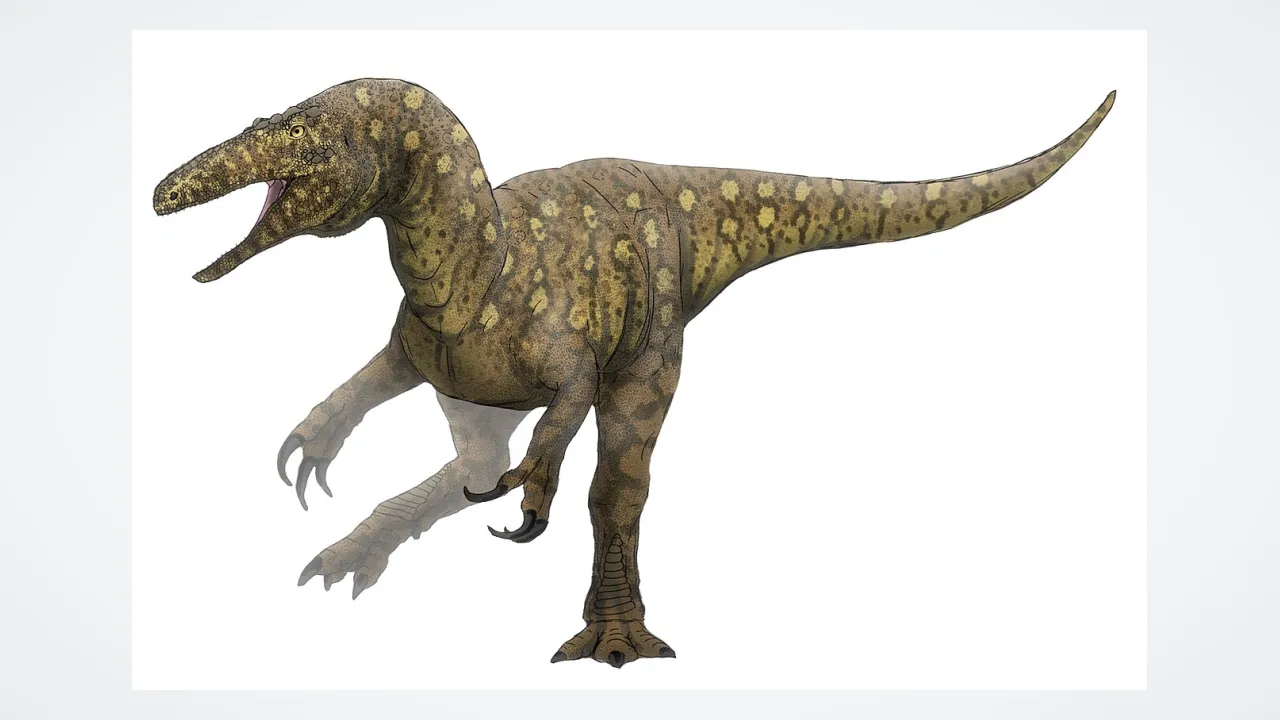
1. Where did Minmi have extra armor that many bigger ankylosaurs lacked?
2. On which continent did Minmi live?
🤯 Mind-Blowing Fact • Grade 2
Minmi was named after Minmi Crossing, a rocky pass in Queensland where its fossils popped out of a hillside in 1964!
✨ Word Sparks (Grade 2 Glossary)
Tap 🔊 to hear
Chainmail
Flexible armor made of tiny linked pieces
Hemisphere
One half of planet Earth, north or south
Backbone
Row of linked bones running down the back
🪝
How could an armored dinosaur jog faster than its heavy cousins?
1
Down Under in the Cretaceous
Travel back 115 million years to cool, misty woodlands in Queensland, Australia. Trotting through the bushes comes Minmi, the first armored dinosaur found anywhere in the Southern ! About ten feet long, it was roughly the size of a pony.
2
Built for Brisk Steps
Giant ankylosaurs had short, stubby legs for slow plodding. Minmi stood on longer legs, and special bony rods ran beside its like springboards to stiffen its back as it ran.
3
Pebble-Shield Tummy
Tiny square-shaped bones packed tightly across its underside like , guarding its belly while bigger ridged plates protected its neck, shoulders, and tail.
1. Why could Minmi move faster than giant cousins like Ankylosaurus?
2. Why was this dinosaur named Minmi?
🤯 Mind-Blowing Fact • Grade 3
Minmi kept the shortest dinosaur name record from 1980 until 2004, when tiny Mei from China beat it with three letters—and later Yi won with just two!
✨ Word Sparks (Grade 3 Glossary)
Tap 🔊 to hear
Paravertebrae
Special bony rods stiffening beside the backbone
Ossicle
A tiny bone embedded inside tough skin
Vertebrae
Individual bones linked together in a spine
🪝
What are the mysterious bony rods beside Minmi's spine that no other ankylosaur had?
1
A Southern Hemisphere Pioneer
Imagine walking along an Early Cretaceous shoreline in eastern Australia 115 million years ago, back when Australia sat much closer to the South Pole! Trotting along the sandy edge is Minmi, a ten-foot, 660-pound herbivore that shocked scientists as the Southern Hemisphere's first known ankylosaur.
2
Secret Backbone Boosters
Running horizontally alongside its were flat, overlapping bony plates and rods called . Found in no other armored dinosaur, these stiffened its spine while muscles pulled during strides, helping long-legged Minmi outrun danger through dense brush.
3
Chainmail Underneath
Instead of leaving its belly bare like many big ankylosaurs, Minmi wore a flexible apron of tiny, pebble-sized across its throat and underside, plus triangular spikes along its hips and tail.
4
Seeds and Fruit Salad
A fossilized cousin once grouped with Minmi preserved chopped seeds, fern spore cases, and chewy plant stems inside its gut—showing Australian ankylosaurs sliced their food carefully before swallowing!
1. What job did the special paravertebrae rods perform in Minmi's body?
2. Which tiny dinosaur eventually broke Minmi's record for the shortest dinosaur name?
🤯 Mind-Blowing Fact • Grade 4
Because Australia sat near the Antarctic Circle during the Early Cretaceous, Minmi endured cool winters with weeks of dim polar twilight!
✨ Word Sparks (Grade 4 Glossary)
Tap 🔊 to hear
Gondwana
Ancient southern supercontinent including Australia and Antarctica
Aponeurosis
A flat sheet of tendon anchoring wide muscles
Eromanga
Shallow inland sea that once covered central Australia
🪝
Why did an Australian ankylosaur evolve springy backbone rods instead of giant size or a tail club?
1
Gondwana's Armored Surprise
For over a century, paleontologists found almost every ankylosaur fossil in North America, Europe, or Asia, leading many to wonder if armored dinosaurs ever reached the southern supercontinent . Then, in 1964, geologist Alan Bartholomai collected eleven vertebrae, ribs, and belly armor embedded in a chalky sandstone boulder near Minmi Crossing, Queensland. Named Minmi paravertebra by Ralph Molnar in 1980, this pony-sized herbivore proved ankylosaurs thrived near the edge of Australia's ancient Sea.
2
Engineering of the Paravertebrae
What caught Molnar's eye immediately were strange horizontal bony plates and rods lining both sides of the backbone—structures so unique they inspired the species name paravertebra. Unlike ordinary ossified tendons found near ankylosaur tails, these ossified muscle sheets (aponeuroses) bridged multiple ribs and vertebrae along the torso. Combined with slender, relatively long limbs, this rigid yet elastic back bridge let Minmi trot far more nimbly than four-ton northern cousins.
3
Flexible Chainmail Protection
Because longer legs lifted its torso higher off the ground, Minmi could not rely solely on crouching flat to hide a soft underside. Evolution answered with a dense mosaic of six-millimeter square ossicles paving its belly like medieval mail, paired with keeled dorsal scutes.
4
Two Cousins Unscrambled
In 1989, cattle rancher Ian Ievers found an almost complete armored skeleton further north at Marathon Station. Assumed to be Minmi for 25 years, detailed 2015 study revealed it was actually a distinct Australian cousin—renamed Kunbarrasaurus ieversi!
1. Why did Minmi need dense pebble-like belly armor more than low-slung northern ankylosaurs?
2. What happened in 2015 to the famous complete skeleton from Marathon Station once called Minmi?
🤯 Mind-Blowing Fact • Grade 5
Phylogenetic studies suggest Minmi's ancestors split off from northern armored dinosaurs way back in the Jurassic Period, evolving in splendid southern isolation for tens of millions of years!
✨ Word Sparks (Grade 5 Glossary)
Tap 🔊 to hear
Graviportal
Built with heavy pillar legs for carrying huge weight
Epaxial
Muscles positioned along the upper side of backbones
Phylogenetic
Tracing evolutionary family trees among related species
🪝
How did eleven vertebrae from Queensland unlock an isolated Gondwanan lineage of agile, chainmail-bellied ankylosaurs?
1
Shores of the High-Latitude Eromanga Sea
During the Aptian stage of the Early Cretaceous Period (roughly 120 to 112 million years ago), eastern Australia lay tethered to Antarctica at high southern latitudes, while the cool Eromanga Sea flooded its interior basin. Along coastal lagoons of the Bungil Formation foraged Minmi paravertebra, a compact, three-meter (10-foot), 300-kilogram herbivore whose discovery shattered the long-held assumption that ankylosaurs were restricted to northern Laurasian continents.
2
Biomechanics of Ossified Paravertebrae
Described in 1980 by paleontologist Ralph Molnar from holotype specimen QM F10329, Minmi preserves an anatomical innovation unmatched across Dinosauria: paired series of thin, horizontal bony rods and subrectangular plates running parallel to the dorsal neural spines. Histological and biomechanical analyses identified these 'paravertebrae' as ossified muscle aponeuroses rather than standard caudal tendons. Acting like tensioned suspension cables across the vertebral column, they prevented spinal sagging during rapid strides without sacrificing ribcage expansion, complementing Minmi's notably elongated, cursorial-leaning limbs.
3
Ventral Pavement and Basal Armor
Standing higher above the substrate than Late Cretaceous ankylosaurids left Minmi's abdomen potentially exposed to agile Gondwanan megaraptorans such as Australovenator. Consequently, its ventral integument carried a tightly articulated pavement of small, textured polygonal ossicles functioning like flexible brigandine armor, beneath larger keeled dorsal osteoderms.
4
Taxonomic Clarification and Kunbarrasaurus
When a virtually complete ankylosaur skeleton—replete with skull, labyrinthine inner ear, and cololite of diced seeds, fern sporangia, and vascular bundles—surfaced in 1989 from younger marine mudstones near Richmond, researchers provisionally referred it to Minmi sp. However, a 2015 cranial and postcranial re-evaluation by Lucy Leahey and colleagues erected Kunbarrasaurus ieversi for the Richmond specimen while reaffirming Minmi paravertebra as a valid, diagnostic taxon.
5
Relict Window Into Early Ankylosauria
analyses recover both Australian genera near the very base of Ankylosauria—a distinct Gondwanan radiation that diverged during the Jurassic before ankylosaurids and nodosaurids split in the Northern Hemisphere, preserving archaic evolutionary experiments in agile armor.