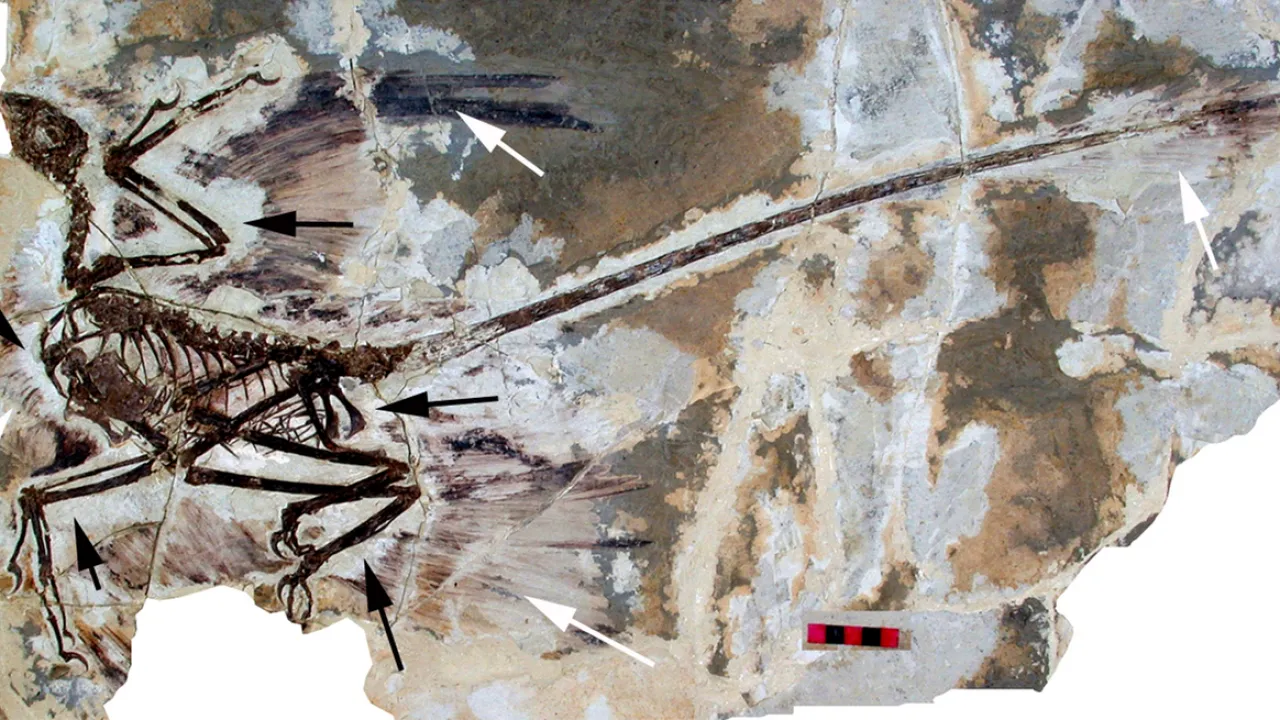
⚡ Survival SuperpowerFour feathered wings and shimmering crow-like iridescent plumage
🤯 Mind-Blowing Fact • Grade 1
Microraptor was only about the size of a hawk and weighed just two pounds—roughly as light as a loaf of bread!
✨ Word Sparks (Grade 1 Glossary)
Tap 🔊 to hear
glide
To coast smoothly through air on spread wings
shiny
Bright and glossy when light hits it
perch
To rest high up on a tree branch
🪝
Have you ever heard of a tiny dinosaur with FOUR feathered wings?
1
Four Wings to Glide!
Whoosh! High in an ancient ginkgo tree, a crow-sized dinosaur leaps into the air! Microraptor spread long flight feathers on both its arms AND its back legs!
2
Shiny Blue-Black Feathers
Sunlight flashed across its feathers like a beetle or raven. Scientists found tiny color clues inside its stone feathers!
3
Sharp Little Hunter
Curved toe claws helped it climb trees and catch lizards, small birds, and even pond fish.
1. What made Microraptor's wings unlike any bird alive today?
2. What color were Microraptor's feathers in the sunlight?
🤯 Mind-Blowing Fact • Grade 2
Four separate Microraptor skeletons were found with four completely different last meals—a bird, a mammal, a lizard, and fish!
✨ Word Sparks (Grade 2 Glossary)
Tap 🔊 to hear
iridescent
Shimmering with rainbow-like shine when viewed at angles
melanosome
Microscopic cell packet holding natural feather or skin color
raptor
Agile feathered dinosaur with curved sickle toe claws
🪝
How did scientists figure out the exact shimmering color of a 120-million-year-old dinosaur?
1
Biplane of the Treetops
Imagine looking up into a shady Cretaceous forest in China and seeing a small swoop silently between tree trunks on four wings! Microraptor belonged to the sickle-clawed raptor family, yet long, stiff flight feathers grew on its arms, its hind legs, and the diamond-shaped fan tip of its long bony tail.
2
Microscopic Color Clues
Under powerful microscopes, scientists spotted tiny sausage-shaped pigment packets called inside Microraptor's fossil feathers. Packed in neat shiny layers, they proved Microraptor gleamed with blue-black sheen just like a modern raven!
3
Fossilized Meals
Different Microraptor fossils preserve whole lizards, forest birds, small mammals, and lake fish right inside their stomachs!
1. How did scientists discover Microraptor's glossy blue-black color?
2. What proves Microraptor hunted in trees, on the ground, and near water?
🤯 Mind-Blowing Fact • Grade 3
Engineers at the University of Southampton placed a full-scale feathered model of Microraptor inside an airplane wind tunnel to measure its exact glide angles!
✨ Word Sparks (Grade 3 Glossary)
Tap 🔊 to hear
asymmetric
Having one narrower stiffer edge built for flight lift
aerodynamics
The physics of how air flows around wings
dromaeosaurid
Feathered 'raptor' dinosaur family with curved toe claws
🪝
How did wind-tunnel engineers test how four-winged Microraptor flew through ancient forests?
1
Velociraptor's Tree-Gliding Cousin
Sunlight filters through towering conifers in Liaoning, China, 120 million years ago. Perched high on a branch sits Microraptor gui, a seventy-seven-centimeter cousin of Velociraptor weighing barely one kilogram. Armed with curved second-toe sickle claws and serrated teeth, this miniature hunter launched effortlessly into open air.
2
Aerodynamics of Four Wings
Over three hundred Microraptor fossils have been unearthed in the Jiufotang Formation, preserving primary flight feathers nearly twice as long as its upper arm bones—plus long flight feathers on its feet! Wind-tunnel models built by aeronautical engineers showed that tucking or spreading its hind-leg wings acted like airplane flaps, helping Microraptor bank sharply around tree trunks while its diamond tail fan stabilized landings.
3
Daytime Glossy Display
In 2012, researchers compared Microraptor's elongated, stacked melanosomes with living birds. Because iridescent sheen only sparkles in bright light, scientists concluded Microraptor was active by day rather than night, flashing its glossy feathers to attract mates.
4
Swallowing Prey Whole
Articulated skeletons of tree-perching birds like Enantiornithes inside Microraptor's rib cage prove it snatched nimble prey mid-branch and swallowed catches headfirst!
1. Why did Microraptor's iridescent plumage convince scientists it was active during the daytime?
2. How did hind-leg feathers help Microraptor maneuver in forests according to wind-tunnel tests?
🤯 Mind-Blowing Fact • Grade 4
Laser-stimulated fluorescence scans of Microraptor foot pads in 2022 showed hawk-like gripping tubercles on its toes, ideal for pinning struggling birds and fish!
✨ Word Sparks (Grade 4 Glossary)
Tap 🔊 to hear
diurnal
Active mainly during bright daylight hours rather than night
scleral ring
Circle of tiny bones supporting an animal's eyeball
arboreal
Living and hunting mainly up among tree branches
🪝
Did flight evolve only once in bird ancestors, or did Microraptor invent its own aerial pathway?
1
A Four-Winged Bombshell
Imagine walking beside a volcanic lake in Early Cretaceous northeastern China 120 million years ago as a glossy, crow-sized shadow banks steeply down from a ginkgo canopy to snatch a Darting lizard. When paleontologist Xing Xu and colleagues described Microraptor gui in 2003 from Liaoning's Jiufotang Formation, its unmistakable hind-limb remiges confirmed a bold century-old prediction made by naturalist William Beebe in 1915: a 'tetrapteryx,' or four-winged stage in paravian evolution.
2
Asymmetric Vanes and Flight Mechanics
Just like living flying birds, Microraptor possessed asymmetric flight feathers—narrow, stiff leading vanes paired with broader trailing vanes—on both its hands and its metatarsals, preventing feathers from twisting mid-air. Biomechanical reconstructions show Microraptor could glide efficiently from elevated perches and even generate short bursts of flapping lift, while folding its leg feathers backward when scampering across forest floors using preserved scaly footpads.
3
Melanosomes Versus Eye Rings
Earlier researchers noted Microraptor's wide scleral eye rings and guessed it hunted at night. However, Jakob Vinther and Quanguo Li's 2012 electron-microscopy discovery of tightly packed, high-aspect-ratio melanosomes proved iridescent blue-black plumage—a trait overwhelmingly linked to visual signaling.
4
Generalist Opportunist of the Jehol
Preserved gut contents spanning enantiornithine birds, terrestrial lizards, small mammals, and teleost fish show Microraptor hunted across every vertical layer of its forest-lake home.
1. Why are asymmetric feather vanes important evidence for aerodynamic flight ability in Microraptor?
2. Who predicted a four-winged 'tetrapteryx' glider stage nearly ninety years before Microraptor gui was named?
🤯 Mind-Blowing Fact • Grade 5
In 2024, researchers even confirmed preserved claw sheaths and hawk-like toe-pad scales on Microraptor via laser fluorescence, showing its feet functioned almost identically to modern bird-hunting accipiter hawks!
✨ Word Sparks (Grade 5 Glossary)
Tap 🔊 to hear
Lagerstätte
Fossil deposit with extraordinary preservation of delicate soft tissues
pennaceous
Stiff contour or flight feather with central shaft and vanes
paravian
Clade uniting birds with their closest dromaeosaur and troodontid kin
🪝
What does Microraptor gui reveal about parallel experiments in aerodynamic flight among non-avian paravians?
1
Jewel of the Jiufotang Lagerstätte
Preserved by anoxic volcanic-ash-rich lake sediments in Liaoning's Aptian-stage Jiufotang Formation (~120 MYA), Microraptor is represented by more than three hundred articulated specimens—making it the single most abundant non-avian theropod in the global fossil record. Named Microraptor zhaoianus in 2000 and expanded by Xing Xu's landmark 2003 description of Microraptor gui, this one-kilogram, eighty-centimeter microraptorine dromaeosaurid proved that complex aerodynamic surfaces evolved outside the direct avian lineage.
2
Biplane vs. Abducted Hind-Wing Kinematics
Microraptor carried twelve primary and eighteen secondary asymmetric remiges on each forelimb, mirrored by fourteen elongated asymmetric metatarsal feathers up to nineteen centimeters long and a distal diamond-shaped caudal fan. Wind-tunnel experiments by Gareth Dyke, Colin Palmer, and colleagues demonstrated that Microraptor achieved stable lift-to-drag ratios across varied leg postures, banking sharply via hind-limb pitch adjustments while potentially executing wing-assisted incline running and brief powered strokes.
3
Structural Coloration via Melanosome Arrays
In 2012, Quanguo Li, Jakob Vinther, and colleagues used scanning electron microscopy to compare fossilized melanosomes across twenty-six feather regions against extant birds. Exceptionally narrow, elongated rod-shaped melanosomes organized in coherent nanostructures refracted light into glossy blue-black iridescence, strongly supporting diurnal socio-sexual signaling despite large mesopic scleral rings.
4
Trophic Plasticity in Direct Gut Fossils
Four exceptional specimens preserve distinct ingested vertebrates within the coelomic cavity: an arboreal enantiornithine bird swallowed whole, a scansorial mammal, an unidentifiable squamate lizard, and acid-etched teleost fish bones alongside specialized conical premaxillary teeth.
5
Parallel Pathways to the Skies
Rather than representing a direct ancestor of living birds, Microraptor demonstrates that Early Cretaceous experimented independently with multi-wing airfoils across forested ecosystems.