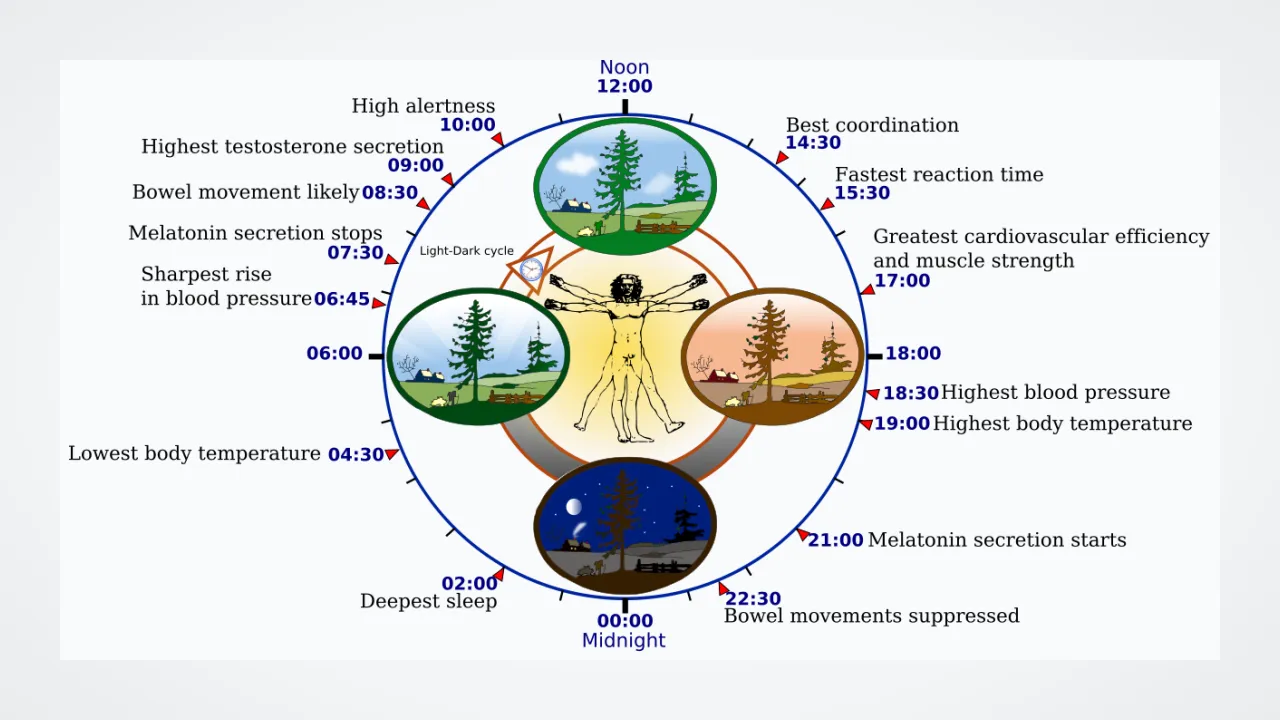
1. When does your brain release the most melatonin to help you feel sleepy?
2. What helps set your brain's built-in clock each morning?
🤯 Mind-Blowing Fact • Grade 2
Even plants, fruit flies, and sunflowers have daily circadian clocks that open leaves by day and fold them up at night!
✨ Word Sparks (Grade 2 Glossary)
Tap 🔊 to hear
Circadian Rhythm
Natural twenty-four-hour cycle guiding sleep and waking
Blue Light
Daytime light color existing in sun and screens
Sensor
Part that detects light, sound, or touch
🪝
Why can staring at a bright tablet screen right before bed trick your brain into thinking it is still daytime?
1
Earth's Spin Inside Your Brain
Every twenty-four hours, planet Earth spins from bright morning to starry night. Inside your brain, a built-in timer called your matches that daily spin to schedule hunger, alertness, body warmth, and sleep!
2
Blue Light vs. Darkness
Special light in the backs of your eyes watch for blue-tinted sky light. All day long, bright light tells your tiny pineal gland to hold back its sleep hormone, melatonin. Once darkness arrives, melatonin flows into your blood so your eyelids grow heavy.
3
Screen-Free Wind-Down
Phones and tablets shine bright just like midday sunshine! Turning screens off an hour before bed lets melatonin flow right on time.
1. Why is it smart to put away bright tablets and phones before bedtime?
2. Roughly how long is one full cycle of your body's circadian rhythm?
🤯 Mind-Blowing Fact • Grade 3
Your core body temperature naturally dips to its coolest point of the entire twenty-four-hour cycle right around four o'clock in the morning!
✨ Word Sparks (Grade 3 Glossary)
Tap 🔊 to hear
Optic Nerve
Cable carrying light signals from eye to brain
Pacemaker
Control center setting a steady repeating beat
Jet Lag
Tiredness when travel outruns your body clock
🪝
Why do travelers feel sleepy at lunchtime—called jet lag—right after flying across several time zones?
1
Around a Day
The word circadian comes from Latin words meaning 'about a day.' Behind your eyes, sitting right above where your cross, ticks a tiny bundle of twenty thousand nerve cells. This master directs daily schedules for body temperature, digestion, focus, and sleep.
2
The Hormone of Darkness
Scientists nickname melatonin the 'hormone of darkness.' It doesn't knock you out like a sleeping potion—instead, when dusk arrives, your master clock signals the pea-sized pineal gland to release melatonin, gently lowering your core temperature by half a degree and announcing bedtime.
3
Clocks in Every Organ
Surprisingly, your liver, heart, and muscles keep their own tiny daily schedules too! Your brain's master clock acts like an orchestra conductor keeping every organ playing in harmony.
4
Understanding Jet Lag
Fly fast across the ocean and local sunlight shifts hours ahead of your internal conductor! Stepping outside into morning sunshine helps reset your clock by about one hour per day until fades.
1. Why do scientists nickname melatonin the 'hormone of darkness'?
2. What causes jet lag after a long airplane flight across several time zones?
🤯 Mind-Blowing Fact • Grade 4
Your eyes contain special melanopsin cells whose main job isn't seeing shapes at all—they measure sky brightness just to set your brain's master clock!
✨ Word Sparks (Grade 4 Glossary)
Tap 🔊 to hear
Melanopsin
Eye pigment sensing blue light for body clocks
Suprachiasmatic Nucleus
Twenty-thousand-neuron master clock inside the hypothalamus
Consolidate
Strengthen and organize new memories during sleep
🪝
What happened when scientists lived in a cozy underground cave with no clocks or windows—did their bodies forget when to sleep?
1
Free-Running Cave Experiments
When volunteer researchers camped inside dim caves with zero clocks or sunlight, they still woke up, felt hungry, and grew sleepy on a regular daily beat—running roughly twenty-four hours and fifteen minutes per cycle! That proved circadian rhythms are built right into our cells rather than simply reacting to sunrises, using morning daylight each day to trim off those extra fifteen minutes.
2
Special Eye Sensors and the SCN
Even beyond rods and cones that form visual pictures, your retina holds specialized ganglion cells loaded with a blue-light pigment called . Whenever 480-nanometer sky light strikes melanopsin, nerves signal the (SCN)—a twenty-thousand-neuron master clock in the hypothalamus—which pauses pineal melatonin until dusk.
3
Ticking Clock Genes
How does a microscopic cell count twenty-four hours? Inside nearly every cell, clock proteins named CLOCK, BMAL1, PER, and CRY build up throughout the day, then switch off their own genes overnight before breaking down by sunrise—creating a molecular hourglass!
4
Why Kids Need Deep Night Sleep
When evening melatonin ushers in nine to eleven hours of deep nighttime sleep, your brain school memories, washes out daytime metabolic waste through fluid channels, repairs active muscles, and cues the pituitary gland to release strong pulses of growth hormone.
1. What happened when volunteers lived in caves without sunlight or clocks?
2. Which blue-light-sensing eye pigment sends brightness updates directly to the Suprachiasmatic Nucleus?
🤯 Mind-Blowing Fact • Grade 5
French astronomer Jean-Jacques d'Ortous de Mairan discovered biological clocks in 1729 by placing a sensitive mimosa plant inside a dark closet and watching it still open its leaves every morning!
✨ Word Sparks (Grade 5 Glossary)
Tap 🔊 to hear
Chronobiology
Scientific study of internal biological timekeeping
Entrainment
Synchronizing an internal clock with external daylight
Tryptophan
Dietary amino acid used to build melatonin
🪝
How do four interlocking proteins inside every cell build a self-winding molecular clockwork that won the 2017 Nobel Prize?
1
The Suprachiasmatic Master Pacemaker
—the science of biological timekeeping—centers in mammals on the paired Suprachiasmatic Nuclei (SCN), twin clusters of roughly twenty thousand neurons perched directly atop the optic chiasm in the anterior hypothalamus. Intrinsically photosensitive retinal ganglion cells expressing melanopsin detect short-wavelength blue light (~480 nm) and project along the retinohypothalamic tract, entraining our natural ~24.2-hour free-running rhythm precisely to Earth's solar day.
2
Pineal Synthesis of Indoleamine Melatonin
Nestled deep between the cerebral hemispheres in the epithalamus sits the eight-millimeter pineal gland. During daylight, GABAergic signals from the SCN inhibit pineal activity. As twilight falls, sympathetic nerve input activates arylalkylamine N-acetyltransferase—the rate-limiting enzyme that converts serotonin (derived from dietary ) into N-acetyl-5-methoxytryptamine, better known as melatonin. Plasma melatonin rises tenfold within two hours of darkness, binding MT1 and MT2 receptors to quiet SCN alerting signals and promote peripheral heat loss.
3
The Nobel-Winning Transcription-Translation Loop
Remarkably, peripheral cells in the liver, pancreas, heart, and immune system maintain autonomous clocks too! In 2017, Jeffrey Hall, Michael Rosbash, and Michael Young shared the Nobel Prize in Physiology or Medicine for decoding this transcription-translation feedback loop: transcription factors CLOCK and BMAL1 activate Period (PER) and Cryptochrome (CRY) genes by day; accumulated PER and CRY dimers enter the nucleus at night to inhibit their own synthesis, then degrade by dawn so the cycle restarts.
4
Two-Process Sleep Regulation and Teen Chronotypes
Sleep scientist Alexander Borbély showed that restful sleep blends Process C (your circadian melatonin rhythm) with Process S (homeostatic sleep pressure driven by daytime adenosine buildup). Notably, during adolescence the nightly melatonin surge naturally shifts one to two hours later before edging earlier again in adulthood.
5
Three Centuries of Chronobiological Discovery
French astronomer Jean-Jacques d'Ortous de Mairan launched in 1729 when he noticed a mimosa plant kept opening and folding its leaves inside a pitch-dark cupboard. Two centuries later, Yale dermatologist Aaron Lerner isolated pineal melatonin in 1958, revealing the chemical messenger linking cosmic rotation to cellular rest.