1. Why didn't Megatherium hang upside down from branches?
2. How did Megatherium's thick tail help it eat?
🤯 Mind-Blowing Fact • Grade 2
Megatherium was the very first prehistoric mammal skeleton ever mounted in a museum, way back in 1795 in Spain!
✨ Word Sparks (Grade 2 Glossary)
Tap 🔊 to hear
armor
a tough covering that protects the body
mudflats
flat stretches of soft, wet coastal mud
mounted
put together on a frame for display
🪝
How did a four-ton sloth walk without breaking its own giant claws?
1
Walking on Foot Edges
Imagine wearing giant curved garden rakes on your hands and feet! Megatherium had claws over a foot long. To keep those claws sharp and unbroken, it turned its paws inward and walked on the outer sides of its feet.
2
Built-In Chainmail Skin
What if a hungry saber-toothed cat crept nearby? Beneath its shaggy fur, Megatherium hid a secret shield! Hundreds of pebble-sized bones grew right inside its thick leather skin like hidden .
3
Fossil Footprints Together
In Argentina, scientists found fossilized tracks of Megatherium walking upright on just two hind legs! Those giant footprints stretched across ancient beside prehistoric human tracks.
1. What hidden protection sat underneath Megatherium's shaggy fur?
2. How did Megatherium protect its foot-long claws while walking?
🤯 Mind-Blowing Fact • Grade 3
Megatherium's hip bones were wider than an Asian elephant's hips, forming a giant anchor for standing upright!
✨ Word Sparks (Grade 3 Glossary)
Tap 🔊 to hear
pelvis
the wide bowl of hip bones
continuously
going on nonstop without taking a break
osteoderms
small bony plates grown inside animal skin
🪝
Why did scientists in 1796 mistake this giant herbivore for an underground mole?
1
The 'Great Beast' Mystery
In 1787, workers digging along the Luján River in Argentina uncovered bones bigger than an ox's! Shipped in crates to Madrid, the skeleton puzzled everyone until French scientist Georges Cuvier studied drawings of its teeth and claws in 1796. Cuvier named it Megatherium, meaning 'Great Beast,' and realized it was a giant cousin of tree sloths!
2
Reaching Twenty Feet High
At first, a few early thinkers wondered if those huge claws dug giant burrows like a mole. Later paleontologists proved Megatherium was far too large for tunnels—rearing onto its broad , pillar-like hind legs, and stout tail, it towered nearly twenty feet tall to browse treetops.
3
Ever-Growing Peg Teeth
Unlike horses or cows, Megatherium had zero enamel on its teeth! Instead, ten square peg-shaped cheek teeth grew from their roots throughout its whole life, wearing down at the exact rate dusty leaves ground them away.
4
Hidden Skin Pebbles
Related to armadillos and anteaters, ground sloths carried tiny bony nodules called embedded deep inside their hides, making an adult Megatherium nearly impossible for Ice Age predators to bring down.
1. Who figured out in 1796 that Megatherium was related to modern tree sloths?
2. How did Megatherium keep its enamel-free teeth from wearing completely away?
🤯 Mind-Blowing Fact • Grade 4
Large-seeded fruits like wild avocados likely evolved so giant ground sloths could swallow the pits whole and plant new trees miles away!
✨ Word Sparks (Grade 4 Glossary)
Tap 🔊 to hear
temperate
having mild weather, neither freezing nor boiling
prehensile
able to wrap around and grasp objects
ichnofossils
fossilized footprints, burrows, or animal tracks
🪝
Did giant ground sloths wear thick woolly fur in warm weather—or did they lose most of their hair?
1
Why Giants Overheat
Step onto the sunlit Pampas plains of Ice Age Argentina, where a four-ton Megatherium lumbers toward a grove of acacia trees. Movies often show giant ground sloths covered in thick fur because smaller cousins found in chilly Patagonian caves preserved shaggy coats. However, large mammals generate tremendous body heat and have less skin surface per pound to cool off! Just like modern elephants and rhinos, full-grown Megatherium living on plains likely had sparse hair over thick, wrinkled skin.
2
Biomechanical Powerhouse
Studies of elbow joints on Megatherium's forearm bones reveal an unexpected talent: its ulna bone formed a long lever that could snap its huge claws forward swiftly as well as pull branches slowly! Coupled with a narrow, snout and long gripping tongue, it stripped nutritious shoots, fruits, and pods with ease.
3
Planting Giant Seeds
Have you ever wondered why avocados have pits far too large for songbirds or foxes to swallow whole? Botanists call fruits like wild avocados and osage oranges 'evolutionary anachronisms'—plants that originally partnered with giant Ice Age browsers like ground sloths and gomphotheres to carry their seeds across landscapes!
4
Tracks in Ancient Mud
At Pehuen-Có in coastal Argentina, 12,000-year-old fossil trackways called preserve three-foot-long Megatherium footprints showing the giant alternating between four-legged strolling and upright two-legged walking.
1. Why do scientists think adult Megatherium on warm plains had sparse hair like elephants?
2. How did Megatherium help wild trees like ancient avocados survive?
🤯 Mind-Blowing Fact • Grade 5
Amino-acid isotope tests on fossil bone collagen proved decisively in 2019 that despite its fierce-looking claws, Megatherium ate 100 percent plants!
✨ Word Sparks (Grade 5 Glossary)
Tap 🔊 to hear
Xenarthra
mammal group of sloths, armadillos, and anteaters
pedolateral
walking on the outer edges of feet
hypselodont
rootless teeth that grow throughout life
🪝
How did a fossil skeleton dug from an Argentine riverbank prove to science that species can go extinct?
1
The Skeleton That Changed Science Forever
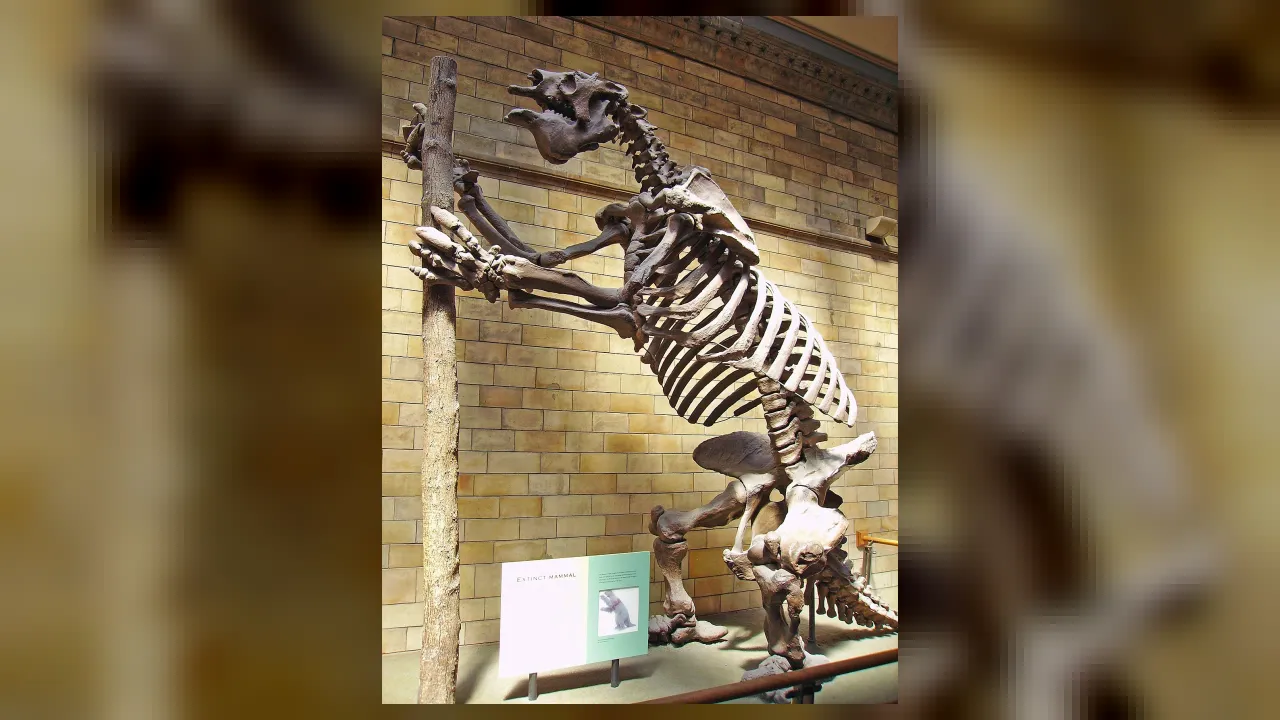
Stand inside Madrid's Royal Cabinet of Natural History in 1795 and gaze upward at a six-meter skeleton wired together by taxidermist Juan Bautista Bru—the first fossil vertebrate ever reconstructed in life posture! Seven years earlier, friar Manuel Torres had excavated these colossal bones from Pleistocene sediments along the Luján River near Buenos Aires. Studying engravings sent to Paris, young anatomist Georges Cuvier demonstrated in 1796 that Megatherium americanum belonged to —the uniquely South American mammal group containing sloths, anteaters, and armadillos—yet matched no living creature on Earth, proving beyond doubt that entire species could vanish through extinction.
2
Xenarthran Anatomy on a Colossal Scale
means 'strange joints,' referring to extra interlocking articulations along the lumbar vertebrae that stiffened the lower spine for heavy digging and upright bracing. Megatherium amplified this blueprint to four metric tons! Its flaring iliac blades spanned more than 1.5 meters across the pelvis, anchoring massive gluteal muscles, while sturdy femora and a thick caudal base formed a stable bipedal or tripodal platform.
3
Pedolateral Locomotion and Dental Chemistry
Because up to seventeen-centimeter ungual cores supported curved keratinous claws, Megatherium practiced locomotion—rotating its hind feet so weight rested along the fifth metatarsal on the outer edge. Meanwhile, a deep mandibular spout supported ten (ever-growing, rootless) molariform teeth made of layered orthodentine and cementum that self-sharpened into twin chisel blades with every chew.
4
Testing the Scavenger Hypothesis with Isotopes
Because Megatherium possessed fast-acting olecranon levers on its ulnae, a few researchers once wondered whether it scavenged carcasses. In 2019, amino-acid nitrogen isotope analysis of fossil collagen settled the debate decisively: Megatherium was a strict herbivore!
5
Young Darwin and the Final Footsteps
In 1832, young Charles Darwin unearthed Megatherium fossils at Punta Alta, Argentina, sparking questions about how ancient South American giants related to tiny modern tree sloths. Radiocarbon dates from Pampas sites such as Campo Laborde show Megatherium survived until roughly 11,000 years ago alongside early human hunter-gatherers.