2. About how wide were Meganeura's outstretched wings?
🤯 Mind-Blowing Fact • Grade 2
Air during the Carboniferous Period had nearly one-third oxygen, compared to only about one-fifth oxygen in the air you are breathing right now!
✨ Word Sparks (Grade 2 Glossary)
Tap 🔊 to hear
Griffinfly
Extinct giant insect related to modern dragonflies
Oxygen
Gas in air that animals need for energy
Nymph
Young stage of an insect before growing wings
🪝
How could an insect grow as big as a crow without lungs to pump air?
1
King of the First Flying Hunters
Listen to the dry crackle of giant wings beating above a quiet swamp pond 300 million years ago! Hovering over the reeds is Meganeura, an ancient that looked like a supersized dragonfly. No birds, bats, or flying reptiles existed yet, so insects ruled the sky.
2
Breathing Through Tiny Tubes
Insects do not breathe with lungs like we do. Instead, air flows through tiny holes along their sides into branching tubes. During Meganeura's time, thick coal forests pumped extra into Earth's air, giving big flight muscles plenty of fuel!
3
Young Hunters in the Water
Baby griffinflies, called , lived underwater in streams and ponds. They hunted tadpole-sized amphibians and water bugs until they climbed a reed, shed their skin, and took flight.
1. Why isn't Meganeura called a true modern dragonfly by scientists?
2. What helped fuel Meganeura's huge flying muscles 300 million years ago?
🤯 Mind-Blowing Fact • Grade 3
Meganeura's compound eyes had nearly thirty thousand tiny lenses, letting it spot a fluttering bug from yards away in almost any direction!
✨ Word Sparks (Grade 3 Glossary)
Tap 🔊 to hear
Spiracle
Tiny breathing hole along an insect's body side
Tracheae
Branching air tubes inside an insect's body
Thorax
Middle insect body part holding legs and wings
🪝
What happens when billions of swamp trees pump extra oxygen into an atmosphere with zero birds?
1
Found in French Coal Mines
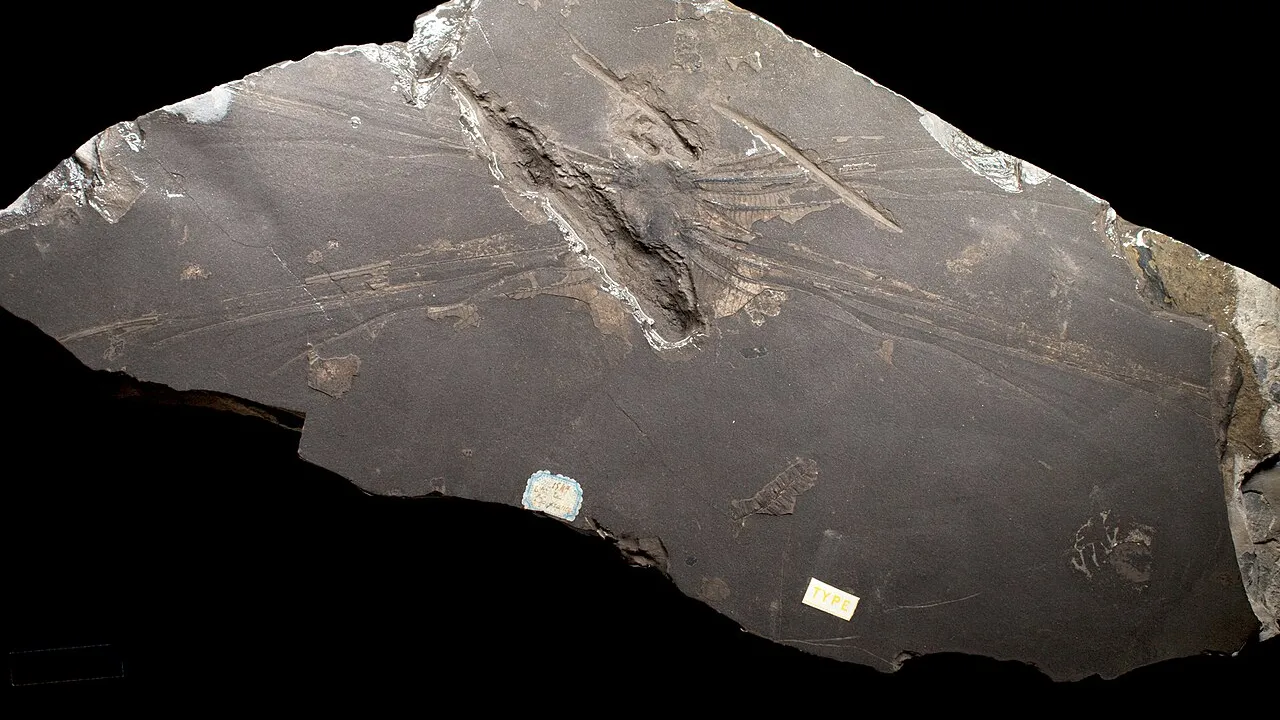
In 1880, miners digging coal in Commentry, central France, split open dark shale and revealed the delicate wing prints of a giant insect. French paleontologist Charles Brongniart named it Meganeura monyi. Stretching seventy centimeters (27.5 inches) from wingtip to wingtip, it stunned scientists around the world.
2
The Tracheal Breathing Trick
Modern insects stay small partly because they breathe through —tiny side vents leading into microscopic tubes called that deliver oxygen straight to cells. Three hundred million years ago, vast swamp forests buried carbon as peat and raised atmospheric oxygen above thirty percent. Denser oxygen pushed deeper down long tracheal tubes, powering Meganeura's heavy muscles.
3
Built for Open-Air Patrols
Meganeura was a griffinfly, lacking a few specialized wing-folding joints and stabilizing spots found on modern dragonflies. Because seventy-centimeter wings would snag on dense branches, it patrolled open lakes and river channels.
4
When Birds Claimed the Sky
Once Permian climates dried out and oxygen dropped, giant griffinflies vanished. Later, agile gliding reptiles, pterosaurs, and birds kept flying insects small forever after.
1. Why did Meganeura hunt mostly over open lakes and wide river channels?
2. Even if oxygen rose slightly again, why couldn't hawk-sized insects easily evolve today?
🤯 Mind-Blowing Fact • Grade 4
Despite having the wingspan of a hawk, Meganeura weighed only about five ounces (150 grams)—roughly as light as a single baseball or apple!
✨ Word Sparks (Grade 4 Glossary)
Tap 🔊 to hear
Diffusion
Natural movement of gas from high to low concentration
Venation
Pattern of stiffening veins across an insect's wing
Mandibles
Strong biting jaws of an insect or arthropod
🪝
How did Meganeura stay cool and supplied with oxygen during high-speed aerial chases over tropical coal swamps?
1
Apex Aviator of the Paleozoic
Hover above a sun-drenched lake in Late Carboniferous France 300 million years ago. Towering scale trees—Lepidodendron—frame the shoreline while a seventy-centimeter shadow skims the water below. Meganeura monyi, a giant member of the extinct order Meganisoptera, beats four stiffly veined wings independently, generating swift bursts of lift to intercept palaeodictyopteran insects in midair.
2
Respiratory Physics and Oxygen Diffusion
Insect flight muscles demand more oxygen per gram than almost any tissue in the animal kingdom. Without lungs or oxygen-carrying hemoglobin in blood, insects rely on gas and rhythmic abdominal pumping through spiracles and tracheal tubules. When Carboniferous peat burial drove atmospheric oxygen toward thirty-one to thirty-five percent, steeper partial-pressure gradients drove oxygen deep into a thick thorax without requiring tracheae to crowd out muscle fibers.
3
Overheating Risks and Gliding Adaptation
Flying hard in a warm tropical swamp created another hazard: overheating. Aerodynamic studies of Meganeura's corrugated wing show stiff leading-edge spars that supported intermittent gliding between wingbeats, conserving energy and letting airflow cool its muscular thorax.
4
Anatomy of an Aerial Interceptor
Enlarged dorsal eye facets gave Meganeura sharp upward tracking against bright sky backgrounds, while forward-angled spiny legs and serrated tackled large insects and even tiny shoreline amphibians.
1. If tracheal tubes simply grew wider and wider inside a giant insect under normal oxygen, what problem would occur?
2. How did Meganeura's corrugated wing structure help prevent its body from overheating?
🤯 Mind-Blowing Fact • Grade 5
Unlike modern dragonflies, Meganeura lacked the tiny weighted dark spot near each wingtip—called a pterostigma—that acts as a built-in shock absorber to stop wing flutter at top speed!
✨ Word Sparks (Grade 5 Glossary)
Tap 🔊 to hear
Pterostigma
Weighted cell on dragonfly wingtips that stops flutter
Meganisoptera
Extinct Paleozoic insect order known as griffinflies
Lagerstatte
Rock deposit preserving fossils in extraordinary fine detail
🪝
What combination of atmospheric chemistry, wing biomechanics, and empty ecological skies produced a seventy-centimeter predatory insect?
1
Discovery in the Commentry Coalfields
During the late nineteenth century, open-pit coal mining in the Stephanian-aged shales of Commentry, central France, yielded an extraordinary Lagerstätte of Late Carboniferous insects (~300 MYA). In 1885, French paleontologist Charles Brongniart formally described a colossal wing and body impression as Meganeura monyi—referencing its robust network of longitudinal and cross veins. With a reconstructed wingspan of 68 to 71 centimeters (nearly 28 inches), it stood alongside its slightly larger Early Permian North American cousin Meganeuropsis permiana at the pinnacle of insect size.
2
Hyperoxia and Larval Oxygen Toxicity
Paleoatmospheric models indicate that massive burial of decay-resistant lignin in Carboniferous coal swamps elevated atmospheric oxygen to roughly 30–35%. In adult insects, higher oxygen partial pressure overcame diffusive bottlenecks in long tracheal networks, supplying metabolically intense flight muscles without sacrificing cross-sectional leg and thorax space. Intriguingly, evolutionary biologists also propose that aquatic griffinfly nymphs initially evolved larger body sizes to buffer their tissues against oxidative cell damage in oxygen-supersaturated freshwater streams.
3
Meganisopteran Flight Biomechanics
Although colloquially dubbed a giant dragonfly, Meganeura belonged to the stem-group ('griffinflies'), lacking true odonate structures such as the wing-tip (a weighted fluid cell that dampens flutter) and a fully developed nodus hinge. Pleated, corrugated venation nonetheless imparted exceptional flexural stiffness at minimal mass (~100–150 grams), enabling fast hawking runs interspersed with thermoregulatory glides above open water.
4
Optical Specialization and Trophic Role
Fossilized cephalic capsules show hypertrophied compound eyes split into dorsal and ventral zones—a hallmark of modern hawking dragonflies that silhouette flying prey against bright skies. Obliquely angled thoracic segments positioned six spinose legs forward into an inescapable capture basket capable of seizing large palaeodictyopterans, dictyopterans, and small juvenile tetrapods.
5
Atmospheric Shift and Vertebrate Takeover
As Pangaean aridification curtailed peat burial during the Permian and oxygen fell sharply, giant meganisopterans disappeared before the end-Permian extinction. When oxygen briefly rebounded in the Mesozoic, pterosaurs and birds already monopolized large aerial niches, sealing the ceiling on insect gigantism.