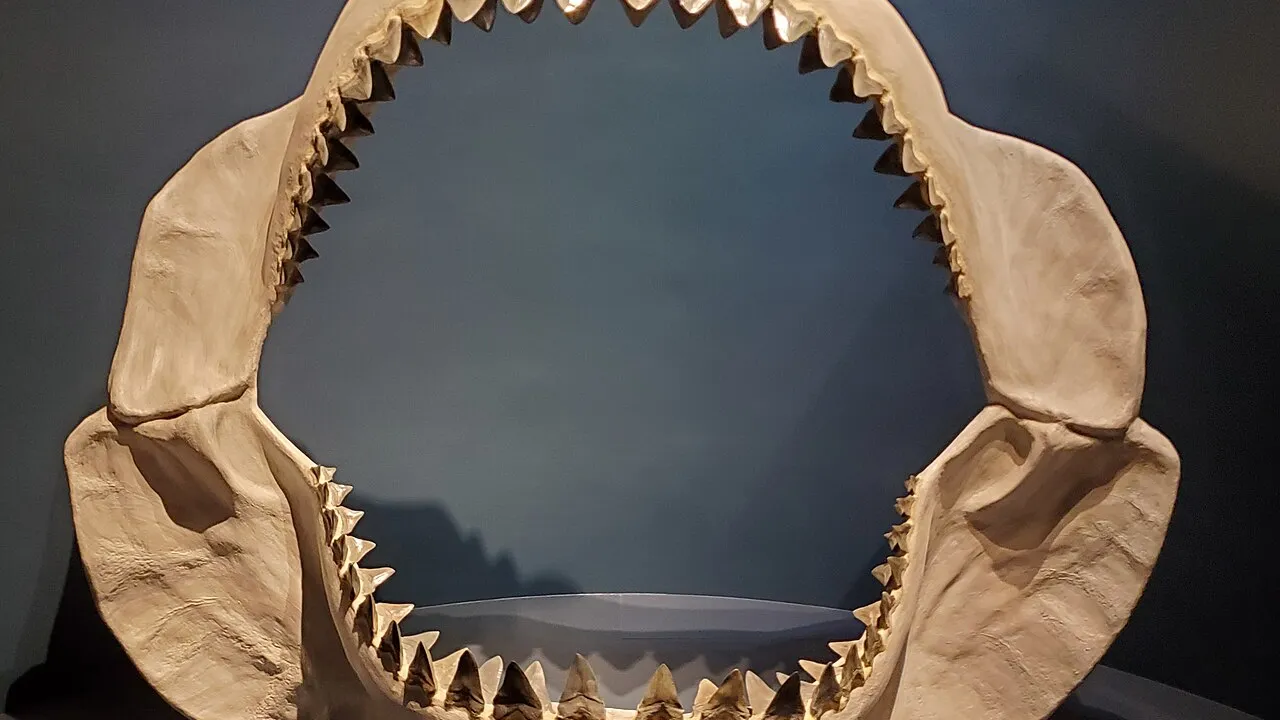
2. Why are so many Megalodon teeth found as fossils around the world?
🤯 Mind-Blowing Fact • Grade 2
Hundreds of years ago, people who found giant triangular Megalodon teeth in rock cliffs thought they were petrified dragon tongues called 'glossopetrae'!
✨ Word Sparks (Grade 2 Glossary)
Tap 🔊 to hear
nurseries
Shallow, calm bays where baby sharks grow
petrified
Turned into solid stone over millions of years
extinct
No longer living anywhere on planet Earth
🪝
Is Megalodon still hiding in the deep ocean today, or did it vanish millions of years ago?
1
Giant of Warm Ancient Seas
Dive back ten million years into warm coastal oceans from Florida to Peru and Australia! Gliding effortlessly overhead passes Megalodon, a colossal shark stretching fifty to sixty-five feet long—three times longer than today's largest great white sharks!
2
Built to Hunt Ancient Whales
Inside its six-foot-wide jaws sat five rows of 276 thick, serrated teeth. Scientists calculate Megalodon possessed the strongest bite of any animal ever—powerful enough to crunch right through ancient whale ribs!
3
Why We Know It's Truly Extinct
Megalodon needed warm coastal waters and shallow shark , and it went 3.6 million years ago when Earth cooled—so our beaches are completely Megalodon-free today!
1. How do scientists know Megalodon is definitely extinct today?
2. What did people in Europe centuries ago think fossil Megalodon teeth were?
🤯 Mind-Blowing Fact • Grade 3
Before even being born, developing Megalodon pups grew six feet long inside their mother by snacking on unfertilized eggs in the womb!
✨ Word Sparks (Grade 3 Glossary)
Tap 🔊 to hear
Cenozoic
The current geological era after dinosaurs vanished
baleen whales
Filter-feeding whales that migrate to cold waters
Otodontidae
Extinct family of giant mega-toothed mackerel sharks
🪝
Why were newborn baby Megalodons already six feet long on the very day they were born?
1
Global Cruiser of the Cenozoic
Long after dinosaurs and mosasaurs vanished 66 million years ago, whales evolved and spread across Earth's oceans. Right behind them rose Otodus megalodon! From 23 million to 3.6 million years ago, this fifty-to-sixty-five-foot mega-toothed shark patrolled every warm ocean except freezing polar waters.
2
Six-Foot Newborns and Shallow Nurseries
Growth rings inside rare fossilized Megalodon backbone discs reveal an astonishing surprise: newborn pups emerged from their mothers already measuring six and a half feet long! Mothers gave birth in warm, shallow nurseries in places like Panama, Florida, and Spain so pups stayed safe from open-ocean predators.
3
Not Just a Supersized Great White
Scientists used to classify Megalodon as a direct sister to the great white shark. Newer fossil tooth series show it actually belonged to a separate extinct family of mega-toothed sharks called !
4
Why Cooling Seas Ended Its Reign
When Ice Age cooling lowered sea levels 3.6 million years ago, shallow nurseries dried up while migrated to icy polar waters where warm-loving Megalodon couldn't follow.
1. About how big was a Megalodon pup at the moment it was born?
2. How did cooling climates 3.6 million years ago hurt Megalodon?
🤯 Mind-Blowing Fact • Grade 4
Nitrogen-isotope tests on Megalodon enamel show it sat two full rungs higher on the ocean food chain than today's great white shark!
✨ Word Sparks (Grade 4 Glossary)
Tap 🔊 to hear
centra
Round central discs forming a shark's backbone
trophic level
An animal's rank on the food chain
Isthmus of Panama
Land bridge joining North and South America
🪝
How did a rare Belgian fossil backbone let scientists build a 3D digital Megalodon—and spark a brand-new debate about its shape?
1
Reconstructing a Cartilage Ghost
Because shark skeletons consist of flexible cartilage rather than solid bone, almost all Megalodon fossils are enamel-coated teeth. Fortunately, deep mineral deposits occasionally preserve calcified vertebral —ringed discs from the spinal column! Using an exceptional 141-vertebra column unearthed in Belgium in the 1860s alongside complete tooth sets, researchers built 3D digital scans showing a 16-meter shark weighing over fifty tons, capable of cruising across entire ocean basins faster than modern whales.
2
Streamlined Cruiser vs. Stocky Giant
In 2024 and 2025, an international team led by Kenshu Shimada re-examined that Belgian vertebral column and noticed its spine discs looked surprisingly slender compared with stocky great white sharks! Their analysis suggests Otodus megalodon may have been even longer—approaching twenty meters (65 feet)—and sleeker, shaped more like an elongated lemon or mako shark for efficient trans-oceanic cruising.
3
Regional Endothermy ('Warm-Bodied' Advantage)
Clumped-isotope thermometer tests on Megalodon tooth enamel proved it maintained an internal body temperature around 27 degrees Celsius—about seven degrees warmer than surrounding seawater! Keeping swimming muscles and stomach organs warm sped digestion and powered rapid bursts, though maintaining fifty tons of warm tissue demanded immense daily calories.
4
Competition in Pliocene Seas
Nitrogen isotopes locked inside Megalodon teeth reveal the highest ever measured in a marine animal—high enough to eat other apex predators! Yet when Pliocene oceans cooled and Central America closed the , agile great white sharks and ancestral killer whales outcompeted Megalodon for dwindling warm-water prey.
1. What surprising idea came from recent re-studies of Belgium's fossil Megalodon spine?
2. What downside came with Megalodon keeping its giant body warmer than seawater?
🤯 Mind-Blowing Fact • Grade 5
A continuous fossil trail in rock layers lets paleontologists watch Megalodon's ancestors slowly shrink their side tooth points and grow saw-edged mega-blades over fifty million years!
✨ Word Sparks (Grade 5 Glossary)
Tap 🔊 to hear
paleothermometry
Measuring ancient temperatures using fossil chemical isotopes
oophagy
Embryos growing big by eating unfertilized eggs
mysticete
Filter-feeding whales equipped with baleen plates
🪝
How did Renaissance 'tongue stones,' clumped-isotope paleothermometry, and modern morphometrics reveal the true biology of Otodus megalodon?
1
From Glossopetrae to Otodontid Phylogeny
In 1666, Danish anatomist Nicolas Steno dissected a Mediterranean great white shark and realized triangular 'glossopetrae'—long revered across Europe as petrified serpent tongues—were fossilized shark teeth, laying cornerstones of modern paleontology! Formally named Carcharodon megalodon by Louis Agassiz in 1843, the species has since been reassigned to Otodus megalodon within the extinct family Otodontidae, tracing a continuous sixty-million-year lineage from smooth-edged Cretaceous Otodus obliquus to finely serrated Miocene megateeth.
2
Bite Mechanics and Super-Apex Trophic Rank
Finite-element biomechanical modeling estimates posterior bite forces between 108,000 and 182,000 Newtons (roughly 24,000 to 41,000 pounds-force), delivered across 276 robust, heart-shaped teeth lacking fragile lateral cusplets. Zinc and nitrogen isotope ratios preserved inside bioapatite enamel reveal that Otodus megalodon occupied an unprecedented 'super-apex' trophic position, preying heavily upon cetotheriid baleen whales, raptorial sperm whales like Livyatan, pinnipeds, and large sharks.
3
Body-Plan Revision: Sleek Cruiser
Because chondrichthyan cartilage rarely mineralizes, body reconstructions rely heavily on an associated column of 141 vertebral centra discovered near Antwerp, Belgium. Whereas 2022 3D models scaled from stocky Carcharodon carcharias yielded a 15.9-meter, 61-metric-ton torpedo, 2024–2025 morphometric analyses by Kenshu Shimada and collaborators demonstrated that thin vertebral diameters relative to crown height require a more elongated, hydrodynamic body plan spanning 18 to 20+ meters to maintain structural spinal stability.
4
Endothermic Physiology and Intrauterine Oophagy
Clumped carbon-oxygen isotope confirms regional mesothermy (~27 °C core temperature) across varied latitudes. Furthermore, vertebral growth bands pinpoint birth size at two meters, powered by intrauterine —unborn embryos consuming unfertilized sibling ova inside the mother before entering warm Miocene nurseries such as Panama's Gatun Formation.
5
Pliocene Extinction Dynamics
Around 3.6 million years ago, closure of the Central American Seaway reorganized global thermohaline currents while Pliocene glaciation lowered sea levels, eliminating coastal nurseries. As surviving whales evolved gigantism inside frigid polar refugia and smaller, metabolically thrifty great white sharks and ancestral orcas proliferated, Earth's mightiest shark vanished.