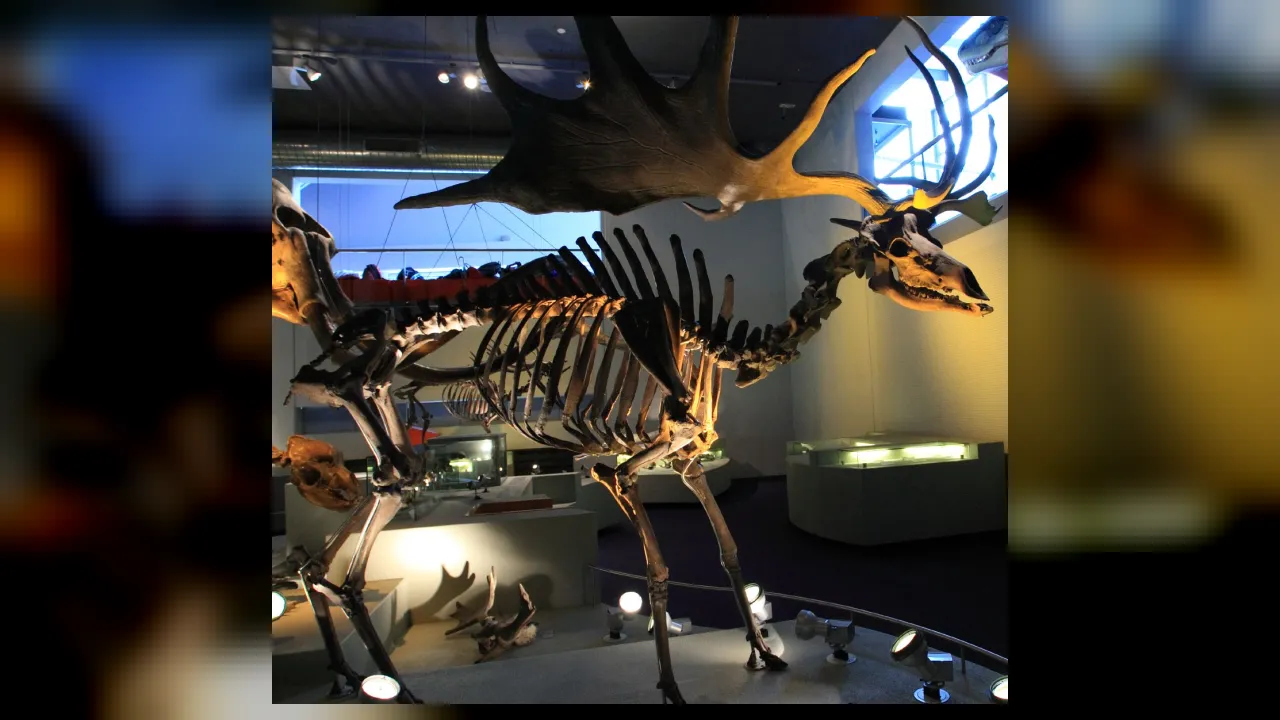
⚡ Survival SuperpowerTwelve-foot-wide antlers regrown from scratch in just five months each year
🤯 Mind-Blowing Fact • Grade 1
A single pair of Megaloceros antlers could weigh ninety pounds—as heavy as a fourth-grade kid!
✨ Word Sparks (Grade 1 Glossary)
Tap 🔊 to hear
antlers
branching bone horns that deer regrow yearly
stag
an adult male deer
meadow
an open field of grass and wildflowers
🪝
What deer carried antlers as wide as a minivan?
1
Crown of Giant Antlers
Crunch, crunch! Out of the misty steps the tallest deer ever! Meet Megaloceros, often called the Irish Elk. Male carried wide spanning twelve feet from tip to tip!
2
New Antlers Every Year
Believe it or not, those huge fell off every winter! Each spring, a brand-new pair grew back in just a few warm months.
3
Why 'Irish' Elk?
This giant deer did not live only in Ireland. It roamed grassy across Europe and Asia! Soft mud in Ireland simply saved the best bones.
1. How wide could a male Megaloceros's antlers grow?
2. What happened to a stag's giant antlers every winter?
🤯 Mind-Blowing Fact • Grade 2
Despite its famous nickname, ancient DNA shows Megaloceros is most closely related to the much smaller, graceful fallow deer!
✨ Word Sparks (Grade 2 Glossary)
Tap 🔊 to hear
minerals
natural nutrients like calcium that build bone
peat
thick wet soil made of decayed moss
spans
stretches all the way from side to side
🪝
Was the 'Irish Elk' really from Ireland—or really an elk?
1
A Double Nickname Trick
Surprise—the famous 'Irish Elk' was neither strictly Irish nor a true elk! Megaloceros lived all the way from Ireland across Europe to Siberia. Plus, DNA tests show its closest living cousin is actually the spotted fallow deer, not the North American elk or moose!
2
Growing Bone Super Fast
Growing ninety pounds of solid bone on your head every spring takes tons of ! Male stags munched mineral-rich grasses, willow shoots, and herbs near lakes all summer long to fuel the fastest bone growth in the mammal world.
3
Saved Under Peat Bogs
Why did people call it Irish? Hundreds of complete, uncrushed skeletons were found buried beneath mossy bogs in Ireland, preserved in chalky ancient lake mud.
1. Which living deer is actually the closest relative of Megaloceros?
2. Why have so many complete Megaloceros skeletons been found in Ireland?
🤯 Mind-Blowing Fact • Grade 3
During peak spring growth, a Megaloceros stag added more than half a pound of solid bone to its antlers every single day!
✨ Word Sparks (Grade 3 Glossary)
Tap 🔊 to hear
ligaments
tough stretchy bands connecting bones together
parklands
wide grasslands scattered with small tree groves
display
showing off size or color to communicate
🪝
Why did Megaloceros grow a dark shoulder hump—and how do we know what its coat looked like?
1
Portraits on Ice Age Cave Walls
Look by torchlight at the painted walls of Lascaux and Cougnac caves in France! Prehistoric artists who watched living Megaloceros herds sketched a dramatic dark hump rising above its shoulders, a bold dark stripe framing its pale throat, and broad palm-shaped antlers.
2
Holding Up Ninety Pounds
That shoulder hump was not just for show! Long spines rose upward from Megaloceros's chest vertebrae to anchor thick elastic , helping hold up a head crowned with ninety pounds of bone without exhausting its neck muscles.
3
Built for Open Parklands
With a twelve-foot antler rack, weaving through dense tangled forests would be like carrying a ladder sideways through a closet! Instead, Megaloceros thrived in open grassy dotted with scattered birch and willow groves.
4
Showing Off to Rival Stags
Paleontologist Stephen Jay Gould noticed that Megaloceros positioned its broad, scoop-shaped antlers forward so rival stags and female deer could admire their full width simply by tilting its head—settling many contests peacefully through visual !
1. How do scientists know what coat markings and shoulder hump Megaloceros had?
2. Why did Megaloceros prefer open parklands over thick forests?
🤯 Mind-Blowing Fact • Grade 4
Megaloceros survived in Siberia's Ural Mountains until 7,700 years ago—long after ancient humans began farming wheat in the Middle East!
✨ Word Sparks (Grade 4 Glossary)
Tap 🔊 to hear
phosphate
an essential mineral that hardens bones
allometry
how body parts scale with overall size
Holocene
the warm geologic epoch we live in
🪝
Where does a deer get enough calcium to build ninety pounds of bone in just 150 days?
1
Borrowing Calcium From Its Own Skeleton
Every spring across Ice Age Eurasia, adult Megaloceros stags faced an extraordinary biological deadline: grow up to forty kilograms (ninety pounds) of solid bone antlers before autumn! Even eating calcium-packed willow twigs and sedges around the clock could not supply minerals fast enough. Just like modern deer pushed to an extreme, stags temporarily borrowed calcium and directly out of their own ribs and leg bones—experiencing seasonal bone thinning—then rebuilt their skeletons once summer forage peaked!
2
Busting an Old Extinction Myth
Early twentieth-century textbooks claimed 'runaway evolution' doomed the Irish Elk by forcing its antlers to grow so gigantic that stags starved or got tangled in trees. Modern evolutionary biologists disproved that myth! Comparing body size across every living deer species shows : bigger deer naturally grow proportionally larger antlers, and seven-foot-tall Megaloceros carried the exact antler size expected for a deer its height.
3
Changing Climates in Ireland
Around 12,800 years ago, a sudden cold snap called the Younger Dryas froze Ireland's lakeshore meadows into barren tundra. Short growing seasons robbed stags of the rich spring nutrients needed to stay healthy, wiping out Irish populations.
4
Holdouts in the Ural Mountains
Remarkably, Megaloceros did not vanish everywhere at the end of the Ice Age! Radiocarbon dating reveals herds survived in western Siberia and the Ural Mountains until 7,700 years ago—thousands of years into the modern Epoch!
1. How did male Megaloceros get enough minerals to grow antlers rapidly in spring?
2. Where did the very last Megaloceros herds survive until 7,700 years ago?
🤯 Mind-Blowing Fact • Grade 5
Stephen Jay Gould's famous 1974 study measured museum skeletons to prove Megaloceros antlers matched the exact mathematical scaling rule of modern deer!
✨ Word Sparks (Grade 5 Glossary)
Tap 🔊 to hear
palmate
broad and flat like an open hand
cervids
members of the biological deer family
refugia
sheltered pockets where species survive climate shifts
🪝
How did mathematically measuring giant deer antlers overturn one of biology's most famous textbook myths?
1
Allometry Versus Orthogenesis
Stand beneath a mounted Megaloceros giganteus skeleton in Dublin's Natural History Museum, where antlers span 3.65 meters (12 feet) overhead! For decades, early paleontologists cited this Ice Age stag as proof of orthogenesis—an outdated hypothesis claiming evolutionary trends gain unstoppable momentum until oversized traits drive species extinct. In 1974, evolutionary biologist Stephen Jay Gould measured skull length against antler size across dozens of living and Megaloceros specimens, demonstrating positive allometry: across deer species, antler dimensions scale predictably faster than body height, meaning earth's largest-bodied cervid naturally grew proportionally vast antlers through ordinary sexual selection.
2
Biomechanical Jousting or Pure Display?
Could stags actually lock those sweeping racks in combat without snapping them? Finite-element computer stress models published by researchers studying Megaloceros crania and antlers found that when stags lowered their heads and twisted locked beams near the thickened basal tines, bone stress remained well within safe limits—confirming antlers served both visual intimidation and ritualized pushing matches.
3
Physiological Cost of Physiological Osteoporosis
Synthesizing 40 kilograms of hydroxyapatite bone within 150 days required unmatched mineral mobilization. Histological sections of Irish specimens show seasonal cyclic osteoporosis in non-weight-bearing ribs and vertebrae, demanding abundant summer calcium, phosphorus, and protein from willow browse and lakeshore sedges to restore bone density before winter.
4
The Younger Dryas Ecological Squeeze
High-resolution radiocarbon and pollen records from Ballybetagh Bog in Ireland reveal why local herds collapsed around 10,600 radiocarbon years ago (roughly 12,600 calendar years ago): abrupt Younger Dryas cooling shortened spring plant growth, causing mineral starvation—visible directly in smaller, thinner antlers among the final Irish stags.
5
Holocene Refugia in Continental Eurasia
Across Europe, warming Holocene climates soon closed open steppe-tundra under dense oak-hazel forests impassable to wide-antlered stags. Only along the forest-steppe mosaic of the Urals and western Siberia did open mineral-rich meadows persist until roughly 7,700 years ago, when expanding forests and Neolithic hunting closed the final chapter of Megaloceros.