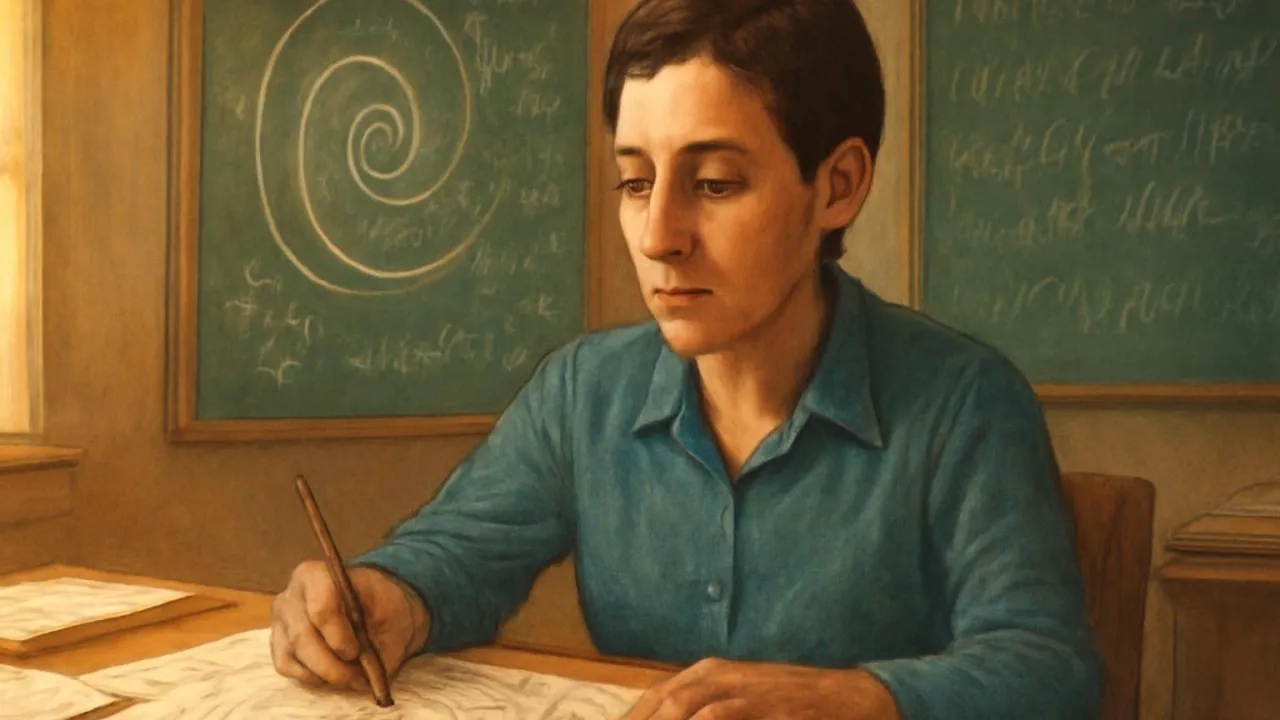
Maryam's notebooks were filled with colorful math drawings and ideas.
✨ Word Sparks (Grade 2 Glossary)
Tap 🔊 to hear
pattern
A design that repeats
curiosity
Wanting to learn more
mathematician
A person who studies math
🪝
Have you ever solved a puzzle with pictures and numbers?
1
A Curious Mind
Maryam liked to read stories and imagine new worlds. She also loved drawing shapes and . Her made her wonder about how math works.
2
Practicing Every Day
She practiced math puzzles with her brother at home. Sometimes the problems were hard, but Maryam kept trying. She learned that practice helped her get better.
3
Winning the Top Prize
Maryam became a famous for her work. She was the first woman to win the Fields Medal. Her math ideas inspired people all around the world.
Maryam could picture twisting shapes in her mind and draw them from memory.
✨ Word Sparks (Grade 3 Glossary)
Tap 🔊 to hear
geometry
The math of lines, shapes, and spaces
perseverance
Never giving up, even when it’s hard
Olympiad
A big contest for smart students
🪝
Can you imagine a world where math and art come together?
1
A Childhood Full of Wonder
Maryam Mirzakhani grew up loving stories and solving puzzles. She often imagined magical lands and drew winding shapes in her notebooks. Her favorite puzzles were math challenges that made her think deeply. Even as a child, she believed every problem had a creative solution.
2
Discovering the Beauty of Geometry
In school, Maryam became fascinated by , the study of shapes and spaces. She saw patterns everywhere and enjoyed exploring how lines and curves could fit together. Her teachers noticed her talent and encouraged her to try harder problems. Geometry became her favorite part of mathematics.
3
Perseverance and Hard Work
Maryam faced many obstacles as she grew older, including being one of the few girls in math competitions. She practiced for hours, never giving up when problems seemed impossible. Her helped her win gold medals in international math . She learned that hard work and creativity could solve even the toughest puzzles.
4
Making History in Mathematics
As an adult, Maryam studied complicated shapes called 'hyperbolic surfaces' and made big discoveries. She became the first woman to win the Fields Medal, the highest award in mathematics. Her work changed how mathematicians understand shapes and spaces. Maryam inspired girls and boys everywhere to follow their dreams in math.
Maryam once said, 'The beauty of mathematics only shows itself to more patient followers.'
✨ Word Sparks (Grade 4 Glossary)
Tap 🔊 to hear
hyperbolic
A shape that twists or curves a lot
topology
The math of how shapes connect
legacy
What someone leaves for the future
🪝
How do you turn a daydream into a math discovery that changes the world?
1
A Young Imagination in Tehran
Maryam Mirzakhani grew up in Tehran, Iran, during a time when few girls pursued advanced mathematics. As a child, she filled her notebooks with stories and colorful doodles, often imagining mathematical puzzles as adventures. Her early curiosity for patterns and logic set her apart from her classmates. Family support and encouragement from teachers helped her believe she could achieve anything.
2
Breaking Barriers and Finding Her Passion
In high school, Maryam joined Iran’s math Olympiad team, becoming one of the first girls to do so. She practiced for hours, solving difficult problems and learning to think outside the box. Her dedication paid off when she won two gold medals at the International Mathematical Olympiad. These victories inspired her to study mathematics at a higher level, despite facing challenges as a woman in the field.
3
Inventing New Ways to See Shapes
At university, Maryam became fascinated by geometry, which explores shapes and surfaces that twist and curve in strange ways. She developed creative methods for visualizing these complex spaces, often sketching them out by hand. Her groundbreaking research helped mathematicians understand how shapes can change and connect. Maryam’s work opened new doors in the study of geometry and .
4
A Lasting Legacy in Mathematics
In 2014, Maryam became the first woman and the first Iranian to win the Fields Medal, mathematics’ highest honor. Her discoveries have influenced mathematicians worldwide and encouraged more girls to pursue math. Maryam’s story shows that creativity, hard work, and courage can break barriers and shape the future. Today, her continues to inspire young thinkers everywhere.
1. What special team did Maryam join in high school?
2. Why is Maryam’s work important today?
🤯 Mind-Blowing Fact • Grade 5
Maryam scored a perfect 42/42 at the 1995 International Mathematical Olympiad—an extremely rare achievement.
✨ Word Sparks (Grade 5 Glossary)
Tap 🔊 to hear
Riemann surface
A special kind of curved math shape
moduli space
A collection of shapes that can change
dynamics
How things move or change over time
🪝
What happens when imagination, perseverance, and mathematics combine in one brilliant mind?
1
A Childhood of Curiosity and Challenge
Maryam Mirzakhani’s fascination with mathematics began in her childhood in Tehran, Iran, where she filled her school notebooks with both stories and intricate doodles. She was captivated by the idea that math could be a creative adventure, not just a set of rules to memorize. Despite growing up during a time of war and limited opportunities for girls in science, Maryam’s family and teachers encouraged her curiosity and ambition. She often worked with her brother to solve challenging math problems, developing her resilience and love for discovery. This early environment fostered her belief that every problem could be approached in a new, imaginative way.
2
Breaking New Ground in Mathematics Competitions
As a teenager, Maryam made history by joining Iran’s International Mathematical Olympiad team, one of the first girls ever to do so. She trained rigorously, spending countless hours on complex problems that required both logic and creativity. Her dedication led her to win two gold medals, including a perfect score in 1995, a remarkable achievement for any student. These victories not only brought her national recognition but also inspired other Iranian girls to pursue mathematics. Maryam’s Olympiad experience taught her the value of perseverance, collaboration, and thinking beyond traditional boundaries.
3
Innovative Research in Geometry and Topology
Maryam’s passion for mathematics flourished at Sharif University and later at Harvard, where she explored the mysterious world of hyperbolic geometry and topology. She became known for her ability to visualize complex mathematical surfaces—called —and to draw them in vivid detail. Her groundbreaking doctoral work connected the study of shapes, surfaces, and , leading to new insights about how objects can twist, stretch, and connect in multidimensional spaces. Maryam’s research changed how mathematicians understand the geometry of curved surfaces and the ways in which they interact.
4
The Fields Medal and Lasting Impact
In 2014, Maryam Mirzakhani became the first woman and the first Iranian to receive the Fields Medal, the most prestigious award in mathematics. Her citation recognized her 'outstanding contributions to the and geometry of and their .' Maryam’s achievements broke significant barriers in a field long dominated by men, showing that talent and creativity know no gender or national boundaries. Her work continues to influence research in mathematics, inspiring both established scholars and young students worldwide.
5
A Legacy of Imagination and Perseverance
Maryam’s story is a testament to the power of imagination, hard work, and courage in the face of obstacles. She often described mathematics as 'like being lost in a jungle and trying to use all the knowledge that you can gather to come up with some new tricks.' Even after her untimely passing in 2017, Maryam’s legacy lives on through her groundbreaking research, her role as a mentor, and her inspiration to countless young mathematicians—especially girls. Her life reminds us that with creativity and determination, anyone can change the world of ideas.