🇺🇸 U.S. HISTORY
🏛️ Continental Army Major General & French Ally • 1757–1834
VA History & Social Science SOL K.1, 1.2, 2.4, VS.1–VS.10, USI & USII
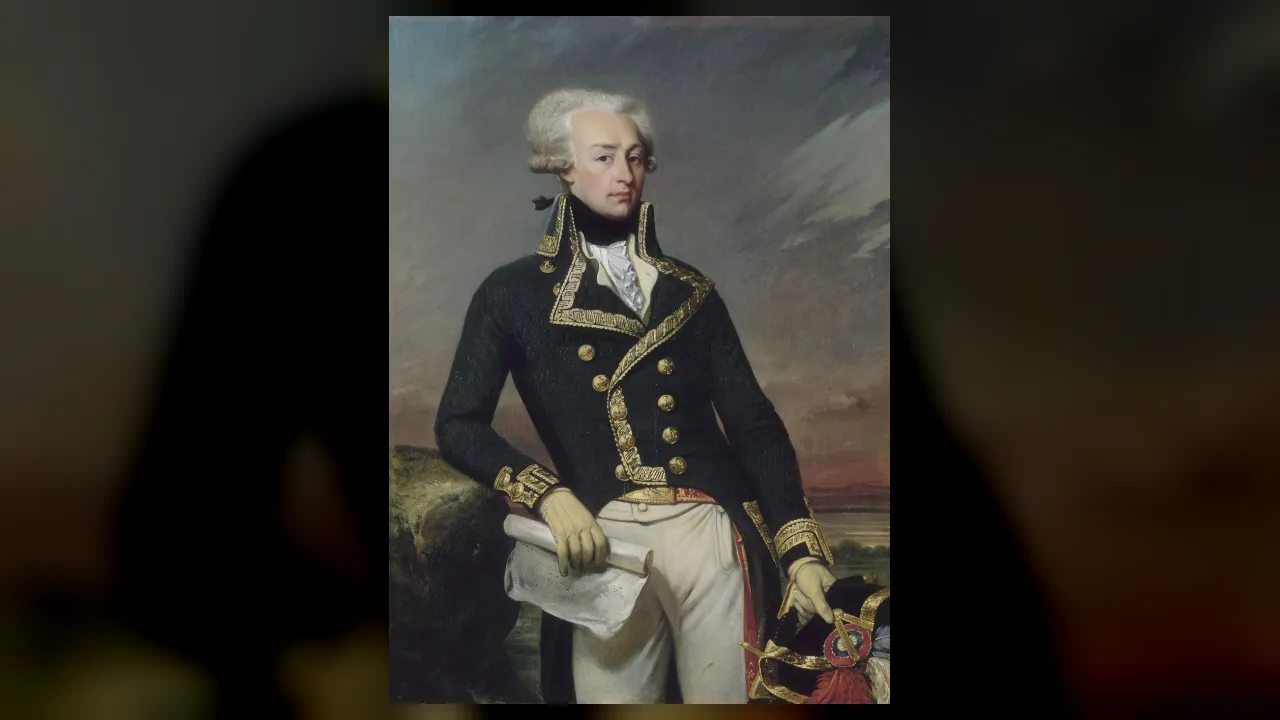
Marquis de Lafayette
Young French Hero of American Independence
Grade 2 • Developing • 113 words
⏳ Era / Statehood1757–1834 • American Revolutionary War (1777–1781) & 1824 Tour
🗺️ Region / CapitalChavaniac, France, Valley Forge & Yorktown, Virginia
📜 Key MilestoneServed George Washington without pay & cornered British forces at Yorktown
⚡ Historical SparkForged the vital French-American alliance that helped win independence at Yorktown, Virginia
🤯 Mind-Blowing Fact • Grade 1
Dozens of American towns, counties, parks, and colleges—from Fayetteville to Lafayette Square across from the White House—are named after the Marquis de Lafayette!
✨ Word Sparks (Grade 1 Glossary)
Tap 🔊 to hear
ally
A helpful friend who stands beside you
general
A top leader of an army
independence
Freedom for a country to rule itself
🪝
Why did a nineteen-year-old teenager sail all the way from France to help America win freedom?
1
Sailing for Freedom
Across the ocean in France, young Lafayette heard that Americans wanted to be free. At nineteen, he bought a ship named Victory and sailed to help!
2
Trusted by Washington
Lafayette asked for zero pay. George Washington loved him like a son. Even during freezing winter snow, Lafayette stayed right beside his soldiers.
3
Victory at Yorktown
Lafayette led brave troops across Virginia. He helped trap the British army at Yorktown so America could win !
1. From which country did the Marquis de Lafayette sail to help America?
2. How much pay did Lafayette ask for when he joined George Washington's army?
🤯 Mind-Blowing Fact • Grade 2
Lafayette admired General George Washington so deeply that he named his own son Georges Washington de Lafayette!
✨ Word Sparks (Grade 2 Glossary)
Tap 🔊 to hear
nobleman
A person born into high-ranking European royalty
fleet
A large group of ships sailing together
liberty
The freedom to live and choose fairly
🪝
How did a young French nobleman become George Washington's closest young partner during the American Revolution?
1
Buying His Own Ship
Imagine believing so strongly in that you buy a sailing ship at age nineteen to cross the Atlantic Ocean! In 1777, Gilbert du Motier, Marquis de Lafayette, left comfort in France, landed in South Carolina, and offered Congress his service without pay. Congress named him a Major General.
2
Bravery From Brandywine to Valley Forge
Wounded in his first battle at Brandywine, Lafayette calmly organized his troops before letting doctors treat his leg. Through the icy winter at Valley Forge, he shared hardships with American soldiers and bought them warm shoes and coats with his own money.
3
Winning at Yorktown, Virginia
In 1781, Lafayette outsmarted British General Cornwallis across Virginia, holding him at Yorktown until Washington and the French arrived to win the war!
1. What did Lafayette use his own money to buy for cold Continental soldiers?
2. In which Virginia town did Lafayette help corner General Cornwallis in 1781?
🤯 Mind-Blowing Fact • Grade 3
When Lafayette visited all twenty-four states in 1824–1825 as the 'Nation's Guest,' he spotted his old Virginia friend James Armistead Lafayette in a huge Richmond crowd, stopped his carriage, and hugged him warmly!
✨ Word Sparks (Grade 3 Glossary)
Tap 🔊 to hear
alliance
A formal partnership between friendly countries
double agent
A spy pretending to help the other side
peninsula
Land surrounded by water on three sides
🪝
How did Lafayette and a brave Virginia spy named James Armistead team up to outwit the British Army in 1781?
1
'My Heart Was Enrolled'
Picture a glittering banquet in Europe in 1775 where eighteen-year-old Marquis de Lafayette first hears about American colonists standing up for self-government. As he later wrote, 'At the first news of this quarrel, my heart was enrolled in it!' Buying the ship La Victoire in 1777, he crossed the Atlantic, became a Continental Major General at nineteen, and formed a lifelong father-and-son bond with George Washington.
2
Bringing French Ships and Troops
After proving his courage at Brandywine, Valley Forge, and Monmouth, Lafayette sailed back to France in 1779 to urge King Louis XVI to send more help. Thanks to his persuasive diplomacy, France dispatched thousands of soldiers under General Rochambeau and a powerful navy fleet.
3
Teamwork in Virginia
Sent to defend Virginia in 1781 against a much larger British army led by Lord Cornwallis, Lafayette worked closely with James Armistead—an enslaved Virginian who volunteered as a inside Cornwallis's camp! Armistead's secret reports helped Lafayette shadow Cornwallis straight to Yorktown.
4
The Nation's Guest
Following victory at Yorktown, Lafayette championed freedom for James Armistead—who proudly took the surname Lafayette! Nearly fifty years later, in 1824, millions cheered Lafayette during his grand tour of all twenty-four U.S. states.
1. Who gathered secret British plans in Virginia in 1781 to help Lafayette trap Cornwallis at Yorktown?
2. How many U.S. states did Lafayette visit during his celebrated 1824–1825 farewell tour?
🤯 Mind-Blowing Fact • Grade 4
At Lafayette's own wish, when he died in Paris in 1834, his son covered his grave at Picpus Cemetery with soil Lafayette had brought back in trunks from Bunker Hill in Massachusetts!
✨ Word Sparks (Grade 4 Glossary)
Tap 🔊 to hear
expeditionary
Sent overseas on a military mission
emancipate
To set an enslaved person legally free
testimonial
A written statement praising someone's loyal service
🪝
Why did Virginia's General Assembly place a marble bust of Lafayette in the Capitol in Richmond alongside George Washington?
1
Idealism Across the Atlantic
Listen to church bells pealing from Boston to Savannah in August 1824 as aging Revolutionary veterans weep with joy to welcome back the last surviving Major General of the Continental Army: the Marquis de Lafayette. Nearly half a century earlier, in June 1777, nineteen-year-old Gilbert du Motier had defied royal travel restrictions in France, financed his own vessel La Victoire, and landed near Georgetown, South Carolina. Volunteering without salary, he won George Washington's enduring trust through humility, discipline, and valor when wounded at the Battle of Brandywine.
2
Architect of Franco-American Cooperation
Enduring the brutal 1777–1778 winter at Valley Forge reinforced Lafayette's devotion to the Patriot cause. Returning briefly to Versailles in 1779, he lobbied French ministers to commit an army under the Comte de Rochambeau and naval squadrons under Admiral de Grasse—transforming a colonial rebellion into a coordinated international campaign.
3
The 1781 Virginia Campaign and James Armistead
Dispatched to Virginia in spring 1781 with just 1,200 light infantry, twenty-three-year-old Lafayette protected Richmond's supply depots and deftly maneuvered across the Piedmont to evade British General Charles Cornwallis's larger force. Crucial to Lafayette's success was intelligence supplied by James Armistead, an enslaved New Kent County Virginian who infiltrated Cornwallis's headquarters while feeding false dispatches to the British. Once Cornwallis fortified Yorktown along the York River, Lafayette held him on the peninsula until Washington and Rochambeau marched south and de Grasse sealed Chesapeake Bay, compelling British surrender on October 19, 1781.
4
Champion of Abolition and Constitutional Rights
Afterward, Lafayette wrote the glowing that persuaded the Virginia General Assembly in 1787 to James Armistead Lafayette, urged Washington to support gradual emancipation, co-authored France's 1789 Declaration of the Rights of Man with Thomas Jefferson's counsel, and unified Americans during his 1824–1825 tour.
1. How did Lafayette help James Armistead after the Revolutionary War ended?
2. How did Admiral de Grasse's French fleet help complete the trap Lafayette set in Virginia in October 1781?
🤯 Mind-Blowing Fact • Grade 5
In 2002, the U.S. Congress passed a joint resolution naming the Marquis de Lafayette only the sixth person in history—alongside figures like Winston Churchill and Mother Teresa—to be made an Honorary Citizen of the United States!
✨ Word Sparks (Grade 5 Glossary)
Tap 🔊 to hear
Fabian strategy
Wearing down stronger armies without risky pitched battles
Enlightenment
Historical era emphasizing reason, science, and rights
munitions
Military supplies such as gunpowder and tools
🪝
How did a nineteen-year-old French aristocrat become an indispensable military strategist in Virginia, a voice against slavery, and an honorary citizen of the United States?
1
Enlightenment Conviction and Continental Commission
Stand beneath the rotunda of the Virginia State Capitol in Richmond, where Jean-Antoine Houdon's marble bust of the Marquis de Lafayette faces his iconic statue of George Washington—twin monuments commissioned by the Commonwealth to honor the commanders who secured Virginia's deliverance in 1781. Born in 1757 at Château de Chavaniac in Auvergne, Marie-Joseph Paul Yves Roch Gilbert du Motier, Marquis de Lafayette, inherited immense wealth yet embraced ideals of constitutional liberty. Purchasing La Victoire at age nineteen despite royal prohibitions, he arrived at Philadelphia in July 1777, stipulating two conditions to the Continental Congress: to serve at his own expense and to begin as a volunteer. Commissioned a Major General on July 31, 1777, he quickly earned Washington's paternal affection and battlefield confidence after rallying retreating troops while wounded at Brandywine.
2
Valley Forge Loyalty and the Expédition Particulière
Remaining steadfast beside Washington at Valley Forge during the winter of 1777–1778 and commanding skillfully at Barren Hill and Monmouth, Lafayette proved an invaluable bridge after the February 1778 Treaty of Alliance with France. Granted leave to return to Versailles in early 1779, he persuaded Foreign Minister Vergennes and King Louis XVI not merely to supply funds, but to dispatch 5,500 French regulars under the Comte de Rochambeau alongside Caribbean naval support—the decisive strategic commitment of the war.
3
Strategic Mastery in the 1781 Virginia Campaign
Ordered south in February 1781, twenty-three-year-old Lafayette reached Richmond hours ahead of British raiders, saving critical . Outnumbered nearly three-to-one when Lord Cornwallis entered Virginia with over 7,000 veterans—who boasted 'the boy cannot escape me'—Lafayette conducted a textbook Fabian campaign of rapid marches across the Rapidan and Rivanna rivers until reinforced by Anthony Wayne and Baron von Steuben. Partnering with James Armistead, an enslaved New Kent County patriot acting as a double agent inside British lines, Lafayette tracked every British movement, fought fiercely at Green Spring near Jamestown, and bottled Cornwallis inside Yorktown until Washington, Rochambeau, and Admiral de Grasse converged to force surrender on October 19, 1781.
4
Transatlantic Reformer and Principled Abolitionist
Throughout the 1780s, Lafayette urged Washington to join him in emancipating enslaved laborers on experimental free estates, purchased plantations in French Guiana to educate and free workers, and authored the 1784 certificate that secured James Armistead Lafayette's statutory emancipation from Virginia's legislature in 1787. In 1789, consulting Minister Thomas Jefferson in Paris, Lafayette drafted France's Declaration of the Rights of Man and of the Citizen and later endured five years as a political prisoner at Olmütz for defending constitutional monarchy against extremism.
5
The 1824–1825 Farewell Tour and Honorary Citizenship
Invited by President James Monroe in 1824 as the 'Nation's Guest,' sixty-seven-year-old Lafayette traveled 6,000 miles across all twenty-four states over thirteen months, rekindling civic unity—visiting Jefferson at Monticello, Madison at Montpelier, Washington's tomb at Mount Vernon, and embracing James Armistead Lafayette in Richmond. In 2002, Congress posthumously proclaimed him one of history's rare Honorary Citizens of the United States.