1. How deep is the Mariana Trench compared to Mount Everest's height?
2. How much sunlight reaches the bottom of the Mariana Trench?
🤯 Mind-Blowing Fact • Grade 2
In 1960, explorers Jacques Piccard and Don Walsh took nearly five hours just to sink straight down to the bottom of Challenger Deep!
✨ Word Sparks (Grade 2 Glossary)
Tap 🔊 to hear
Challenger Deep
Deepest known valley slot inside Mariana Trench
Water Pressure
Heavy pushing force of deep water overhead
Crescent
Curved shape like a fingernail or banana
🪝
How can soft little fish survive water pressure as heavy as a stack of elephants?
1
Welcome to Challenger Deep
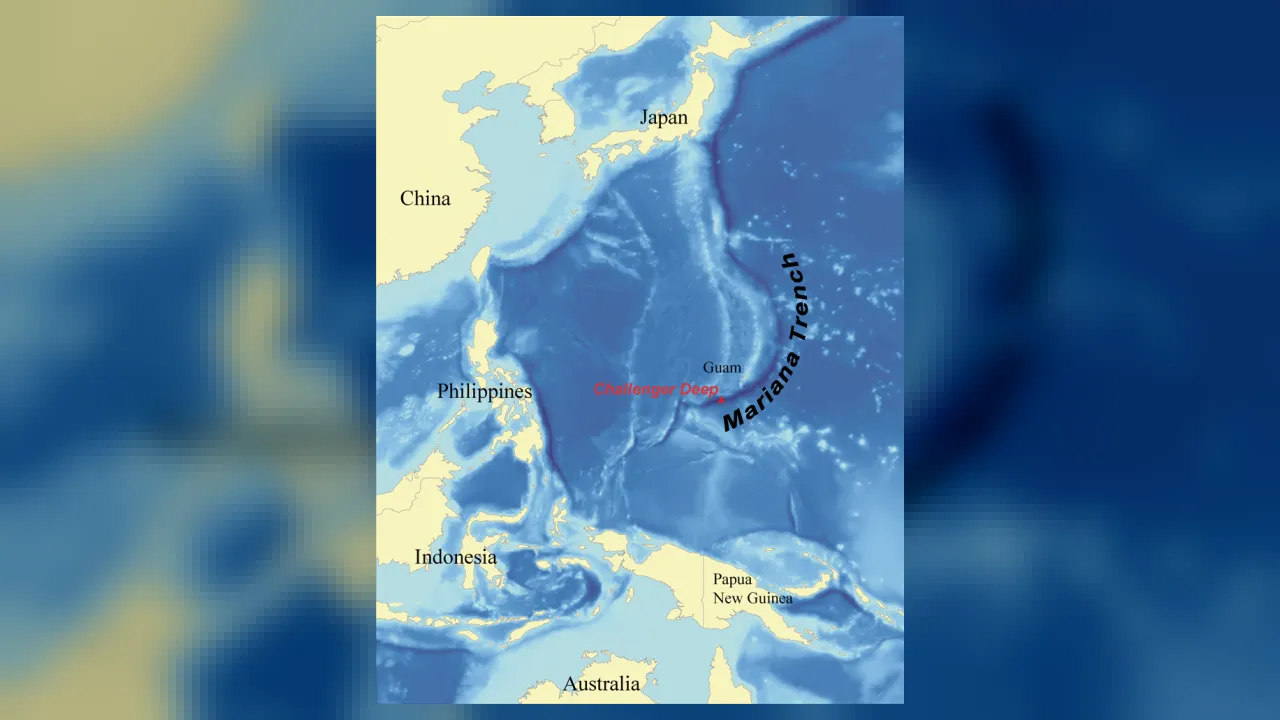
Shine a submarine spotlight across the curved floor of the western Pacific Ocean! Stretching 1,580 miles in a giant , the Mariana Trench holds Earth's deepest point—a slot named nearly 36,000 feet below the waves.
2
Crushing Water Weight
All seven miles of water overhead push down with tremendous force called ! At the bottom, the water squeezes over one thousand times harder than the air around your playground.
3
Built Without Air Pockets
Submarines need thick metal spheres so they won't squish, yet pale Mariana snailfish and shrimp-like amphipods glide effortlessly! Because their jelly-like bodies are filled with water instead of air spaces, the pressure cannot crush them.
1. What is the name of the deepest known spot inside the Mariana Trench?
2. Why don't soft Mariana snailfish get squished by extreme deep-sea pressure?
🤯 Mind-Blowing Fact • Grade 3
Many underwater volcanoes along the Mariana arc bubble out liquid carbon dioxide and yellow sulfur ponds instead of red lava!
✨ Word Sparks (Grade 3 Glossary)
Tap 🔊 to hear
Tectonic Plates
Giant moving slabs of Earth's rocky crust
Subduction
One heavy tectonic plate sliding under another
Sonar
Mapping underwater depths using bouncing sound echoes
🪝
What giant collision on the ocean floor dug a canyon five times longer than the Grand Canyon?
1
Crashing Tectonic Plates
Earth's outer rocky shell is cracked into giant puzzle pieces called that creep slowly across the planet. East of the Mariana Islands in the western Pacific, two ocean plates collide head-on! Because the older Pacific Plate is colder and heavier, it bends downward and slides underneath the Mariana Plate.
2
Subduction Carves a V-Shaped Trench
Geologists call this downward dive . Right where the giant slab bends into Earth's mantle, it pulls the seafloor down into a colossal V-shaped crease—carving the 1,580-mile-long Mariana Trench!
3
Mapping With Sound Waves
In 1875, sailors aboard HMS Challenger lowered weighted ropes miles overboard to discover the trench. Modern ships bounce sound waves off the seafloor, timing the echo to map Challenger Deep at roughly 10,935 meters (35,876 feet) deep!
4
Volcanic Islands Next Door
As the sinking plate melts deep underground, rising magma builds a curved chain of underwater volcanoes and islands—forming the Mariana Islands right beside the trench!
1. What geological process carved the Mariana Trench?
2. How do modern research ships measure the exact depth of Challenger Deep?
🤯 Mind-Blowing Fact • Grade 4
Xenophyophores living on the floor of the Mariana Trench are single-celled organisms that can grow four inches wide—as big as a softball made of just one cell!
✨ Word Sparks (Grade 4 Glossary)
Tap 🔊 to hear
Hadal Zone
Deepest ocean trench zone below 6,000 meters
Abyssal Plain
Vast flat sediment-covered deep ocean floor
Marine Snow
Tiny organic food flakes sinking from above
🪝
Where does an ocean trench fit on a map of the seafloor—and how do creatures survive without sunlight?
1
Journey Across the Ocean Floor
Imagine walking barefoot off a beach and strolling across a drained ocean basin! First you cross the gently sloping continental shelf, plunge down the steep continental slope and continental rise, and trek across flat three miles deep. Suddenly, at a convergent plate boundary, the floor drops another four miles into a narrow ocean trench—the deepest feature anywhere on Earth's crust!
2
Welcome to the Hadal Zone
Oceanographers name depths below 6,000 meters (20,000 feet) the . Inside the Mariana Trench, temperatures hover just above freezing (1°C to 4°C), while hydrostatic pressure reaches eight tons per square inch—like balancing fifty jumbo jets on a single person! Historic dives by the bathyscaphe Trieste in 1960, filmmaker-explorer James Cameron in 2012, and Victor Vescovo's titanium-hulled Limiting Factor proved engineered spheres can withstand that squeeze.
3
Marine Snow and Giant Single Cells
Without sunlight for photosynthesis, trench animals dine on ''—tiny flakes of organic detritus drifting down from sunlit waters miles above—or gather near chemical-rich seeps. Explorers even spotted fist-sized xenophyophores, giant single-celled organisms building fragile sand houses on the trench floor!
4
A Protected National Monument
In 2009, the United States established the Marianas Trench Marine National Monument, safeguarding over 95,000 square miles of trench, mud volcanoes, and coral islands for scientific discovery.
1. As you travel from a sandy beach out to the deepest ocean feature, which order of seafloor landforms do you cross?
2. Where do most animals living at the pitch-black bottom of the Mariana Trench get their food energy?
🤯 Mind-Blowing Fact • Grade 5
Fish hit a hard biochemical depth limit around 8,200 to 8,400 meters because deeper water requires more pressure-shielding TMAO molecules than seawater's own saltiness allows—leaving amphipods, sea cucumbers, and microbes to rule Challenger Deep's deepest floor!
✨ Word Sparks (Grade 5 Glossary)
Tap 🔊 to hear
Lithosphere
Rigid outer shell of crust and upper mantle
Chemosynthesis
Microbes making food energy from vent chemicals
Piezolyte
Cell molecule protecting proteins under extreme pressure
🪝
Why does 170-million-year-old oceanic crust plunge nearly straight down at the Mariana Trench—and what molecular trick keeps hadal cells working?
1
Oldest Oceanic Crust on Earth
Compare seafloor age maps across the globe, and a remarkable clue explains why the Mariana Trench out-depths every other canyon on Earth. Forged at a distant mid-ocean ridge roughly 170 to 180 million years ago, the western Pacific Plate here represents some of the oldest, coldest, and densest oceanic basalt still existing on our planet! Because it is markedly denser than the underlying asthenosphere, the slab sinks steeply—almost vertically at depth—beneath the overriding Mariana microplate, flexing the seafloor downward to ~10,935 meters (±15 meters by modern multibeam and pressure-sensor calibrations) at Challenger Deep.
2
Serpentinite Mud Volcanoes and Chemosynthesis
Measuring roughly 2,550 kilometers long and averaging 69 kilometers wide, the trench system hosts bizarre geology along its forearc wall. Seawater squeezed out of the subducting Pacific slab reacts with mantle peridotite rock to form slick green serpentinite mud, which erupts cold from towering seafloor mud volcanoes! Hydrogen and methane seeping from these vents feed chemosynthetic microbes that construct food webs completely independent of sunlight.
3
Piezolytes: Molecular Shields Against 1,086 Bars
At 10,935 meters, ambient hydrostatic pressure hits ~1,086 bars (108.6 megapascals, or ~15,750 pounds per square inch)—high enough to warp ordinary cell membranes and unfold vital enzymes! Hadal champions like the Mariana snailfish (Pseudoliparis swirei, filmed down to ~8,178 meters, below which fish physiology hits an osmotic ceiling) and giant amphipod Hirondellea gigas pack their cells with —especially trimethylamine N-oxide (TMAO), a small molecule that stabilizes water networks around proteins so enzymes keep flexing smoothly.
4
Sound Speed Corrections in Precision Mapping
Pinpointing Challenger Deep's exact meter count challenges hydrographers because sound speed in seawater varies with temperature, salinity, and extreme pressure (~1,640 meters per second at the bottom versus ~1,500 near the surface), requiring CTD profiler casts alongside full-ocean-depth landers.
5
Human Footprints in the Ultimate Abyss
Deep-sea landers have also delivered a sobering lesson in global stewardship: amphipods collected seven miles down in Challenger Deep carried microplastics and industrial pollutants in their guts—proving that even Earth's remotest hadal trench connects directly to surface oceans.