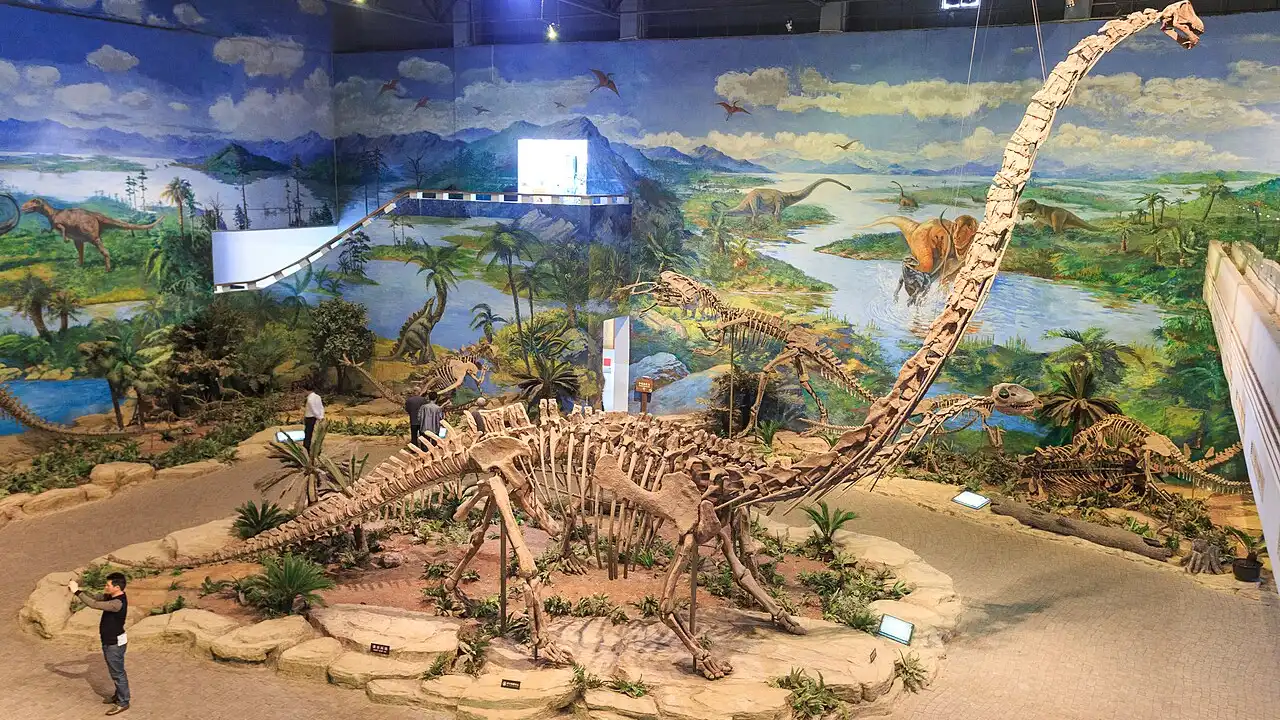
1. How much of Mamenchisaurus's total body length was just its neck?
2. What made its giant neck light enough to lift?
🤯 Mind-Blowing Fact • Grade 2
Humans have 7 neck bones and giraffes also have 7, while Mamenchisaurus had up to 19 super-long neck bones!
✨ Word Sparks (Grade 2 Glossary)
Tap 🔊 to hear
brace
a stiff rod supporting something from bending
highway
a wide main road built for travel
club
a heavy knob on a tail tip
🪝
How did road builders in China stumble across the longest neck in Earth's history?
1
Found While Building a Highway!
Clang, crunch! In 1952, road workers digging a mountain in Sichuan, China, hit strange giant stones. Paleontologists rushed over and uncovered a dinosaur whose neck stretched longer than its body and tail!
2
Nineteen Bones in One Neck
Humans and giraffes both have just seven neck bones. Mamenchisaurus packed nineteen extra-long vertebrae into its neck, braced underneath by thin bony rods like fiberglass tent poles!
3
A Tiny Club on Its Tail
At the other end, fused bones formed a small, bumpy tail to swat away hungry Jurassic predators while the herd grazed peacefully along sunny riverbanks.
1. How many neck vertebrae did Mamenchisaurus have compared with a giraffe's seven?
2. Who accidentally uncovered the very first Mamenchisaurus fossils in 1952?
🤯 Mind-Blowing Fact • Grade 3
X-ray scans proved that up to 77 percent of a Mamenchisaurus neck bone was empty air space, with outer bone walls sometimes thinner than a nickel!
✨ Word Sparks (Grade 3 Glossary)
Tap 🔊 to hear
volume
the total amount of space inside something
boom
a long, stiff crane arm reaching outward
overlap
extend partly over the next piece inline
🪝
How do you build a fifty-foot neck out of bone as thin as an eggshell without it snapping?
1
Honoring the Road Builders
When highway crews near Mamingxi Ferry in Sichuan, China, unearthed giant vertebrae in 1952, renowned paleontologist Yang Zhongjian named the fossil Mamenchisaurus constructus—honoring both the river crossing and the construction workers! Soon, even larger species turned up across China.
2
Record-Breaking Fifty-Foot Reach
In 2023, CT scans of the giant species Mamenchisaurus sinocanadorum showed its neck stretched 49.5 feet (15.1 meters) long—longer than a semi-truck trailer and the longest neck reliably measured on any animal ever!
3
Eggshell Walls and Thirteen-Foot Rods
How did it keep from toppling forward? Air sacs filled up to seventy-seven percent of each neck bone's , leaving outer bone walls just millimeters thin! Underneath, overlapping bony cervical ribs up to thirteen feet long stiffened the neck into a steady horizontal .
4
Sweeping Forest Canopies
Holding its neck at a gentle upward angle, Mamenchisaurus swept spoon-shaped teeth through ginkgo and conifer groves while barely moving its feet.
1. Roughly how much of each Mamenchisaurus neck vertebra was filled with air spaces?
2. How did thirteen-foot overlapping neck ribs affect how Mamenchisaurus moved its neck?
🤯 Mind-Blowing Fact • Grade 4
One single bony neck-rib rod from Mamenchisaurus sinocanadorum measured 13.5 feet (4.1 meters) long—the longest cervical rib ever found in any dinosaur!
✨ Word Sparks (Grade 4 Glossary)
Tap 🔊 to hear
endemic
native and unique to one geographic region
windpipe
the breathing tube carrying air to lungs
incline
a gentle upward slope or tilt angle
🪝
How could Mamenchisaurus breathe fresh air down a fifty-foot windpipe without suffocating on its own stale breath?
1
Isolated Giants of Jurassic Asia
During the Late Jurassic around 155 million years ago, shallow seas separated East Asia from North America and Europe. Inside China's lush river basins, an family of sauropods called Mamenchisauridae took neck elongation to extremes never matched anywhere else on Earth.
2
Solving the 'Dead Space' Breathing Puzzle
Think about breathing through a fifty-foot garden hose: if you had mammal lungs that inhale and exhale back and forth, you would simply re-breathe the stale air trapped inside the hose! Paleontologists solved this mystery when CT scans revealed extensive bird-like air sacs invading Mamenchisaurus vertebrae. Just like modern birds, one-way airflow looped fresh oxygen continuously through its lungs, powering gigantic with ease!
3
CT Scans Confirm a Fifteen-Meter Record
In 2023, researchers led by Andrew Moore used medical CT scanners to peer inside rock-encased vertebrae of Mamenchisaurus sinocanadorum from Xinjiang's Shishugou Formation. Reconstructing all nineteen cervical segments yielded a record-setting 15.1-meter (49.5-foot) neck held at a shallow twenty-to-thirty-degree above the Late Jurassic ground.
4
Spiky Tail Tip Surprise
Excavations of Mamenchisaurus hochuanensis also uncovered fused terminal tail vertebrae forming a knobby bony tail club—an unexpected rear weapon against large sinraptorid predators like Yangchuanosaurus that patrolled China's lush floodplain forests alongside early feathered dinosaurs!
1. Why didn't Mamenchisaurus suffocate on stale air trapped inside its fifty-foot windpipe?
2. What surprising weapon was discovered at the tip of the tail in Mamenchisaurus hochuanensis?
🤯 Mind-Blowing Fact • Grade 5
Even though individual neck vertebrae in Mamenchisaurus sinocanadorum grew bigger than beer kegs, CT scans proved their outer bone walls were just 2 to 4 millimeters thick—roughly the thickness of two stacked pennies!
✨ Word Sparks (Grade 5 Glossary)
Tap 🔊 to hear
cantilever
a long beam anchored at one end
trachea
scientific name for the main breathing windpipe
ossified
soft tendon tissue hardened into stiff bone
🪝
How did hospital CT scanners and cantilever engineering explain how Mamenchisaurus sinocanadorum supported a 15.1-meter neck with millimeter-thin bone?
1
From Sichuan Road Cut to Asian Sauropod Dynasty
Discovered in 1952 during highway blasting at Mamingxi Ferry in Sichuan's Upper Shaximiao Formation and described in 1954 by Yang Zhongjian (C. C. Young), Mamenchisaurus constructus launched research into East Asia's isolated Late Jurassic mamenchisaurid radiation. Subsequent discoveries—including multiple skeletons of 22-meter Mamenchisaurus hochuanensis and the colossal Xinjiang species Mamenchisaurus sinocanadorum unearthed by a 1987 Sino-Canadian expedition—revealed necks occupying fully half of total body length.
2
Quantifying the 15.1-Meter Record Neck
In 2023, Andrew J. Moore, Paul Upchurch, Xu Xing, and colleagues published a landmark osteological and CT analysis of Mamenchisaurus sinocanadorum, scaling its preserved anterior skeleton against complete close relative Xinjiangtitan. Their reconstruction confirmed 18 to 19 hyper-elongated cervical vertebrae totaling 15.1 meters (49.5 feet)—more than six times the neck length of the tallest giraffe and the longest reliably documented neck in metazoan history.
3
Extreme Pneumaticity and Ossified Tendon Rods
CT slices revealed that respiratory diverticula excavated between 69 and 77 percent of the total volume of individual cervical vertebrae, reducing external cortical bone walls to mere 2-to-4-millimeter shells reinforced by internal trabecular struts. Ventrally, cervical ribs stretched up to 4.1 meters across three consecutive intervertebral joints—acting as tension-compression bracing rods that traded swan-like flexibility for energy-efficient horizontal cantilevering at a 20-to-30-degree elevation.
4
Overcoming Tracheal Dead Space
A 15-meter creates immense anatomical 'dead space' volume; only high-capacity abdominal air sacs driving unidirectional parabronchial ventilation—matching extant birds—could exchange enough fresh oxygen per breath to sustain a 35-to-50-metric-ton metabolism.
5
Spatulate Dentition and Caudal Clubbing
Equipped with robust spatulate teeth along a compact skull for cropping araucarian and podocarp foliage—and, in M. hochuanensis, fused terminal caudals forming an expanded sensory-defensive tail club—Mamenchisaurus mastered low-cost, wide-radius foraging across Jurassic China.