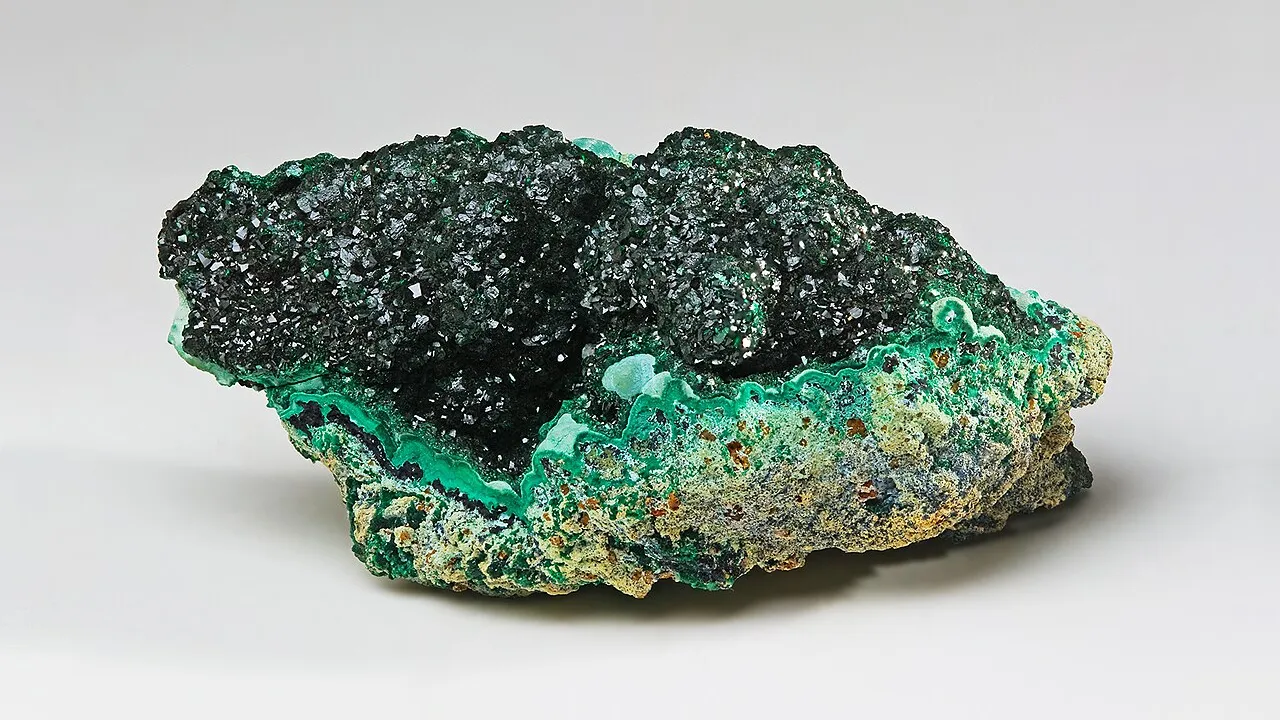
1. What pattern makes polished malachite so easy to recognize?
2. Which metal gives malachite—and the weathered Statue of Liberty—its green color?
🤯 Mind-Blowing Fact • Grade 2
Inside the Winter Palace in Saint Petersburg, Russia, there is an entire 'Malachite Room' where towering columns and fireplaces are covered in swirling green malachite!
✨ Word Sparks (Grade 2 Glossary)
Tap 🔊 to hear
stalactite
An icicle-shaped mineral hanging from cave ceilings
prospector
An explorer who searches rocks for metals
carbonate
A mineral containing carbon and oxygen groups
🪝
How did bright green malachite rocks help ancient humans enter the Metal Age?
1
Green Treasure Maps
Six thousand years ago, early scanning rocky hillsides looked for bright green stains on cliffs. Whenever they spotted malachite on the surface, they knew rich copper ore was hiding right underneath!
2
Campfire Surprise
Even better, tossing chunks of green malachite into a roaring charcoal fire melted pure, shiny red copper metal out of the stone! That discovery helped launch the Copper and Bronze Ages.
3
Velvety Bubbles and Columns
Inside underground pockets in central Africa and Arizona, malachite drips like green candle wax into rounded grape-like clusters and icicle-shaped .
1. What happened when ancient people heated green malachite in hot charcoal fires?
2. What did green malachite stains on a hillside tell early miners?
🤯 Mind-Blowing Fact • Grade 3
Geologists call bubbly, rounded clusters of malachite 'botryoidal,' which comes from the ancient Greek word for a bunch of grapes!
✨ Word Sparks (Grade 3 Glossary)
Tap 🔊 to hear
botryoidal
Shaped like smooth rounded bunches of grapes
azurite
A deep-blue copper mineral cousin of malachite
effervesce
To fizz and bubble by releasing gas
🪝
What happens if a geologist puts a tiny drop of weak acid onto a piece of malachite?
1
Fizz! The Carbonate Bubble Test
Place a tiny drop of dilute acid on a scrap of rough malachite in a science lab and watch closely: fizzzz! Tiny bubbles of carbon dioxide gas pop right on the surface. That fizz proves malachite is a carbonate mineral—specifically copper carbonate, Cu2CO3(OH)2!
2
Grape-Bunch Botryoidal Shapes
When copper-rich water seeps into limestone caves in the Democratic Republic of the Congo or Namibia, malachite grows layer after layer into smooth, bubbly mounds. Geologists call this rounded grape-bunch shape ',' from the Greek word for a bunch of grapes!
3
Best Friends With Blue Azurite
Malachite often grows right alongside its electric-blue twin cousin, ! Over time, moist air slowly turns deep blue azurite crystals into silky green malachite while keeping the exact crystal shape.
4
Soft Stone Polish
At 3.5 to 4 on the Mohs Hardness Scale—about as hard as a copper penny—malachite carves easily into ornate boxes, beads, and museum spheres, though stonecutters wear masks so they never breathe copper dust.
1. Why does malachite fizz and bubble when touched with dilute acid?
2. Which deep-blue copper mineral often grows right next to green malachite?
🤯 Mind-Blowing Fact • Grade 4
When sliced sideways, cave stalactites of malachite reveal concentric bull's-eye rings that record ancient wet and dry seasons in underground groundwater!
✨ Word Sparks (Grade 4 Glossary)
Tap 🔊 to hear
concentric
Circles sharing the exact same center point
patina
Protective green mineral film on weathered copper
smelt
To heat mineral ore to extract metal
🪝
Why do sliced malachite stalactites have dark and light green rings just like a cut tree trunk?
1
Seasonal Pulses Underground
Slice crosswise through a malachite cave stalactite from Katanga's Copperbelt in central Africa and you will see dozens of bull's-eye rings alternating between dark forest green and pale mint green! Those bands record changing underground weather: as wet and dry seasons shift groundwater chemistry and copper concentration, faster pulses precipitate pale, tiny micro-crystals that scatter white light, while slower growth packs dense, dark-green radiating needles.
2
Limestone Meets Copper Sulfide
Where do all those carbonate ions come from? When oxygenated rainwater weathers deep copper sulfide ores (like chalcopyrite), acidic copper solutions trickle into neighboring limestone or dolomite beds. Neutralizing the acid dissolves calcium carbonate and precipitates vibrant green Cu2CO3(OH)2.
3
Virginia Blue Ridge Copper Clues
Along Virginia's Blue Ridge Catoctin greenstone formations and Piedmont copper prospects, green malachite coatings on fractured metabasalt guided 19th-century Virginia geologists to historic copper veins.
4
Green Pigment and Patina Science
Ground malachite painted green foliage in medieval manuscripts and Japanese screens for centuries, while urban chemists study copper carbonate protecting historic bronze roofs against corrosion. In classroom mineral testing, malachite stands out with its pale green powder streak, silky-to-earthy luster, high copper weight, and brisk carbon-dioxide fizz under weak hydrochloric acid.
1. What creates the alternating light-green and dark-green bull's-eye bands inside malachite?
2. What is malachite's scratch hardness on the Mohs scale?
🤯 Mind-Blowing Fact • Grade 5
Nineteenth-century Russian artisans covered thirty-foot palace columns with wafer-thin jigsaw puzzle slices of malachite matched so seamlessly along every green swirl that visitors thought the columns were carved from single giant boulders!
✨ Word Sparks (Grade 5 Glossary)
Tap 🔊 to hear
pseudomorph
One mineral replacing another while keeping its shape
chatoyancy
Silky cat's-eye shimmer from parallel mineral fibers
metallurgy
The science of extracting and working metals
🪝
How can one crystal look faceted like blue azurite on the outside yet be 100 percent silky green malachite on the inside?
1
Pseudomorphs: Chemical Replacement in Disguise
Hold a sharp, chisel-edged monoclinic crystal from Tsumeb, Namibia, that shines velvety forest green instead of blue. Geologists call this marvel a ''—literally 'false form'! Deep in an arid oxidized pocket, blue azurite—Cu3(CO3)2(OH)2—crystallized first under high dissolved carbon-dioxide pressure. Later, fresher, moister groundwater flushed through, driving a subtle hydration reaction that released CO2 and converted every molecule into malachite—Cu2CO3(OH)2—while preserving azurite's exact external crystal faces millimeter for millimeter!
2
Thermodynamics of the Oxidized Copper Zone
Why is green malachite far more widespread at Earth's surface than blue azurite? Geochemical phase diagrams show that under normal atmospheric carbon-dioxide partial pressure, malachite is the thermodynamically stable copper hydroxy-carbonate! Azurite forms only in dry, confined pockets where CO2 gas cannot easily escape; once erosion exposes veins to humid air, azurite inevitably hydrates toward malachite.
3
Chatoyant Velvet Needles and Russian Veneer
Rare fibrous malachite sprays exhibit —a shimmering cat's-eye sheen reflecting off tightly parallel monoclinic acicular needles. Nineteenth-century Russian lapidaries invented 'Russian mosaic': sawing scarce Ural Mountain malachite nodules into two-millimeter wafers and matching curved bands edge-to-edge over giant cast-iron columns so seamlessly they looked carved from solid multi-ton boulders!
4
Dawn of Metallurgy at Timna and Sinai
Unlike deeper copper sulfide ores that required complex multi-stage roasting to drive off sulfur, oxide-zone malachite reduces directly with carbon monoxide inside simple charcoal blowpipe furnaces at 1,100 degrees Celsius—enabling Chalcolithic metallurgists in the Levant and Serbia by 5000 BCE to cast humanity's earliest smelted metal tools.
5
Optical and Streak Diagnostics
Containing nearly 57.5 percent elemental copper by weight, malachite has high specific gravity (3.6 to 4.0) for a non-metallic carbonate and leaves a diagnostic pale-green streak. Modern exploration geologists map spectral reflectance from orbiting satellites to spot surface malachite alteration halos that point directly toward buried copper ore bodies across remote desert mountain ranges.