2. How did Maiasaura keep its eggs warm without squashing them?
🤯 Mind-Blowing Fact • Grade 2
One fossil bonebed in Montana preserves a herd of roughly ten thousand Maiasaura buried together by volcanic ash!
✨ Word Sparks (Grade 2 Glossary)
Tap 🔊 to hear
abandon
to leave behind and not come back
bonebed
a rock layer packed with many fossils
ash
fine gray powder blown from a volcano
🪝
How did one fossil nest in Montana change everything we thought about dinosaur families?
1
Welcome to Egg Mountain
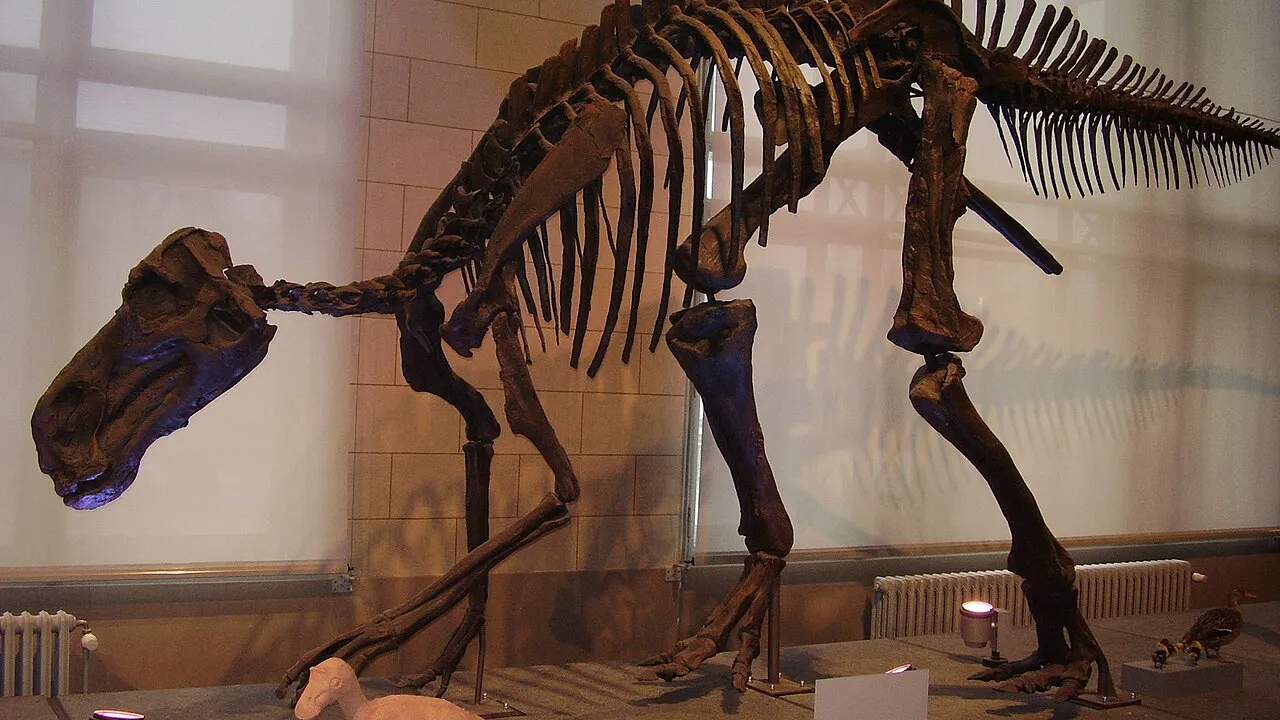
Step gently between dozens of round mud mounds! Seventy-seven million years ago in Montana, huge herds of Maiasaura gathered at the same nesting ground year after year. Each nest was spaced about one adult body length apart so parents would not step on a neighbor's eggs.
2
Clues from Baby Teeth
Scientists used to think all dinosaurs abandoned their eggs like sea turtles. Then they found baby Maiasaura bones inside nests with crushed eggshells! The babies had soft leg bones, yet their tiny teeth were already worn down from chewing.
3
Growing Up Together
Because the babies could not leave the nest yet, parents must have carried food back to them! Once strong enough, young Maiasaura marched beside thousands of adults in a bustling herd.
1. Why were Maiasaura nests spaced about thirty feet apart?
2. What proved that baby Maiasaura ate inside the nest before walking away?
🤯 Mind-Blowing Fact • Grade 3
In 1985, a piece of Maiasaura bone and eggshell flew aboard the Space Shuttle Challenger, making it the first dinosaur fossil in space!
✨ Word Sparks (Grade 3 Glossary)
Tap 🔊 to hear
incubate
to keep eggs warm until they hatch
juvenile
a young animal that is not grown
compost
rotting plants that give off gentle heat
🪝
What happened inside a rock shop in 1978 that rewrote dinosaur science forever?
1
A Game-Changing Discovery
Imagine peeking into a cardboard box of tiny fossils in Montana and spotting the skull of a baby dinosaur! In 1978, paleontologists Jack Horner and Robert Makela traced those bones to a hillside later nicknamed Egg Mountain. There they uncovered mud nests, grapefruit-sized eggs, and fifteen-inch belonging to a new duck-billed dinosaur they named Maiasaura.
2
Clever Nest Engineering
Weighing up to three tons, an adult Maiasaura could never sit directly on fragile eggs like a robin. Instead, mothers hollowed out six-foot bowls in soft soil, arranged up to twenty oval eggs in neat spirals, and heaped shredded ferns on top. As those damp plants decayed, natural heat incubated the clutch.
3
Busy Nursery Life
Inside the nest, hatchlings trampled their empty eggshells into tiny fragments over many weeks. Parents delivered tender shoots, seeds, and berries while guarding the colony against sneaky egg thieves like Troodon.
4
Built for Herd Life
Adult Maiasaura sported a wide duck-like beak and a short, solid bony ridge right above the eyes, likely used for gentle head-pushing contests or recognizing herd mates.
1. Why were the eggshells inside Maiasaura nests smashed into tiny bits?
2. What feature sat right above the eyes of an adult Maiasaura?
🤯 Mind-Blowing Fact • Grade 4
A young Maiasaura grew nearly ten feet during its very first year of life—faster than almost any living reptile on Earth!
✨ Word Sparks (Grade 4 Glossary)
Tap 🔊 to hear
altricial
hatched helpless and needing care from parents
cartilage
firm flexible tissue at the ends of bones
upland
higher dry ground away from swampy lowlands
🪝
How did volcanic eruptions and microscopic bone studies reveal the full life story of Maiasaura?
1
Colonial Nesting on Ancient Uplands
Picture an plain bordered by smoking volcanoes in western Montana seventy-seven million years ago. Every breeding season, vast herds of Maiasaura returned to elevated, well-drained nesting grounds preserved today in the Two Medicine Formation. By nesting in tightly packed colonies like modern seabirds, hundreds of watchful adults could spot prowling tyrannosaurs or small theropod nest raiders long before they reached the eggs.
2
Forensic Clues in Cartilage and Enamel
When Laurie Trexler, Jack Horner, and Robert Makela examined juvenile skeletons from Egg Mountain, two anatomical details stood out immediately. First, the ends of the babies' leg bones still held spongy hollows rather than hard finished joints, proving newly hatched youngsters were —unable to walk far on their own. Second, distinct wear facets on their miniature dental batteries proved they were already grinding tough plant fibers delivered by attentive adults.
3
Turbocharged Growth Rates
Because staying small in a Cretaceous ecosystem was risky, Maiasaura grew at breathtaking speed. Microscopic bone rings reveal warm-blooded growth rates similar to modern birds: a hatchling just over one foot long stretched past ten feet within its first year and reached adult size in roughly seven to eight years!
4
Mega-Herds Preserved in Ash
Nearby bonebeds preserve thousands of individuals from yearlings to elders buried together after a massive volcanic ashfall, confirming that youngsters joined multi-generational herds as soon as they left the nursery.
1. Why did Maiasaura choose dry upland plains for their nesting colonies?
2. What does rapid first-year bone growth tell scientists about Maiasaura?
🤯 Mind-Blowing Fact • Grade 5
Layered rock levels at Egg Mountain show that Maiasaura herds returned to nest on the exact same patch of Montana ground across multiple generations!
✨ Word Sparks (Grade 5 Glossary)
Tap 🔊 to hear
histology
studying thin slices of tissue under microscopes
ossified
hardened from soft tissue into solid bone
fidelity
faithfully returning to the same place repeatedly
🪝
Why did the 1978 discovery of Maiasaura launch a scientific revolution in how we view dinosaur behavior and physiology?
1
Rewriting Reptilian Stereotypes
For more than a century after dinosaurs were first named, textbooks portrayed them as sluggish, solitary reptiles that buried clutches of eggs and lumbered away without a backward glance. That view shattered in 1978 in Bynum, Montana, when paleontologists Jack Horner and Robert Makela inspected tiny hadrosaur bones found by Marion Brandvold and identified an intact baby skull discovered by Laurie Trexler. Naming the species Maiasaura peeblesorum in 1979, the team unveiled the first unmistakable fossil proof of extended dinosaurian parental care.
2
Architecture of Egg Mountain
Excavations in the Campanian-age Two Medicine Formation revealed stacked horizons of fossilized nesting colonies, demonstrating nest-site across generations. Each circular crater measured roughly two meters wide and nearly one meter deep, spaced seven meters apart—precisely the length of an adult Maiasaura. Up to twenty oblong, ridged eggs stood upright in concentric rings, warmed by fermenting vegetation rather than parental body weight.
3
Histology of Helpless Hatchlings
Bone —the microscopic study of sliced fossil bone—supplied decisive biomechanical evidence. Hatchling femora possessed poorly articular surfaces and large vascular canals, indicating rapid growth paired with weak early locomotion. Meanwhile, pulverized eggshell carpets and heavily abraded neonatal teeth confirmed that nestlings remained home for weeks or months, subsisting on regurgitated or sheared foliage carried in by adults.
4
Life History Inside a Ten-Thousand-Strong Herd
Adjacent volcanic ash bonebeds spanning more than a mile contain an estimated ten thousand Maiasaura individuals. Curiously, tiny hatchlings are absent from the herd deposit while nine-foot yearlings and thirty-foot adults abound, capturing the exact season after juveniles graduated from nesting grounds into migratory mega-herds.
5
Surviving High Mortality Through Teamwork
Growth curves show high mortality during the first twelve months and again around maturity, yet cooperative colonial defense, rapid endothermic-style growth, and sheer herd numbers made Maiasaura an ecological powerhouse of Late Cretaceous North America.