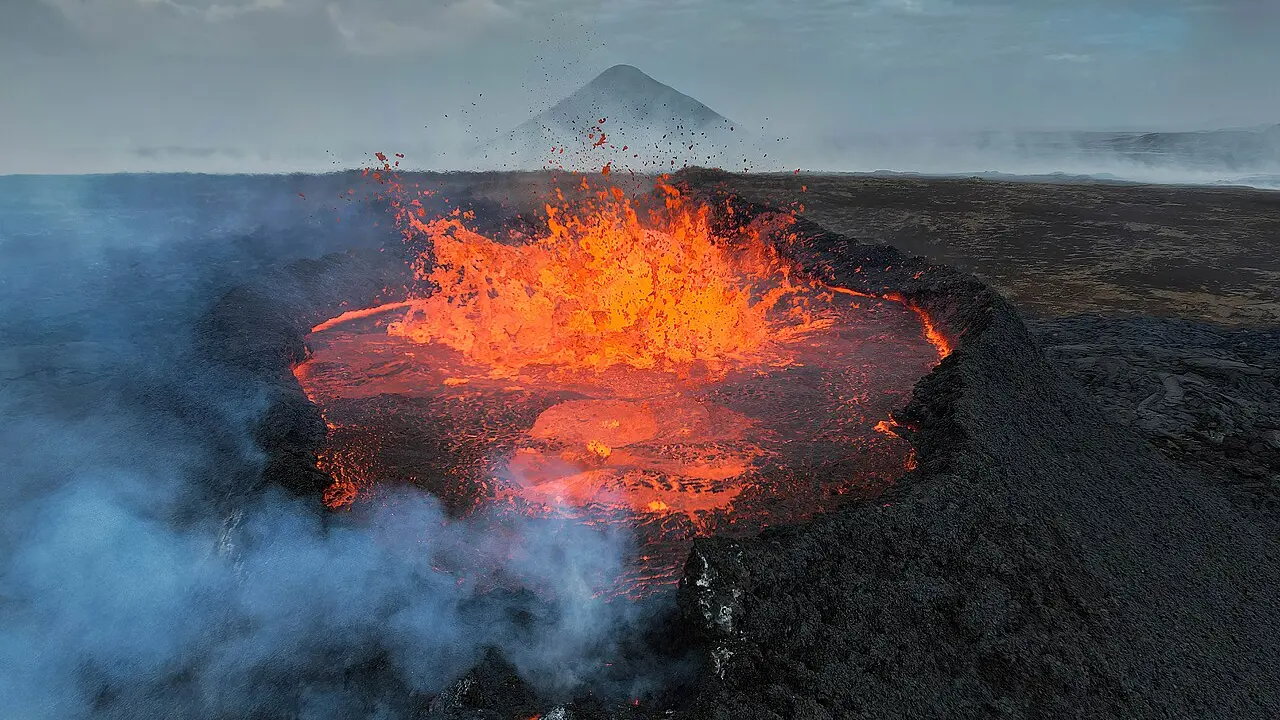
1. What is the main difference between magma and lava?
2. What happens to lava after it flows outside into cool air or ocean water?
🤯 Mind-Blowing Fact • Grade 2
When lava chills super fast in air or water, crystals have zero time to grow—creating razor-sharp black volcanic glass called obsidian!
✨ Word Sparks (Grade 2 Glossary)
Tap 🔊 to hear
granite
Speckled rock cooled slowly from underground magma.
obsidian
Shiny black volcanic glass cooled fast from lava.
chamber
Large underground space holding hot liquid magma.
🪝
How can you tell just by looking at a rock whether it cooled from underground magma or outdoor lava?
1
Location Changes Everything
Picture yourself wearing a warm winter coat indoors, then stepping out into chilly wind! Melted rock goes through an even bigger change when it leaves underground tunnels. Beneath the surface it is magma; out in open air or seawater, it becomes lava.
2
Trapped Gases Escape
Deep underground, heavy rock presses down on magma and traps fizzy gases inside. As soon as lava reaches the surface, those gases hiss and bubble away into the sky.
3
Big Crystals vs. Tiny Grains
Magma trapped underground stays warm for thousands of years, giving mineral crystals plenty of time to grow big and sparkly—like speckled kitchen ! Lava chills fast outside, forming tiny grains or shiny black volcanic glass.
1. Why does granite have big, easy-to-see crystals?
2. What smooth, shiny black rock forms when lava cools so fast that no crystals can grow?
🤯 Mind-Blowing Fact • Grade 3
Virginia's famous rocky summit of Old Rag Mountain is made of granite that cooled from underground magma more than a billion years ago!
✨ Word Sparks (Grade 3 Glossary)
Tap 🔊 to hear
igneous
Rock formed when magma or lava cools solid.
intrusive
Igneous rock cooled slowly beneath Earth's surface.
extrusive
Igneous rock cooled quickly on Earth's surface.
🪝
Did you know most magma never makes it out of a volcano at all?
1
A Three-Part Slush
Touch a cold granite countertop or pick up a dark basalt cobblestone—both started out as blazing-hot melted rock! Underground magma isn't just pure liquid; it is actually a three-part slush of melted silicate rock, floating mineral crystals, and dissolved gases like steam.
2
Intrusive vs. Extrusive Igneous Rocks
Surprisingly, most magma never erupts! Instead, it cools slowly miles underground to form rocks like granite, exposed millions of years later when erosion wears away softer rock above—just like Yosemite's Half Dome or Virginia's Old Rag Mountain.
3
Degassing on the Surface
Magma that reaches the surface becomes lava, cooling quickly into rocks such as basalt, pumice, and rhyolite. Losing its dissolved gases changes how lava flows and hardens.
4
Judging Heat by Glow Color
Volcanologists can estimate lava's temperature by its glow: bright yellow-orange lava blazes around 1,150 °C, cherry-red lava cools near 800 °C, and cooled crust turns charcoal black!
1. What do geologists call igneous rocks that cool slowly underground from magma?
2. Which glowing lava color shows the hottest temperature?
🤯 Mind-Blowing Fact • Grade 4
Contrary to movie myths, Earth's mantle is NOT a giant ocean of liquid magma—it is solid, super-hot rock that melts only in special zones!
✨ Word Sparks (Grade 4 Glossary)
Tap 🔊 to hear
pluton
Large body of magma cooled deep inside crust.
rhyolite
Fine-grained pale lava rock matching granite's chemistry.
felsic
Light-colored magma rich in silica and feldspar.
🪝
How can the exact same chemical batch of melted rock cool into pink-and-black granite underground OR pale grey rhyolite on a mountainside?
1
More Than Just a Name Change
At first glance, 'magma' versus 'lava' sounds like a simple vocabulary rule for Virginia Earth science: subsurface melt is magma, and erupted melt is lava. Yet crossing Earth's surface triggers dramatic physical changes! Deep inside the crust or upper mantle, crushing pressure keeps up to 5 to 7 percent water vapor, carbon dioxide, and sulfur dioxide dissolved inside magma. Once magma vents as lava, pressure plummets and those gases escape—turning lava far denser and more sluggish than the gas-rich magma it came from.
2
Chemical Twins, Different Textures
Because cooling rate controls crystal size, identical magma chemistries produce completely different rock twins depending on whether they freeze inside (intrusive) or outside (extrusive). Silica-rich melt that cools over hundreds of thousands of years inside a deep grows interlocking quartz, feldspar, and mica crystals to become granite; erupted as lava, that exact same chemistry chills rapidly into fine-grained , frothy pumice, or glassy obsidian!
3
Basalt and Gabbro Twins
Dark, iron-and-magnesium-rich mafic melt behaves the same way: erupted onto Hawaii or mid-ocean ridges, lava chills into fine-grained basalt; trapped deep in underground chambers, magma crystallizes into coarse-grained gabbro.
4
Why Earth's Mantle Isn't an Ocean of Magma
A common myth pictures continents floating on a global ocean of liquid magma. In reality, seismic waves prove Earth's mantle is almost entirely solid rock—melting into pockets of magma only where pressure drops, water enters, or hotspots add intense heat!
1. Which fine-grained extrusive lava rock has the exact same chemical makeup as intrusive granite?
2. How do scientists know Earth's mantle is mostly solid rock rather than a global liquid magma ocean?
🤯 Mind-Blowing Fact • Grade 5
Ol Doinyo Lengai in Tanzania is the only active volcano on Earth erupting carbonatite lava—so 'cool' at 510 °C that it flows like black motor oil in daylight and weathers chalk-white overnight!
✨ Word Sparks (Grade 5 Glossary)
Tap 🔊 to hear
porphyritic
Igneous rock with big crystals inside fine grain.
Bowen's Reaction Series
Predictable temperature order in which magma minerals crystallize.
batholith
Massive body of solidified magma forming mountain cores.
🪝
How does Bowen's Reaction Series explain why one single underground magma chamber can erupt several different kinds of lava over its lifetime?
1
Three-Phase Silicate Melts and Volatiles
In igneous petrology, magma is defined as a high-temperature (650 °C to 1,300 °C) multiphase mixture beneath Earth's surface: a liquid melt dominated by silicon-oxygen (`SiO4`) ions, suspended solid mineral crystals, and dissolved volatile compounds (`H2O`, `CO2`, `SO2`, `HCl`, `HF`). Under lithostatic pressures of hundreds of megapascals, volatiles stay dissolved and act as chemical fluxing agents that depolymerize silica chains and lower magma viscosity. When magma breaches the surface to become lava, rapid decompression causes volatile exsolution—transforming melt chemistry, density, and flow behavior instantaneously.
2
Nucleation, Crystal Growth, and Porphyritic Clues
Texture records thermal history. Deep inside insulated and plutons, magma cools at mere degrees per millennium; slow atomic diffusion builds coarse phaneritic crystals visible to the naked eye (granite, diorite, gabbro). Conversely, extruded lava loses heat rapidly by radiation and convection, yielding microscopic aphanitic textures (rhyolite, andesite, basalt) or amorphous glass (obsidian). What if magma begins crystallizing slowly underground and THEN erupts? The resulting '' lava rock preserves large early crystals (phenocrysts) frozen inside a fine-grained groundmass!
3
Bowen's Reaction Series
Early in the 1900s, Canadian petrologist Norman L. Bowen melted rocks in laboratory furnaces and discovered minerals crystallize in a predictable cooling sequence. High-temperature minerals like olivine and calcium-rich plagioclase crystallize first (~1,200 °C) and can settle to the chamber floor, leaving remaining magma progressively enriched in silica, sodium, and potassium until quartz crystallizes last (~700 °C).
4
Exotic Non-Silicate Lavas
Not every lava on Earth glows orange! Tanzania's Ol Doinyo Lengai erupts rare natrocarbonatite—a baking-soda-rich carbonate lava at a cool ~510 °C that looks jet-black in sunlight and turns snowy white within days of absorbing moisture.
5
Cryolavas Beyond Earth
Across icy moons like Saturn's Enceladus and Neptune's Triton, subsurface 'cryomagma' made of liquid water, ammonia, and methane erupts onto frozen surfaces as exotic icy lava!
1. What story does a 'porphyritic' volcanic rock (large crystals set inside a microscopic-grained background) tell geologists?
2. According to Bowen's Reaction Series, what happens to the remaining liquid magma as early iron-and-magnesium minerals like olivine crystallize and sink?