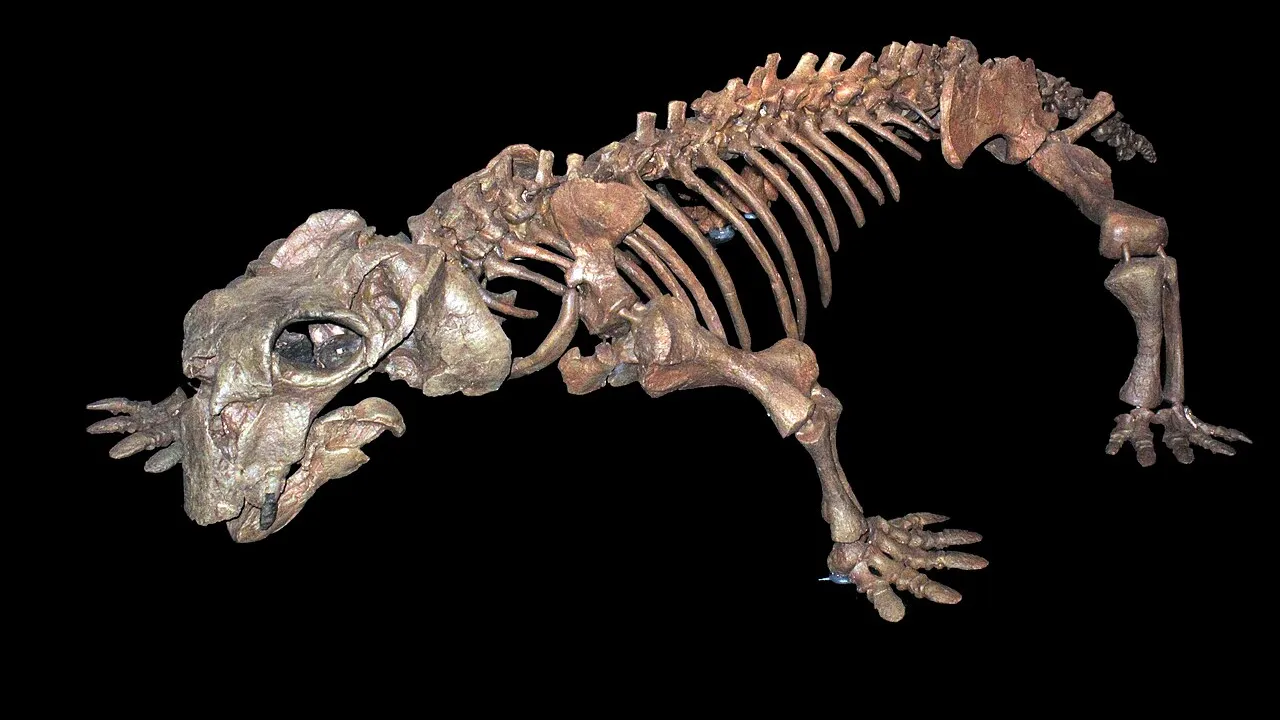
⚡ Survival SuperpowerTough turtle-like beak, twin tusks, and burrows that survived the Great Dying
🤯 Mind-Blowing Fact • Grade 1
Right after Earth's worst extinction 252 million years ago, roughly nine out of every ten land animals with backbones were Lystrosaurus!
✨ Word Sparks (Grade 1 Glossary)
Tap 🔊 to hear
Burrow
An underground tunnel dug for safe shelter
Tusk
A long pointed tooth sticking out
Survivor
Living thing that makes it through hard times
🪝
How did a tubby, pig-sized digger become the champion survivor of ancient Earth?
1
Meet the Plucky Digger
Scritch, dig, scoop! Dirt flies out of a snug tunnel in the riverbank. Out pops Lystrosaurus! It had a round tummy like a little pig and strong digging paws.
2
A Beak Plus Two Tusks
Lystrosaurus had no chewing teeth at all! Instead, it snipped tough stems with a hard turtle-like beak. Two short pointed straight down from its cheeks.
3
Safe Underground
When ancient Earth grew super hot and dusty, big hunters vanished. Lystrosaurus rested safely in cool and munched roots until green plants returned!
1. What mouth parts did Lystrosaurus have for snipping plants and roots?
2. How did digging burrows help Lystrosaurus survive hard times on ancient Earth?
🤯 Mind-Blowing Fact • Grade 2
When paleontologist Edwin Colbert dug up a Lystrosaurus tooth in Antarctica in 1969, newspapers around the world hailed it as proof of continental drift!
✨ Word Sparks (Grade 2 Glossary)
Tap 🔊 to hear
Dicynodont
Beaked ancient mammal cousin with two canine tusks
Continent
One of Earth's giant expanses of land
Extinction
When an entire kind of living thing disappears
🪝
Why did finding Lystrosaurus bones in icy Antarctica prove that Earth's continents move?
1
Shovel Lizard of Pangaea
Peek across a dusty plain 251 million years ago, and you will see herds of stout, snub-nosed animals trotting everywhere! Lystrosaurus means 'shovel lizard,' yet it was actually a mammal cousin called a , not a lizard or dinosaur.
2
Built for Tough Times
At the end of the Permian Period, giant volcanoes warmed the planet and wiped out most land animals. Lystrosaurus had huge lungs in a barrel chest, strong front claws for digging burrows, and a beak able to eat almost any tough root or stem. Soon it spread across empty lands with very few predators around!
3
Clue to Drifting Continents
Scientists found matching Lystrosaurus fossils in South Africa, India, China, and snowy Antarctica. Because this stubby land animal could never swim across wide oceans, its fossils proved all those lands once touched inside one giant !
1. Why were Lystrosaurus fossils in Antarctica, India, and Africa such an important clue for geologists?
2. Why did Lystrosaurus multiply into huge numbers at the dawn of the Triassic Period?
🤯 Mind-Blowing Fact • Grade 3
Lystrosaurus tusks never stopped growing throughout its life, recording daily and seasonal weather clues like a tiny stone diary!
✨ Word Sparks (Grade 3 Glossary)
Tap 🔊 to hear
Torpor
Deep sleep-like state that saves body energy
Dentine
Hard bony layer growing inside teeth and tusks
Greenhouse gas
Gas that traps heat inside Earth's atmosphere
🪝
How did microscopic growth rings inside Lystrosaurus tusks reveal a secret hibernation superpower?
1
Champion of the Great Dying
Two hundred and fifty-two million years ago, massive volcanic eruptions in Siberia filled Earth's atmosphere with , triggering the end-Permian 'Great Dying.' Saber-toothed gorgonopsians and giant pareiasaurs vanished, yet humble, dog-sized Lystrosaurus walked right into the Early Triassic and became the most common vertebrate on land!
2
Anatomy of an Underground Specialist
Fossilized burrow casts in South Africa's Karoo Basin preserve Lystrosaurus skeletons curled up inside underground chambers. Broad shoulder bones, short muscular forearms, and wide flat claws acted like spades. Meanwhile, a deep barrel ribcage held oversized lungs adapted to stale, low-oxygen burrow air.
3
Long Winters and Torpor
In 2020, scientists sliced thin sections of Antarctic Lystrosaurus tusks, which grew continuously like tree trunks. Tightly bunched stress rings inside the showed Antarctic Lystrosaurus slowed its metabolism into deep hibernation-like during dark polar winters!
4
Live Fast, Spread Far
Bone growth studies also show Early Triassic Lystrosaurus grew up and reproduced at a younger age, helping populations bounce back quickly after disasters.
1. What did microscopic stress rings inside Antarctic Lystrosaurus tusks reveal in 2020?
2. How did Lystrosaurus's broad barrel chest help it live in burrows AND survive Early Triassic air?
🤯 Mind-Blowing Fact • Grade 4
Two juvenile Lystrosaurus were found fossilized snuggled side-by-side inside a single 251-million-year-old burrow in South Africa, preserved just as they rested together!
✨ Word Sparks (Grade 4 Glossary)
Tap 🔊 to hear
Disaster taxon
Hardy species that multiplies rapidly right after extinctions
Fossorial
Adapted for digging and living underground in burrows
Hypoxia
Condition where oxygen levels drop dangerously low
🪝
Why do paleontologists call Lystrosaurus the ultimate 'disaster taxon' in the entire history of life on land?
1
When One Genus Ruled Pangaea
Imagine hiking across any continent 251.5 million years ago—from South Africa to Xinjiang, India, or Antarctica—and encountering the exact same stout, tusked herbivore everywhere you look. In the aftermath of the Permian-Triassic mass extinction, four surviving species of Lystrosaurus accounted for seventy to ninety-five percent of individual terrestrial vertebrate fossils, earning fame as paleontology's quintessential '.'
2
Pre-Adapted for Ecological Crisis
Why did this dicynodont therapsid succeed while larger relatives perished? (burrowing) habits buffered Lystrosaurus from lethal daytime heat spikes and wildfire smoke. Its downward-sloping snout placed eyes and nostrils high on the skull, while wide neural canals and barrel ribs supported forceful ventilation under Early Triassic and elevated carbon dioxide (hypercapnia). A keratinous rhamphotheca—horny beak—sliding fore-and-aft sliced tough roots, rhizomes, and drought-hardy Pleuromeia clubmosses.
3
Shrinking Size and Rapid Life Cycles
Bone histology studied by Jennifer Botha-Brink revealed another survival secret—the 'Lilliput effect.' While Late Permian species like Lystrosaurus maccaigi reached over two meters long, Early Triassic species shrank to under one meter, matured rapidly within a single year, and invested in high reproductive output despite brief lifespans.
4
Keystone of Plate Tectonics
On December 4, 1969, Edwin H. Colbert's team unearthed Lystrosaurus at Coalsack Bluff in the Transantarctic Mountains—clinching paleontological proof that Gondwanan continents once locked together.
1. How did the life cycle of Early Triassic Lystrosaurus change compared to its larger Late Permian relatives?
2. Where in Antarctica did Edwin Colbert's 1969 team discover the Lystrosaurus fossils that helped confirm plate tectonics?
🤯 Mind-Blowing Fact • Grade 5
Bone thin-sections show that after the end-Permian catastrophe, fewer than five percent of Lystrosaurus individuals survived to full adult size—yet they reproduced so early that their herds still blanketed the globe!
✨ Word Sparks (Grade 5 Glossary)
Tap 🔊 to hear
Exaptation
Trait evolved for one job helping another later
Rhamphotheca
Tough horny outer sheath covering a bony beak
Hypercapnia
Elevated levels of carbon dioxide gas in air
🪝
How did tusk histology, bone microstructure, and Antarctic stratigraphy reveal the survival playbook of Pangaea's billion-strong dicynodont?
1
Anatomy of a Pangaean Cosmopolitan
First named by Edward Drinker Cope in 1870 from a skull collected in South Africa's Beaufort Group, Lystrosaurus ('shovel reptile') belonged to Dicynodontia—herbivorous anomodont therapsids on the synapsid stem. Characterized by a steeply deflected premaxillary snout, edentulous jaws sheathed in a sharp keratinous , and a single pair of ever-growing maxillary caniniform tusks, Lystrosaurus bridged the catastrophic Permian-Triassic boundary (251.9 MYA) to achieve unrivaled global abundance across Induan floodplains.
2
Physiological Exaptation to Greenhouse Stress
Siberian Traps flood volcanism plunged Early Triassic ecosystems into severe warming, aridification, floral collapse, atmospheric hypoxia, and . Lystrosaurus possessed key forged for semi-fossorial living: robust deltopectoral crests on the humerus and broad unguals excavated thermal-refuge burrows, while enlarged costal cages and accessory respiratory musculature tolerated high CO2 concentrations common underground. Propalinal jaw shearing pulverized fibrous rhizomes and opportunistic lycopsids like Pleuromeia when glossopterid forests vanished.
3
Osteohistology and the Lilliput Life-History Shift
Comparative bone histology across the extinction horizon by Jennifer Botha-Brink and Kenneth Angielczyk documented a dramatic life-history shift. Whereas two-meter Changhsingian Lystrosaurus maccaigi displayed cyclical growth marks indicating multi-year maturation, Induan survivors (L. murrayi and L. declivis, ~0.8 meters) exhibited uninterrupted, highly vascularized fibrolamellar bone with almost zero lines of arrested growth—reflecting high mortality offset by rapid maturation and r-selected fecundity.
4
Sclerochronology of Polar Hibernation
In 2020, Megan Whitney and Christian Sidor examined incremental dentine growth increments in Lystrosaurus tusks from Antarctica's Fremouw Formation (~70° S paleolatitude). Compared with Karoo specimens showing steady growth, Antarctic tusks preserved thick zones of closely spaced, dark stress increments reactivated seasonally—representing the earliest paleontological signature of metabolic torpor in vertebrate history.
5
Geotectonic Legacy and Triassic Recovery
Edwin Colbert's landmark 1969 Coalsack Bluff discovery cemented Lystrosaurus as textbook proof of Gondwanan continental continuity. As Middle Triassic ecosystems stabilized a few million years later, recovering archosauromorphs and specialized kannemeyeriiform dicynodonts gradually replaced Pangaea's crisis champion.