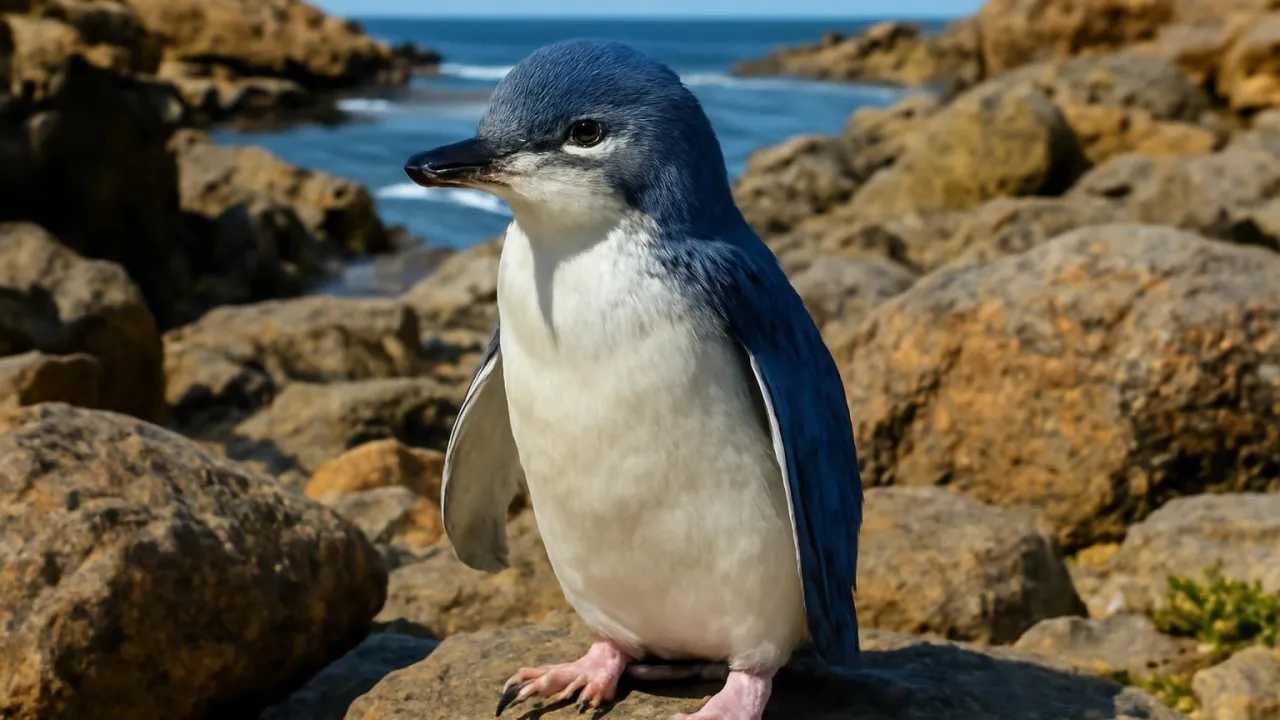
1. What color are the little blue penguin's feathers?
2. Where does the little blue penguin like to hide?
🤯 Mind-Blowing Fact • Grade 2
Little blue penguins can swim up to 6 miles per hour underwater!
✨ Word Sparks (Grade 2 Glossary)
Tap 🔊 to hear
species
A group of animals that are the same kind
burrows
Holes in the ground where animals live
flippers
Flat limbs penguins use to swim fast
🪝
Have you ever seen a penguin smaller than your school backpack?
1
Small but Strong
The little blue penguin is the smallest penguin in the world. It stands about thirteen inches tall and weighs around two pounds. Its feathers are a soft blue color that helps it blend into the ocean. This penguin walks upright on its two short legs.
2
Coastal Home
These penguins live along rocky coasts in New Zealand and southern Australia. They nest in or caves near the sea to stay safe. At night, they come ashore to rest and hide from predators. Their homes protect them from harsh weather and animals.
3
Fast Swimmer
Little blue penguins eat small fish, squid, and crustaceans they catch underwater. They swim quickly using strong to chase their food. Their speed helps them avoid predators like seals and sharks. They can dive deep to find their meals.
Little blue penguins can dive up to 200 feet deep when hunting for food!
✨ Word Sparks (Grade 3 Glossary)
Tap 🔊 to hear
camouflage
Colors that help animals hide from others
predators
Animals that hunt other animals for food
nutrients
Food parts that help animals grow strong
🪝
Did you know the little blue penguin uses camouflage to hide in the ocean?
1
Smallest Penguin with Blue Camouflage
The little blue penguin is the smallest penguin species, measuring about thirteen inches tall. Its blue feathers provide by blending with the ocean water. This adaptation helps protect it from like seals and sharks. The penguin’s lightweight body allows it to move quickly in water.
2
Habitat and Nesting
These penguins live along rocky coastal areas in New Zealand and southern Australia. They build nests in burrows or under rocks to stay safe from . At night, they return to their nests to rest and avoid danger. Their habitat provides shelter and from the sea.
3
Diet and Hunting
Little blue penguins hunt small fish, squid, and crustaceans in the ocean. They use their strong flippers to swim fast and catch prey underwater. This hunting skill is vital for their survival because it provides the they need. Their sharp eyesight helps them spot food even in murky water.
4
Survival Adaptations
The penguin’s blue feathers help with , while its flippers allow quick swimming to escape . Its burrowing behavior protects it from harsh weather and enemies. These adaptations work together to increase the penguin’s chances of survival in a tough ecosystem.
1. Why do little blue penguins have blue feathers?
2. Where do little blue penguins build their nests?
🤯 Mind-Blowing Fact • Grade 4
Little blue penguins can swim at speeds up to 6 miles per hour to escape predators!
✨ Word Sparks (Grade 4 Glossary)
Tap 🔊 to hear
ecosystem
A community of living things and their environment
conservation
Protecting nature and animals from harm
predators
Animals that hunt other animals for food
🪝
How does the little blue penguin’s size help it survive in the wild?
1
Size and Camouflage Benefits
The little blue penguin’s small size allows it to hide easily among rocks and in burrows, protecting it from larger . Its blue feathers blend with the ocean water, providing effective camouflage when swimming. This combination reduces the chances of being caught by seals or sharks. These adaptations help it survive in a competitive coastal .
2
Ecosystem Role and Food Web
As a predator, the little blue penguin controls populations of small fish, squid, and crustaceans, maintaining balance in the marine food web. It also serves as prey for larger marine animals like seals and sharks, linking ocean and land . Its presence indicates healthy coastal waters, which benefit other species and humans who rely on fishing.
3
Nesting Habits and Human Impact
Little blue penguins build nests in burrows or under rocks to protect their eggs and chicks from and weather. Human activities like coastal development and pollution threaten nesting sites and food sources. efforts include protecting habitats and reducing pollution to support their populations. These actions help preserve biodiversity and health.
4
Geographic Distribution
These penguins are native to coastal regions of New Zealand and southern Australia, where ocean currents provide abundant food. They prefer rocky shorelines with safe nesting areas. Seasonal migrations may occur to find food, but most stay close to their breeding sites. Their distribution reflects adaptations to specific environmental conditions.
1. What helps little blue penguins avoid predators?
2. Why is conservation important for little blue penguins?
🤯 Mind-Blowing Fact • Grade 5
Little blue penguins can dive over 200 feet deep and swim at speeds up to 6 miles per hour underwater!
✨ Word Sparks (Grade 5 Glossary)
Tap 🔊 to hear
taxonomy
How scientists group and name living things
metabolic
How animals use energy to live and move
ecosystem
All living things and their home working together
🪝
What unique adaptations allow the little blue penguin to thrive in coastal environments?
1
Taxonomy and Scientific Classification
The little blue penguin, scientifically named Eudyptula minor, belongs to the family Spheniscidae. It is the smallest member of the penguin family, measuring approximately thirty-three centimeters tall. This species is divided into several subspecies across New Zealand and southern Australia. Its classification helps scientists understand its evolutionary history and ecological niche.
2
Physiological Adaptations for Swimming
Little blue penguins have streamlined bodies and strong flippers that enable efficient underwater propulsion. Their dense feathers provide waterproofing and insulation in cold coastal waters. They can dive to depths of up to sixty meters while hunting for fish, squid, and crustaceans. Their rate supports sustained swimming speeds of up to ten kilometers per hour.
3
Conservation Status and Human Impact
Although currently classified as Least Concern, little blue penguin populations face threats from habitat loss, introduced predators, and pollution. Coastal development reduces available nesting sites, while oil spills and plastic waste harm their health. Conservation programs focus on habitat protection, predator control, and public education to ensure population stability.
4
Ecological Role and Food Web Dynamics
As mid-level predators, little blue penguins regulate populations of small marine organisms, maintaining balance. They also serve as prey for seals, sharks, and large seabirds, linking marine and terrestrial food webs. Their foraging behavior influences nutrient cycling in coastal waters, supporting biodiversity and fisheries important to humans.
5
Quantitative Comparisons and Behavior
Compared to larger penguin species, little blue penguins weigh about two kilograms and stand roughly one-third the size of emperor penguins. They swim at speeds reaching six miles per hour and can dive up to two hundred feet deep. Their nocturnal behavior helps avoid daytime predators, and they often return to the same nesting burrows year after year.