⚡ Survival SuperpowerFive-foot crocodile-like jaws and stereo nostrils that smelled underwater
🤯 Mind-Blowing Fact • Grade 1
Liopleurodon's enormous skull took up nearly one-fifth to one-fourth of its entire twenty-one-foot body length!
✨ Word Sparks (Grade 1 Glossary)
Tap 🔊 to hear
Ambush
Surprise rush from a hidden spot
Nostril
Nose opening used for breathing or smelling
Pliosaur
Short-necked sea reptile with giant jaws
🪝
How could this four-flippered sea hunter actually smell dinner underwater?
1
Power Under the Waves
Whoosh, surge, chomp! Four giant flippers beat hard to launch a speedy swimmer forward. Meet Liopleurodon! Unlike long-necked cousins, it had a short thick neck.
2
Giant Crocodile Jaws
Its huge head grew nearly five feet long—almost as tall as a fourth-grader! Strong cone teeth lined its jaws.
3
Sniffing Under Water
As it swam, water flowed in its mouth and out its nose so it could smell prey from far away!
1. How did Liopleurodon's body shape differ from its cousin Elasmosaurus?
2. What cool sensory trick could Liopleurodon's nostrils do while swimming?
🤯 Mind-Blowing Fact • Grade 2
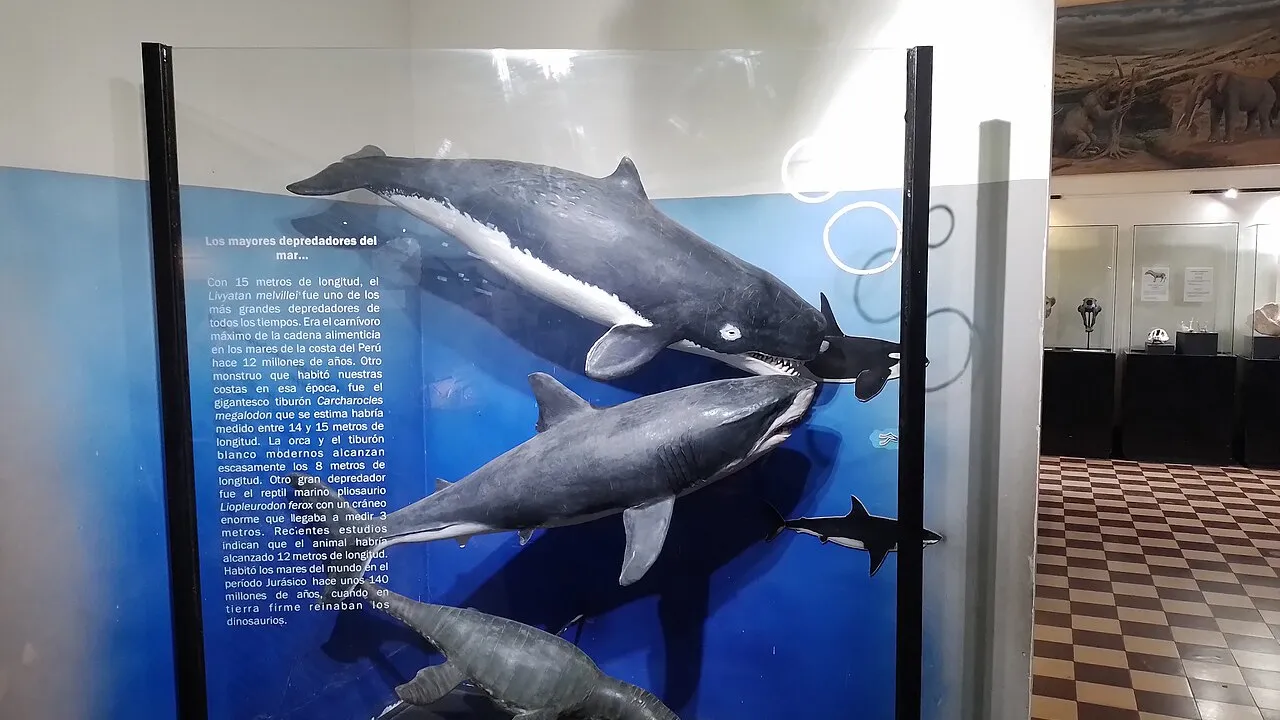
At twenty-one feet long and around two tons, real-life Liopleurodon matched a modern male orca in length—plenty big enough to rule its Jurassic sea!
✨ Word Sparks (Grade 2 Glossary)
Tap 🔊 to hear
Exaggerate
To describe something way bigger than reality
Acceleration
Picking up speed very quickly
Ichthyosaur
Dolphin-shaped prehistoric marine reptile
🪝
Why did an old TV show claim Liopleurodon was eighty-two feet long—and how big was the real ocean predator?
1
Real Size vs. TV Myth
Maybe you heard rumors of an eighty-foot sea monster bigger than a blue whale! In 1999, a famous television program exaggerated a mystery bone fragment and stretched Liopleurodon to gigantic cartoon size. Careful paleontology measurements show real adult Liopleurodon grew twenty to twenty-three feet long—the size of a killer whale!
2
Smooth-Sided Teeth
Even at killer-whale size, Liopleurodon ferox was a powerhouse of Jurassic seas 160 million years ago! French scientist Henri Émile Sauvage named it smooth-sided tooth in 1873 after a single three-inch tooth with one smooth side and one ridged side.
3
Four-Flipper Rocket
Beating all four muscular flippers together gave Liopleurodon explosive to surprise fast squid, sharks, and !
1. How long did real, scientifically verified adult Liopleurodon ferox grow?
2. What does the name Liopleurodon translate to?
🤯 Mind-Blowing Fact • Grade 3
Unlike land animals that breathe air IN through their outer nostrils, Liopleurodon scooped seawater IN through openings in the roof of its mouth and pushed it OUT its outer nostrils to smell underwater!
✨ Word Sparks (Grade 3 Glossary)
Tap 🔊 to hear
Olfaction
The biological sense of smelling scents
Murky
Cloudy dark water hard to see through
Orca
Toothed ocean whale known as killer whale
🪝
How did water flowing backward from Liopleurodon's palate out through its nostrils give it stereo underwater smell?
1
Apex Hunter of the Oxford Clay
Dive 160 million years back into the warm, muddy-bottomed Jurassic sea covering England and northern France! Patrolling those waters was Liopleurodon ferox, most famous member of the pliosaurs—a branch of plesiosaurs that shortened their necks and supersized their skulls to hunt large marine prey.
2
Stereo Underwater Smelling
Paleontologist Judy Massare and fluid scientists noticed something weird: Liopleurodon's external nostrils sat tiny and high in front of its eyes, while two scoop-shaped internal nostril openings sat forward on the roof of its mouth! As Liopleurodon swam with its jaws slightly parted, water rushed IN through its mouth scoops, swept past smell sensors, and exited OUT its top nostrils!
3
Left vs. Right Scent Tracking
Because its two nasal passages were separated, Liopleurodon could tell whether a scent came from the left or right—steering straight toward hidden squid or plesiosaurs in water!
4
Rosette of Grip Fangs
At the tip of its five-foot snout, an expanded spoon-shaped rosette held huge interlocking fangs backed by crushing jaw muscles.
1. Which direction did seawater flow through Liopleurodon's nasal passages for underwater smelling?
2. Why was having two separate left and right nasal channels so helpful in cloudy Jurassic seas?
🤯 Mind-Blowing Fact • Grade 4
Bite marks matching Liopleurodon teeth have been found scored right across the flipper and jaw bones of long-necked Cryptoclidus plesiosaurs from the exact same English clay beds!
✨ Word Sparks (Grade 4 Glossary)
Tap 🔊 to hear
Callovian
Final geologic stage of the Middle Jurassic
Crocodyliform
Ancient reptile cousin of modern crocodiles
Conical
Shaped like a sturdy round cone
🪝
How did paleontologists separate 25-meter television legends from genuine Oxford Clay fossils—and uncover an even cooler real predator?
1
Terror of the Callovian Seas
Step aboard a virtual submarine descending into the Middle-to-Late Jurassic seas of Western Europe (~166 to 155 million years ago), where soft mudstones of England's Oxford Clay entombed rich marine ecosystems. Cruising through schools of ammonites, long-necked Cryptoclidus plesiosaurs, and Leedsichthys giant fish was Liopleurodon ferox—first named in 1873 by Henri Émile Sauvage from a tooth found near Boulogne-sur-Mer, France.
2
Fact-Checking the 25-Meter Myth
In 1999, BBC's Walking with Dinosaurs famously portrayed a 25-meter (82-foot), 150-ton Liopleurodon based on misidentified giant vertebrae and an isolated jaw fragment from Mexico ('Monster of Aramberri'). Subsequent anatomical work by Leslie Noè, Richard Forrest, and Roger Benson demonstrated two truths: adult Oxford Clay Liopleurodon ferox consistently measured 5 to 7 meters (16 to 23 feet) and weighed 1.5 to 2.5 tons—while even the largest giant Jurassic pliosaurs like Pliosaurus funkei ('Predator X') topped out around 10 to 12 meters!
3
Cranial Biomechanics and Trihedral Teeth
Even at six to seven meters, Liopleurodon possessed a formidable 1.5-meter skull! Its expanded premaxillary snout tip carried five pairs of massive interlocking fangs with circular cross-sections capable of resisting twisting forces while seizing fast ichthyosaurs, sharks, and marine like Metriorhynchus.
4
Hydrodynamic Burst Ambush
Rowing-flight tests on four-flippered pliosaur models show that snapping all four broad paddles simultaneously delivered explosive forward acceleration from stealthy ambush!
1. Why did 1999 TV estimates of an 82-foot, 150-ton Liopleurodon get overturned by paleontologists?
2. Why were Liopleurodon's large front teeth round in cross-section instead of thin flat blades?
🤯 Mind-Blowing Fact • Grade 5
Pressure differences between Liopleurodon's mouth scoops and eye-level nostrils worked by the exact physics principle—the Venturi effect—that pulls fluid through modern carburetors and laboratory aspirators!
✨ Word Sparks (Grade 5 Glossary)
Tap 🔊 to hear
Venturi Effect
Fluid pressure drop driving steady suction flow
Tropotaxis
Steering by comparing left-right sensory signals
Choanae
Internal nostril openings inside mouth's roof
🪝
How did thalassophonean pliosaurs like Liopleurodon remodel the plesiosaur body plan into a high-speed, scent-guided macropredator?
1
Thalassophonea of the Oxford Clay
Spanning the Callovian to Oxfordian stages of the Middle-to-Late Jurassic (~166 to 155 million years ago), epicontinental seas blanketing England and northern France deposited the organic-rich mudstones of the Oxford Clay Formation. Ruling this trophic pyramid was Liopleurodon ferox ('fierce smooth-sided tooth'), erected by Henri Émile Sauvage in 1873 and anchored in the pliosaurid clade Thalassophonea ('sea murderers'—meaning giant marine hunters!).
2
Morphometrics vs. Media Hyperbole
Whereas late-1990s popular media extrapolated dubious Mexican and English fragments into a mythical 25-meter titan, rigorous osteological revisions by Leslie F. Noè (2001) and Knutsen, Druckenmiller, and Hurum (2012) established realistic scaling: mature Oxford Clay L. ferox reached 5 to 7 meters (16.5 to 23 feet) with a 1.2-to-1.5-meter cranium and a body mass of 1.5 to 2.5 metric tons. Rather than an unwieldy leviathan, its skull-to-body ratio (~1:4.5) forged an agile pursuit predator comparable in mass and niche to modern Orcinus orca.
3
Rostral Rosette and Bite Mechanics
Liopleurodon shortened its cervical count to roughly twenty stout vertebrae while elongating its temporal fenestrae to house colossal jaw-adductor muscles. Its constricted premaxillary-maxillary diastema framed a spoon-like anterior rosette bearing five pairs of coarse-ridged, circular-sectioned caniniform fangs—engineered to puncture and shake large vertebrates including Ophthalmosaurus ichthyosaurs, Cryptoclidus plesiosaurs, and thalattosuchian crocodyliforms.
4
Hydrodynamic Olfaction
Comparative fluid-flow reconstructions of pliosaurid palates demonstrate remarkable sensory adaptation: anterior scoop-shaped internal nares () sat rostral to the tiny dorsolateral external nares! Forward swimming created a Venturi-style pressure differential that drove water into the buccal cavity, across paired olfactory epithelia, and out the external nostrils—enabling directional underwater in turbid shelf waters.
5
Quadrupedal Hydrofoil Surge
Synchronizing or tightly phasing four broad, powerful hydrofoil paddles generated immense transient thrust, launching Liopleurodon from dark lower water layers straight into sunlit prey.