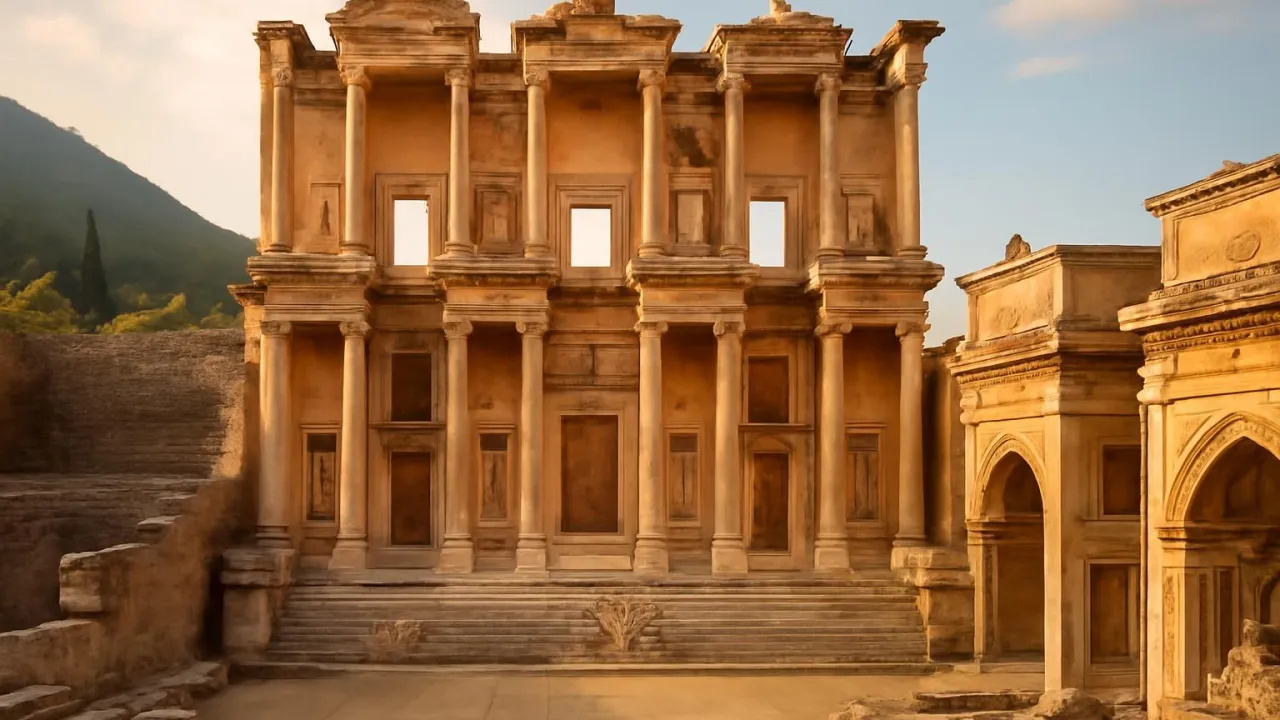
The library’s walls were built double-thick to keep scrolls safe from heat!
✨ Word Sparks (Grade 2 Glossary)
Tap 🔊 to hear
marble
Smooth, shiny white stone
façade
The front face of a building
statue
Stone figure that looks like a person
🪝
Can you picture a library made from shining stone under the sky?
1
Stone Walls and Tall Columns
The Library of Celsus stands with big stone columns and walls. The sun makes the shine and glow. Visitors climb steps to see its beautiful front. People take pictures of the grand entrance every day.
2
Home for Ancient Scrolls
Long ago, the library held thousands of scrolls on shelves. People read stories and learned about the world here. The walls protected the scrolls from hot sun and rain. It was a special place for reading and learning.
3
A Place to Explore
Today, people visit to see the old carvings and . They imagine what it was like to read here long ago. The library is a famous place to learn about history. It is one of the most visited sites in Turkey.
The Library of Celsus was once the third largest library in the ancient world!
✨ Word Sparks (Grade 3 Glossary)
Tap 🔊 to hear
façade
Fancy front of a building
parchment
Animal skin used for writing
arch
Curved stone shape for support
🪝
What secrets might echo inside a giant stone library from ancient times?
1
A Marvel of Marble and Light
The Library of Celsus rises with tall marble columns and a decorated . Its entrance faces the morning sun, making the stone glow brightly. People walk up wide steps to see the carved statues and grand . The building looks like a palace for stories and learning.
2
Protecting Ancient Knowledge
Inside, the library once stored over 12,000 scrolls on wooden shelves. The scrolls were made of papyrus and , rolled up and labeled for easy finding. Builders used a double-wall design to block heat and moisture, keeping the scrolls safe from damage. This clever engineering helped preserve precious knowledge for many years.
3
History Written in Stone
The library was built around 117 CE to honor a Roman leader named Celsus. His son wanted people to remember him, so he created this beautiful monument. The library’s statues represent wisdom, knowledge, and virtue—important ideas in Roman culture. Even after earthquakes and fires, its stone front still stands tall today.
4
Exploring the Ruins Today
Visitors from all over the world come to Ephesus to see the library’s ruins. They marvel at the detailed carvings, high , and tall columns. Guides tell stories about ancient readers and lost scrolls that once filled the shelves. The library inspires people to imagine the power of books and learning long ago.
The library’s main hall was built above Celsus’s tomb, making it both a library and a mausoleum.
✨ Word Sparks (Grade 4 Glossary)
Tap 🔊 to hear
insulation
Material that keeps heat or cold out
relief
Raised picture carved in stone
virtue
A good quality like wisdom or honesty
🪝
Imagine the sound of footsteps echoing through marble halls filled with ancient scrolls—what stories would you hear?
1
A Roman Wonder in Asia Minor
The Library of Celsus stands as a breathtaking example of Roman architecture in ancient Ephesus. Its marble façade, with soaring Corinthian columns and intricate carvings, was designed to impress visitors and honor the memory of Tiberius Julius Celsus Polemaeanus. The library’s entrance faces east, so the rising sun illuminates its statues and decorated stonework each morning. Even after centuries, the detailed and grand arches inspire awe in everyone who visits.
2
Ingenious Engineering for Knowledge
Builders used a double-wall construction technique to protect the scrolls from Ephesus’s hot, humid climate. The air gap between the outer and inner walls acted as , reducing heat transfer and moisture that could damage the precious scrolls. The library could hold up to 12,000 papyrus and parchment scrolls, stored in wooden cabinets along the walls. This clever engineering helped preserve the knowledge of philosophers, scientists, and poets for generations.
3
A Monument to Memory and Learning
Commissioned by Celsus’s son in 117 CE, the library served as both a tomb and a monument to wisdom. Statues representing like Sophia (wisdom) and Arete (excellence) decorated the façade, showing the Roman respect for learning. The library became a gathering place for scholars and citizens who valued books and education. Even after earthquakes and fires, its iconic façade remains a symbol of the city’s rich history.
4
Legacy Across the World
Today, the Library of Celsus is one of the most visited ruins in Turkey, attracting travelers and historians from around the globe. Its design has inspired modern libraries and museums, showing how ancient engineering can influence the present. Visitors marvel at the craftsmanship and imagine the countless stories once read within its walls. The library reminds us of the importance of protecting and sharing knowledge for future generations.
1. How did the library’s double walls help preserve scrolls?
2. What Roman values did the library’s statues represent?
🤯 Mind-Blowing Fact • Grade 5
The Library of Celsus’s double-wall insulation system is considered one of the earliest known examples of passive climate control in public buildings.
✨ Word Sparks (Grade 5 Glossary)
Tap 🔊 to hear
sarcophagus
A stone coffin used in ancient times
niche
A small space in a wall for storage or display
passive climate control
Building design that keeps temperature steady without machines
🪝
If you could step through the marble arches of Ephesus, could you unlock the secrets of the ancient world’s lost library?
1
A Beacon of Roman Engineering
The Library of Celsus at Ephesus stands as a testament to Roman architectural ingenuity and cultural ambition. Completed around 117 CE, the library’s façade rises 52 feet (16 meters) high, featuring two stories of intricately carved marble columns and statues. Its east-facing orientation was intentional, allowing the morning sunlight to illuminate the entrance and highlight the detailed reliefs. The structure was designed not only to house knowledge but also to awe visitors with its grandeur and symmetry.
2
Protecting Knowledge Through Design
One of the library’s most remarkable features was its double-wall construction, an early form of environmental engineering. The 3-foot (1-meter) air gap between the outer marble walls and the inner brick storage rooms functioned as insulation, regulating temperature and humidity. This protected the estimated 12,000 papyrus and parchment scrolls from Ephesus’s hot summers and damp winters, preventing decay. The scrolls were stored in wooden cabinets set into wall , demonstrating advanced archival practices for the era.
3
A Monument and Mausoleum
Commissioned by Gaius Julius Aquila to honor his father, Tiberius Julius Celsus Polemaeanus, the library uniquely served as both a public library and a mausoleum. Celsus’s was placed in a crypt beneath the main hall, blending commemoration with public education. The façade’s statues personify Roman virtues such as Sophia (wisdom), Arete (excellence), Ennoia (thought), and Episteme (knowledge), reflecting the values celebrated by Roman society.
4
Survival, Ruin, and Rediscovery
Although the library was partially destroyed by an earthquake in the third century and later by fire, its façade was rediscovered and restored in the 1970s. Archaeologists carefully reconstructed the surviving stones, using historical records and architectural analysis to ensure accuracy. Today, the library’s façade is one of the best-preserved examples of Roman public architecture in the eastern Mediterranean, drawing scholars, tourists, and architects from around the world.
5
Legacy of Ancient Learning
The Library of Celsus remains a symbol of the enduring importance of knowledge, cultural memory, and architectural innovation. Its engineering solutions—such as the double-wall insulation—have influenced modern building techniques in libraries and archives. The library’s combination of beauty, function, and commemoration continues to inspire the design of educational institutions worldwide. Visiting its ruins invites us to reflect on the value of preserving knowledge for future generations and the stories still hidden in ancient stones.