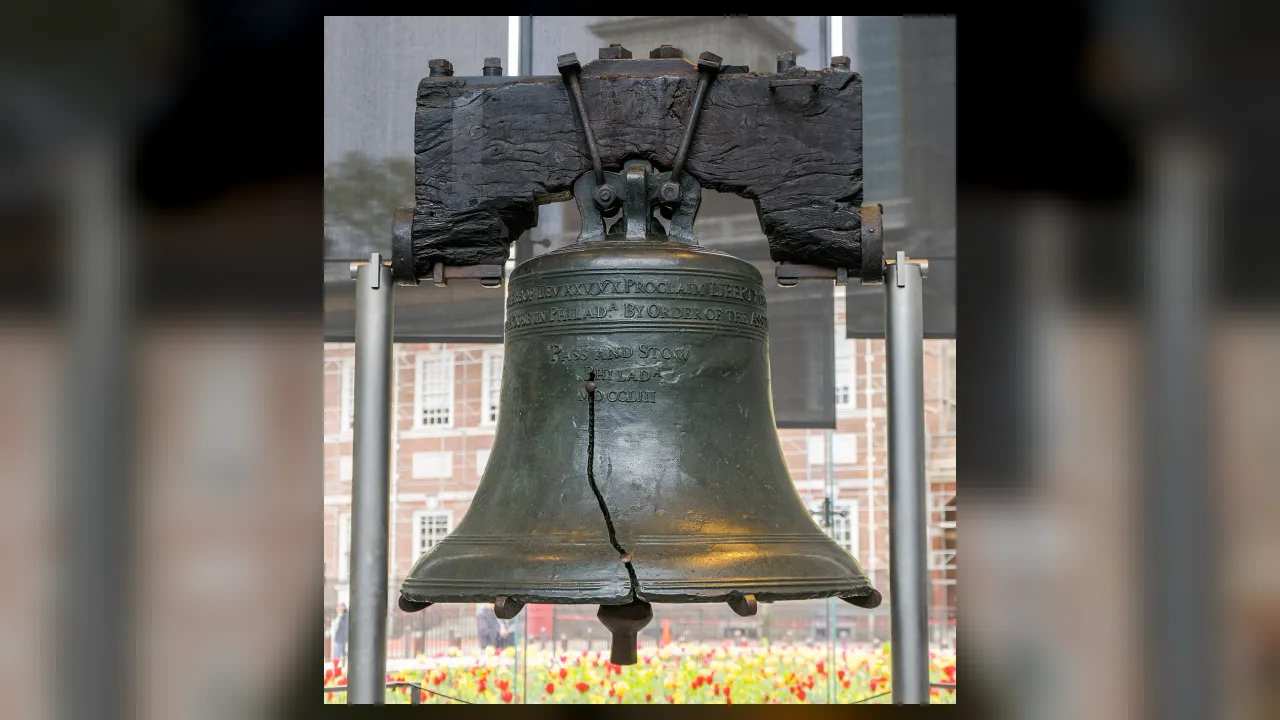
1. In which American city can you visit the Liberty Bell today?
2. Why does the Liberty Bell never ring out loud today?
🤯 Mind-Blowing Fact • Grade 2
Look closely at the Liberty Bell and you will spot a funny spelling mistake—Pennsylvania is spelled 'Pensylvania' with just one N!
✨ Word Sparks (Grade 2 Glossary)
Tap 🔊 to hear
inscription
Words carved or cast onto metal or stone
yoke
Heavy wooden beam holding a hanging bell
patriot
A colonist who supported American independence
🪝
Why did patriots hide a 2,080-pound bronze bell under a church floor during the Revolutionary War?
1
Words of Freedom on Bronze
Step close to the Liberty Bell and read the bold letters circling its top: 'Proclaim LIBERTY Throughout all the Land unto all the Inhabitants thereof.' Ordered in 1751 for the Pennsylvania State House—now called Independence Hall—it called lawmakers and citizens together.
2
A Secret Wagon Rescue
In July 1776, bells chimed across Philadelphia when the Declaration of Independence was read aloud! A year later, as British troops marched toward the city, loaded the heavy bell onto a hay wagon and hid it beneath a church floor in Allentown so it could not be melted into cannonballs.
3
The Final Ring in 1846
After ringing for George Washington's birthday in February 1846, a crack spread too far to fix, giving the silent bell its unmistakable look!
1. Why did patriots hide the bell in Allentown in 1777 during the American Revolution?
2. Whose birthday was the Liberty Bell celebrating when it rang for the last time in 1846?
🤯 Mind-Blowing Fact • Grade 3
Every Fourth of July, descendants of the signers of the Declaration of Independence gently tap—never strike—the Liberty Bell thirteen times in honor of the thirteen original colonies!
✨ Word Sparks (Grade 3 Glossary)
Tap 🔊 to hear
foundry
A workshop where hot melted metal is shaped
brittle
Hard yet easy to crack or snap
abolitionist
A reformer who worked to end slavery
🪝
Did you know the wide gap you see on the Liberty Bell is actually a repair job, not the crack itself?
1
Twice Melted in Philadelphia
Imagine ordering a brand-new bell from London's famous Whitechapel in 1752, hanging it up, and hearing—clunk!—as the clapper cracks the rim on the first test! Local Philadelphia metalworkers John Pass and John Stow melted the bronze down, mixed in extra copper, and recast the 2,080-pound bell twice in 1753.
2
Summoning Citizens in 1776
Hanging inside the Pennsylvania State House steeple, the State House Bell announced big news. On July 8, 1776, bells rang out to gather Philadelphians in the courtyard to hear Colonel John Nixon read the Declaration of Independence aloud for the first time!
3
How It Earned Its Famous Name
For eighty years people simply called it the Old State House Bell. Then in the 1830s, working to end slavery pointed to its inscription—'Proclaim LIBERTY Throughout all the Land'—and named it the Liberty Bell!
4
The Mystery of the Wide Slot
In 1846, workers drilled a half-inch-wide gap along an old hairline crack so the edges would stop rubbing. Sadly, when the bell rang for Washington's Birthday, a new hairline crack shot upward above the letters, silencing its voice forever.
1. Who first gave the Old State House Bell the famous name 'Liberty Bell' in the 1830s?
2. Why is there a wide half-inch slot visible on the side of the Liberty Bell?
🤯 Mind-Blowing Fact • Grade 4
In 1950, the U.S. Treasury ordered fifty-five full-size bronze replicas of the Liberty Bell—one for every state and territory—and Virginia's replica stands on display near the Capitol grounds in Richmond!
✨ Word Sparks (Grade 4 Glossary)
Tap 🔊 to hear
metallurgy
Science of mixing and shaping useful metals
proclamation
An official public announcement of big news
replica
An exact copy made to match an original
🪝
Why did the Liberty Bell ride cross-country on flatcar trains after the Civil War—and why did it stop traveling forever?
1
Born From William Penn's Charter
Travel back to 1751—twenty-five years before the Declaration of Independence! Speaker Isaac Norris ordered a great bell for the Pennsylvania State House to celebrate the fiftieth anniversary of William Penn's 1701 Charter of Privileges, which protected religious liberty and self-government in colonial Pennsylvania. That celebration inspired Norris to choose the biblical verse from Leviticus 25:10 proclaiming liberty throughout the land.
2
Metallurgy of Pass and Stow
Made of roughly seventy percent copper and twenty-five percent tin—with small traces of lead, zinc, arsenic, gold, and silver—the bell stretched twelve feet around its lip and hung from a tough American elm beam called a yoke. After cracking in 1752 and being recast twice by John Pass and John Stow in 1753, it rang for royal , Stamp Act protests, and early Revolutionary milestones.
3
Whistle-Stop Unity Tours
Between 1885 and 1915, Philadelphia sent the Liberty Bell on seven cross-country railroad journeys to fairs from New Orleans and Chicago to Atlanta and San Francisco! Millions of Americans stood beside the tracks to heal divisions after the Civil War—until bumpy rails lengthened the interior crack and officials retired it from travel after 1915.
4
Inspiring Expanding Freedom
Adopted by abolitionists in the 1830s, echoed by women's suffrage campaigners who cast a 'Justice Bell' in 1915 for voting rights, and visited by civil rights leaders, the bell symbolizes America's ongoing pursuit of liberty for all.
1. What event in 1751 originally inspired Pennsylvania leaders to order the bell and choose its 'Proclaim LIBERTY' inscription?
2. Why did Philadelphia stop sending the Liberty Bell on cross-country train tours after its 1915 trip to San Francisco?
🤯 Mind-Blowing Fact • Grade 5
When women's suffrage organizers toured Pennsylvania in 1915 with a full-size bronze replica called the 'Justice Bell,' they chained its clapper silent so it could not ring until women won the constitutional right to vote in 1920!
✨ Word Sparks (Grade 5 Glossary)
Tap 🔊 to hear
alloy
Metal made by melting two elements together
fracture
A narrow crack or break in solid material
reconciliation
Restoring friendship and unity after deep division
🪝
How did a flawed eighteenth-century bronze casting transform from a colonial courthouse bell into an international emblem of human rights?
1
Colonial Commission and Casting Challenges
Stand inside Philadelphia's Liberty Bell Center with Independence Hall framed through floor-to-ceiling glass behind the 2,080-pound bronze icon! Commissioned in November 1751 by Pennsylvania Assembly Speaker Isaac Norris to commemorate the golden jubilee of William Penn's Charter of Privileges, the bell arrived from London's Lester and Pack (Whitechapel) Foundry in August 1752. Cracking on a test strike due to brittle high-tin or transit stress, it was recast twice in spring 1753 by local founders John Pass and John Stow—who stamped their names and the colonial spelling 'Pensylvania' across its waist.
2
Separating Myth From 1776 History
Although an 1847 fictional tale claimed an anxious bell-ringer waited in the steeple on July 4, 1776, historians note the Declaration was first read publicly four days later, on July 8, 1776—and the decaying wooden steeple was actually too shaky for heavy swinging, though smaller bells or clapper strikes called townspeople together! Evacuated in September 1777 under armed guard past Bethlehem to Allentown's Zion Reformed Church, the bell escaped British melting furnaces and returned to Philadelphia in June 1778.
3
Stop-Drilling and the Acoustic Silence of 1846
Before Washington's Birthday in February 1846, craftsmen attempted 'stop-drilling'—milling a nearly half-inch-wide channel along an existing so the bronze edges could vibrate cleanly without buzzing. Hours into the celebration, a catastrophic compound fracture extended upward through the word 'Liberty,' permanently silencing its E-flat resonance.
4
Abolition, Suffrage, and National Reconciliation
First christened the 'Liberty Bell' in an 1835 anti-slavery publication and popularized on the cover of the 1839 abolitionist annual Liberty, the bell reminded Americans that Leviticus 25:10 promised liberty unto 'all the Inhabitants thereof.' Seven cross-country rail tours between 1885 and 1915 reunited post-Civil War regions, while Katharine Wentworth Ruschenberger's 1915 Women's Liberty Bell ('Justice Bell') chained its clapper silent until the Nineteenth Amendment secured women's right to vote in 1920.
5
Global Resonance in Silence
On D-Day, June 6, 1944, Philadelphia's mayor tapped the bell softly over live nationwide radio; from Nelson Mandela to Martin Luther King Jr., leaders worldwide have cited its silent silhouette as proof that imperfect vessels can still carry timeless ideals.