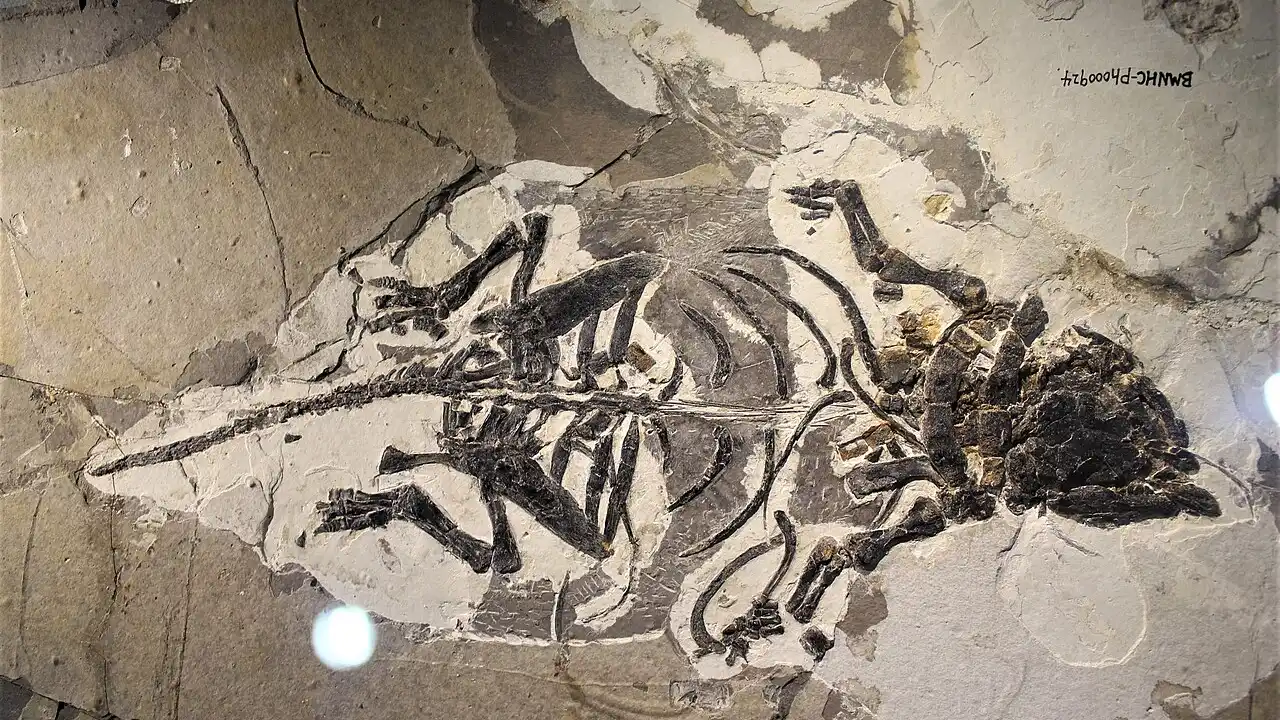
1. What surprising meal did scientists find fossilized inside Liaoningosaurus?
2. How big are the Liaoningosaurus fossils found so far?
🤯 Mind-Blowing Fact • Grade 2
Its species name, paradoxus, means puzzling surprise because it mixes ankylosaur features with turtle-like armor and fish-eating habits!
✨ Word Sparks (Grade 2 Glossary)
Tap 🔊 to hear
Paradox
A puzzling surprise that breaks normal rules
Plastron
A flat bony shield covering the belly
Specimen
A single fossil animal studied by scientists
🪝
Why did scientists give this miniature armored dinosaur the name 'paradox'?
1
A Pint-Sized Puzzle
Peek into a cool volcanic lake in northeastern China 122 million years ago. Scrambling down the muddy bank is Liaoningosaurus, one of the strangest armored dinosaurs ever discovered! Every fossil found so far is only about 15 inches long.
2
Built Like a Little Turtle
Other ankylosaurs had soft bellies or pebble-like bumps underneath. Liaoningosaurus wore two broad, six-sided bony plates across its underside like a turtle's bottom shell, protecting it from hungry fish or water reptiles below.
3
Fishing With Sharp Claws
Instead of blunt hooves, it had pointed claws and fork-tipped teeth. One fossil still held dozens of tiny Ray-finned fish bones inside its belly!
1. Why might a belly shield have helped Liaoningosaurus in a lake?
2. How were Liaoningosaurus's claws different from those of giant land ankylosaurs?
🤯 Mind-Blowing Fact • Grade 3
Fine volcanic ash in Liaoning's Yixian Formation preserved tiny hexagonal surface textures less than half a millimeter wide on Liaoningosaurus's belly plate!
✨ Word Sparks (Grade 3 Glossary)
Tap 🔊 to hear
Ventral
Located on the underside or belly area
Hexagonal
Shaped with six straight sides like honeycomb
Aquatic
Living, swimming, or feeding inside water
🪝
Was Liaoningosaurus a semi-aquatic fishing ankylosaur, a tiny baby, or both?
1
Treasure From the Jehol Lakes
Ash from ancient volcanoes drifted gently over freshwater lakes in Liaoning, China, 122 million years ago. Preserved inside paper-thin shale slabs alongside feathered dinosaurs and early birds lay Liaoningosaurus paradoxus—a tiny ankylosaur measuring barely 14 inches from snout to tail tip!
2
Hexagonal Belly Armor
Flipping the fossil visually reveals its weirdest feature: two large, flat plates covered in tiny six-sided bumps shielded its entire abdomen. No other known dinosaur grew a solid turtle-style shield.
3
Forked Teeth and Fish Bones
In 2016, paleontologist Ji Qiang described a second specimen packed with tiny Lycoptera fish skeletons right inside its ribcage! Combined with large crown-shaped teeth and sharp claws, this evidence suggested Liaoningosaurus waded or paddled to snap up small prey.
4
The Great Baby Debate
Recently, bone-slice microscopes spotted rapid growth lines with zero annual rings, convincing many researchers that known Liaoningosaurus fossils are actually newly hatched ankylosaur babies!
1. What kind of ancient fish was found fossilized inside a Liaoningosaurus skeleton?
2. Why do many paleontologists think the known Liaoningosaurus skeletons are hatchlings?
🤯 Mind-Blowing Fact • Grade 4
If Liaoningosaurus truly ate fish, it would be the first known meat-eating member of the entire bird-hipped (ornithischian) dinosaur branch!
✨ Word Sparks (Grade 4 Glossary)
Tap 🔊 to hear
Piscivore
An animal whose diet consists mostly of fish
Ungual
The toe bone at the tip supporting claws
Ornithischian
Bird-hipped dinosaur group of mostly plant-eaters
🪝
How did a 14-inch skeleton from China spark one of paleontology's liveliest debates about armored dinosaurs?
1
Discovery in the Yixian Shale
In 2001, paleontologist Xu Xing and colleagues unveiled an astonishingly small skeleton from the 122-million-year-old Yixian Formation of Liaoning Province, China. Measuring just 34 centimeters long, Liaoningosaurus paradoxus combined traits of both major ankylosaur families: its skull held an external jaw opening and tiny premaxillary teeth like early nodosaurs, yet its pointed triangular skull shape hinted at ankylosaurids.
2
Hypothesis One: Semi-Aquatic Piscivore
Fifteen years later, a second equally tiny specimen turned paleontology upside down. Packed neatly inside its abdominal cavity lay the skeletons of numerous small teleost fishes called Lycoptera! Pointing to its long, sharp claws, oversized denticles on its cheek teeth, loose hip-to-spine attachment, and a broad turtle-like ventral armor shield, researchers proposed Liaoningosaurus was the first known carnivorous, semi-aquatic dinosaur—foraging in shallow lakes while its belly plate blocked underwater bites.
3
Hypothesis Two: Precocial Hatchlings
In 2023, osteohistological studies sliced thin sections from two tiny Liaoningosaurus limb bones and found vascularized infant bone lacking lines of arrested growth, indicating the animals were younger than twelve months—possibly hatchlings of a larger local ankylosaur like Chuanqilong! Even as babies, though, opportunistic snacking on protein-rich fish or carrion along lake shores may have fueled fast early growth.
4
Why Science Loves a Mystery
Whether Liaoningosaurus stayed miniature for life or grew into a multi-ton adult, its fossils prove early ankylosaurs experimented with far more diverse diets and lifestyles than anyone ever imagined.
1. Why did finding fish inside Liaoningosaurus surprise dinosaur researchers so much?
2. Why might baby plant-eating dinosaurs occasionally eat small fish or insects?
🤯 Mind-Blowing Fact • Grade 5
Histological cross-sections discovered an actual 'hatching line' inside a tiny Liaoningosaurus limb bone, proving that individual had emerged from its egg shortly before burial!
✨ Word Sparks (Grade 5 Glossary)
Tap 🔊 to hear
Lagerstätte
Fossil site preserving extraordinary soft details
Ontogenetic
Relating to how an organism changes while growing
Lacustrine
Formed inside or belonging to ancient lakes
🪝
Does Liaoningosaurus paradoxus represent an evolutionary leap into semi-aquatic piscivory—or an extraordinary window into hatchling ankylosaur biology?
1
Lagerstätte Preservation in the Jehol Biota
Roughly 122 million years ago during the Aptian stage of the Early Cretaceous, rhythmic volcanic eruptions blanketed freshwater lake basins across northeastern China's Liaoning Province. Within these anoxic mudstones of the Yixian Formation—famous worldwide for feathered theropods—paleontologists Xu Xing, Wang Xiaolin, and You Hailu described Liaoningosaurus paradoxus in 2001 from an articulated skeleton measuring a mere 34 centimeters from rostrum to tail.
2
Mosaic Anatomy and Ventral Shielding
True to its species epithet paradoxus, the holotype blended plesiomorphic and derived traits across Ankylosauria: it retained premaxillary teeth and an external mandibular fenestra alongside an un-fused sacrum. Most strikingly, large flat osteodermal plates sculpted with sub-millimeter hexagonal and rhombic tubercles covered the ventral abdomen, superficially resembling a chelonian plastron.
3
The 2016 Piscivory Hypothesis
Debate intensified in 2016 when Ji Qiang and colleagues analyzed a second 40-centimeter specimen preserving a dense cluster of teleost fishes (Lycoptera) inside its ribcage. Citing disproportionately large, fork-denticled cheek teeth (up to five millimeters tall in a minuscule skull), trenchant pedal and manual unguals rather than hooves, and its ventral shield, the authors proposed that Liaoningosaurus evolved an amphibious, fish-hunting niche analogous to freshwater turtles.
4
Osteohistology and Ontogenetic Testing
To test whether Liaoningosaurus was a dwarf adult or a juvenile, Wenjie Zheng and collaborators conducted microscopic bone histology on humeri, radii, and fibulae from two small specimens in 2023. Absence of lines of arrested growth (LAGs), open neurocentral sutures, and primary woven-fibered bone tissue revealed both individuals were under one year old—and the smaller specimen still showed a neonatal hatching line!
5
Synthesizing Growth and Ecology
Whether those putative ventral plates represent specialized juvenile armor or displaced dermal sheets—and whether Liaoningosaurus matured into a larger sympatric ankylosaur such as Chuanqilong chaoyangsaurus—its fossils illuminate how juvenile ornithischians likely exploited high-protein aquatic prey along Cretaceous lake margins before transitioning to adult herbivory.