Leshan Giant Buddha
The Mountain That Became a Colossal Calm Face
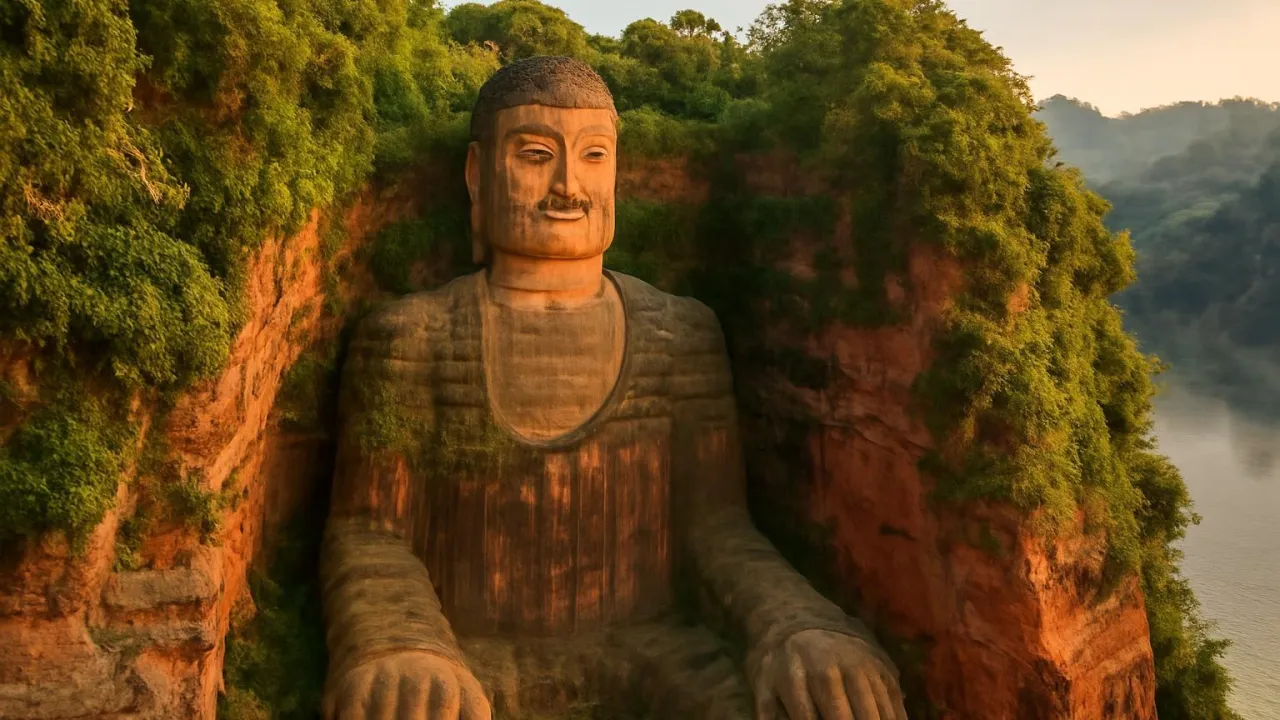
The Leshan Giant Buddha’s drainage system includes over 1,000 hidden channels and holes carved by hand.
1 The Vision and Setting of the Leshan Giant Buddha
Nestled at the of the Minjiang, Dadu, and Qingyi Rivers in Sichuan, China, the Leshan Giant Buddha was conceived as both a spiritual guardian and an engineering solution to treacherous river currents. The statue’s serene visage, carved directly into the red sandstone cliff, faces Mount Emei, a sacred Buddhist site. Its strategic placement was intended to calm the turbulent waters below, which frequently endangered passing boats and local communities. The Buddha’s presence transformed the landscape into a revered destination, blending natural wonder with human ingenuity.
2 Construction: Tools, Techniques, and Teamwork
The project began in 713 CE under the guidance of the Buddhist monk Hai Tong and spanned approximately 90 years, involving thousands of artisans, laborers, and engineers. Workers employed iron chisels, hammers, and wooden scaffolding to meticulously carve the 71-meter-tall figure, making it the world’s largest ancient stone Buddha. The statue’s proportions are remarkable: its head alone measures 14.7 meters high, while each shoulder stretches 28 meters across, and its feet extend 8.5 meters in length. The construction process required careful planning and coordination, as well as innovative problem-solving to manage the risks of landslides and rock instability.
3 Architectural Ingenuity: The Drainage System and Erosion Control
One of the Buddha’s most impressive engineering features is its sophisticated internal drainage system, designed to combat the persistent threat of erosion. Channels and hidden gutters were carved throughout the head, arms, and body, efficiently diverting rainwater away from vulnerable surfaces. This system has preserved much of the statue’s detail for over twelve centuries, despite the soft, nature of the sandstone. Conservationists today study and maintain these ancient features, integrating modern technology with traditional methods to prevent further weathering and biological growth.
4 Cultural Impact and Global Recognition
The Leshan Giant Buddha stands as a testament to the Tang Dynasty’s architectural prowess and the enduring influence of Buddhist culture in China. For centuries, the monument has drawn pilgrims, artists, and scholars, inspiring countless poems, paintings, and legends. Its designation as a UNESCO World Heritage Site in 1996 elevated its global profile, attracting millions of visitors annually and contributing significantly to the local economy. The statue’s symbolic role as a protector and unifier continues to shape the identity and traditions of the Leshan region.
5 Preservation Challenges and the Future
Despite its resilience, the Buddha faces ongoing threats from natural erosion, air pollution, and the pressures of mass tourism. Conservation efforts combine scientific research, digital mapping, and hands-on restoration to address issues such as water infiltration, biological colonization, and structural cracks. International collaborations support sustainable tourism practices and educational outreach, ensuring that future generations can appreciate both the monument’s artistry and its environmental context. The Leshan Giant Buddha endures as a living legacy—an awe-inspiring fusion of faith, engineering, and the enduring human desire to create meaning from stone.
1. How did the Leshan Giant Buddha help make river travel safer?
2. What modern methods help conserve the Buddha today?