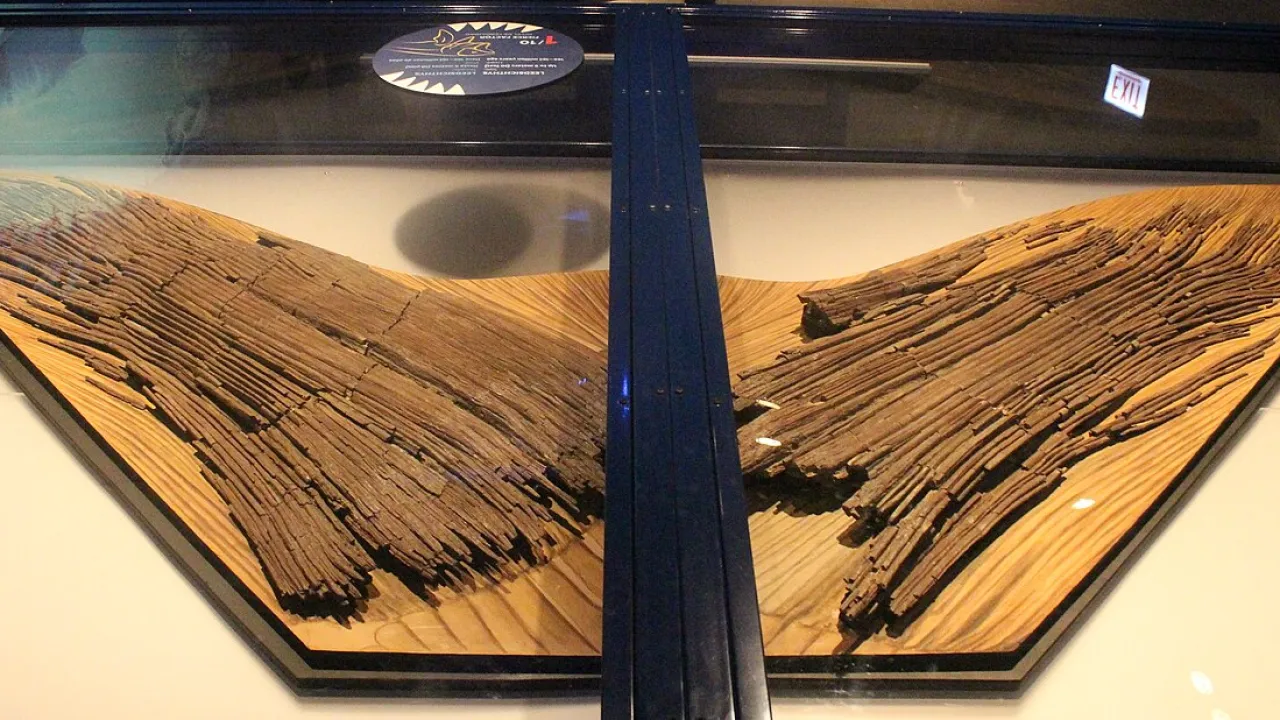
1. What did giant Leedsichthys eat to grow longer than a school bus?
2. How did Leedsichthys catch such tiny ocean snacks?
🤯 Mind-Blowing Fact • Grade 2
Scientists initially mistook the giant tail fin rays of Leedsichthys for the bony back plates of a Stegosaurus dinosaur!
✨ Word Sparks (Grade 2 Glossary)
Tap 🔊 to hear
problematicus
Latin word meaning puzzling or tricky
gill rakers
Comb-like bony fingers that strain food
zooplankton
Microscopic animals drifting in ocean currents
🪝
Why did scientists give this fifty-foot Jurassic fish the funny middle name 'problematicus'?
1
A Jigsaw Puzzle of Thousand Pieces
Imagine finding thousands of broken, paper-thin bone strips scattered across a clay pit in England! When farmer Alfred Leeds began collecting them in the 1880s, scientists couldn't tell if they belonged to a dinosaur's back plates or a flying reptile! Finally they realized it was a fifty-foot bony fish and named it Leedsichthys —'Leeds's puzzling fish.'
2
Forty Thousand Tiny Sieves
Most of its skeleton was light, bendy cartilage, so only its skull plates, fin rays, and delicate fossilized. Over 40,000 tiny comb-like rakers lined its gill arches to strain from Jurassic seas!
3
Cruising Across the Globe
Fossils from England, France, Germany, and South America show these gentle filter-feeders swam across oceans worldwide.
1. Why was Leedsichthys given the species name problematicus?
2. What dinosaur part did experts once confuse Leedsichthys fin bones with?
🤯 Mind-Blowing Fact • Grade 3
Starting life from a tiny fish egg smaller than a pea, Leedsichthys grew millions of times heavier to reach forty-five tons within twenty to forty years!
✨ Word Sparks (Grade 3 Glossary)
Tap 🔊 to hear
ray-finned
Bony fishes whose fins are held by thin rods
copepods
Tiny teardrop-shaped crustaceans teeming in oceans
filter-feeder
An animal that strains small food from water
🪝
Why were the gill strainers of Leedsichthys once mistaken for the sharp jaws of a meat-eating predator?
1
Filling the Whale Job Early
One hundred sixty million years ago in the Jurassic Period, baleen whales and whale sharks did not exist yet. Instead, a colossal bony fish named Leedsichthys claimed the role of giant ocean ! Stretching roughly forty-five to fifty-four feet long, it outweighed six elephants combined.
2
Delicate Mesh, Not Fierce Fangs
Each three-inch gill raker carried dozens of microscopic needle-like projections along its top edge. For years, researchers mistook those tiny prongs for fierce slashing teeth! Closer microscope work revealed they locked together into a silky mesh basket that trapped tiny shrimp and without letting a crumb escape.
3
Stirring Up Seafloor Snacks?
Across ancient European seafloors, geologists discovered mysterious twelve-foot-wide grooves plowed through fossil mud layers. Some paleontologists suspect Leedsichthys occasionally dipped its huge mouth to stir up plump bottom-dwelling worms and shellfish!
4
Surviving Predators by Pure Size
Fossil fin bones bearing healed tooth marks from Metriorhynchus sea crocodiles and Liopleurodon pliosaurs prove that adult Leedsichthys was so huge and tough it shrugged off predator bites!
1. How did microscope studies change what scientists thought about Leedsichthys's gill rakers?
2. What do healed bite marks on fossilized Leedsichthys fin rays prove?
🤯 Mind-Blowing Fact • Grade 4
To uncover the famous English Leedsichthys specimen nicknamed 'Ariston,' researchers had to dig away 10,000 tons of heavy clay using excavators before brushing each bone with tiny paintbrushes!
✨ Word Sparks (Grade 4 Glossary)
Tap 🔊 to hear
actinopterygian
Member of the ray-finned bony fish class
articulated
Fossil bones still connected in natural position
pachycormid
Extinct family of fast Jurassic-Cretaceous bony fishes
🪝
How did paleontologists spend over a year excavating 'Ariston'—the most complete giant bony fish ever found?
1
Taming 'Leeds's Problematic Fish'
Because bone weighs far more than shark cartilage, evolving a fifty-foot bony fish required radical weight savings. Leedsichthys problematicus—named by Arthur Smith Woodward in 1889—solved this by leaving most of its internal vertebral column unossified while keeping porous, lightweight skull plates and sprawling five-foot pectoral fin rays! Unfortunately for paleontologists, skeletons shattered into thousands of fragile splinters upon burial.
2
Excavating 'Ariston' in Star Pit
In 2001, geology students spotted pectoral fin rays protruding from Oxford Clay quarry walls at Whittlesey, England. Paleontologist Jeff Liston led a heroic team removing ten thousand tons of overburden clay to rescue 'Ariston,' the most specimen ever found! Measuring its gill basket and paired fins finally trimmed runaway 90-foot myths down to a scientifically solid 13.5 to 16.5 meters (45–54 feet)—still by far the largest fish in Earth's history.
3
Suspension-Feeding Guild Pioneers
Leedsichthys spearheaded a 100-million-year dynasty of giant filter-feeding fishes that occupied the ecological guild filled today by mysticete whales, whale sharks, and manta rays. Cruising with cavernous jaws agape, ram pressure forced plankton-rich water across forty thousand fimbriated gill rakers.
4
Fast Cruising Speeds
Physiological muscle modeling published by Humberto Ferrón and Liston revealed that Leedsichthys had surprisingly high metabolic stamina—capable of cruising up to eleven miles per hour between rich Jurassic plankton blooms!
1. How did Leedsichthys keep its fifty-foot skeleton light enough to swim?
2. Why were older guesses that Leedsichthys grew ninety feet long inaccurate?
🤯 Mind-Blowing Fact • Grade 5
Until baleen whales and filter-feeding sharks evolved millions of years later, Leedsichthys and its pachycormid cousins held the job of ocean giant filter-feeders for a whopping 100 million years!
✨ Word Sparks (Grade 5 Glossary)
Tap 🔊 to hear
lepidotrichia
Segmented bony rays supporting fish fins
ossification
Process turning soft cartilage into hard bone
guild
Unrelated species sharing the same feeding role
🪝
Why could an ancient bony fish grow to sixteen meters when modern teleost fishes top out at barely half that length?
1
Pachycormid Rise to Suspension-Feeding Gigantism
Today, Earth's largest extant bony fish—the ocean sunfish (Mola) and oarfish (Regalecus)—falls far short of giant cartilaginous sharks and cetaceans. Yet during the Callovian–Oxfordian stages of the Middle to Late Jurassic (165–152 MYA), the stem-teleost clade Pachycormidae shattered that ceiling with Leedsichthys problematicus! Spanning 13.5 to 16.5 meters and weighing up to forty-five metric tons across European and Chilean marine basins, it pioneered vertebrate pelagic suspension-feeding gigantism.
2
Skeletal Reduction and Taphonomic Bias
When Victorian collector Alfred Nicholson Leeds recovered thousands of splintered (fin rays) and fibrous cranial plates near Peterborough—initially misidentified as stegosaurian dermal armor by visiting American paleontologist Othniel Charles Marsh before Arthur Smith Woodward named the fish in 1889—its anatomy baffled scholars. To avoid sinking under dense hydroxyapatite bone, Leedsichthys suppressed endochondral across its axial column, leaving a taphonomic puzzle resolved only after Jeff Liston's 2001–2003 excavation of the articulated Whittlesey specimen 'Ariston.'
3
Hydrodynamic Gill-Raker Mesh
Inside its cavernous branchial chamber, tens of thousands of ossified gill rakers lined five branchial arches. Delicate bifurcating fimbriae crowned each raker, creating cross-flow filtration sieves analogous to basking shark rakers and mysticete baleen that concentrated swarming Jurassic mesozooplankton bloom productivity triggered by Pangaean rifting.
4
Growth Rings and Metabolic Energetics
Osteohistological growth-ring counts across fin rays demonstrate rapid somatic expansion from millimeter-scale pelagic eggs to eight meters within two decades, plateauing near sixteen meters by age forty. Bioenergetic tissue-oxygenation modeling indicates Leedsichthys sustained vigorous aerobic cruising speeds up to 17.8 kilometers per hour without tissue hypoxia, outperforming many modern megafaunal fishes.
5
Legacy of a Hundred-Million-Year Guild
Embedded tooth crowns of the thalattosuchian crocodylomorph Metriorhynchus surrounded by healed bony callus prove adult Leedsichthys possessed formidable survival resilience. Though Leedsichthys vanished in the Late Jurassic, smaller suspension-feeding pachycormids like Bonnerichthys carried its ecological blueprint right up to the end-Cretaceous asteroid impact—after which whale sharks and baleen whales inherited the plankton-straining crown.