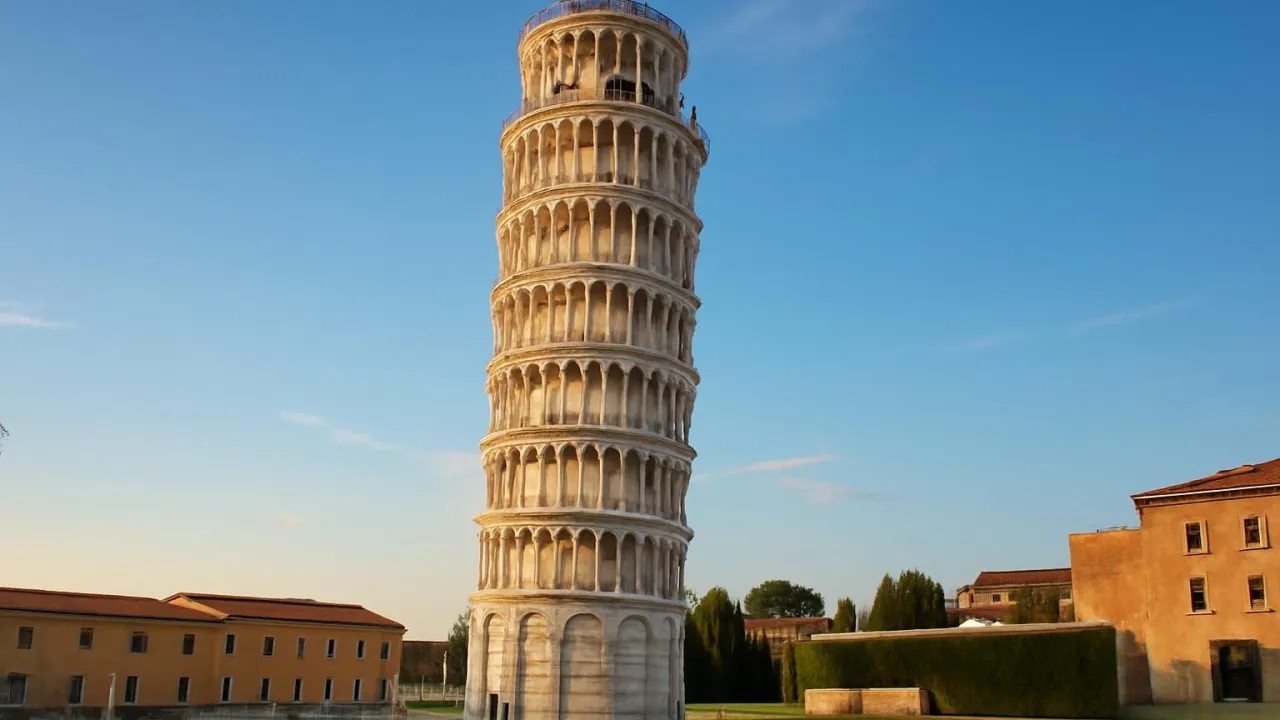
The tower leans about 16 feet from straight at the top!
✨ Word Sparks (Grade 2 Glossary)
Tap 🔊 to hear
spiral
A shape that winds around
tilt
To slant or lean over
view
What you see from a place
🪝
Have you ever seen a building that leans but does not fall?
1
A Tower That Tilts
The Leaning Tower of Pisa leans far to one side, but it stays up. Many people visit to see how it stands. It looks like it might tip over, but it never does.
2
Climbing the Steps
Inside the tower, there are stairs you can climb. Visitors walk up to the top and look out over the city. The is beautiful and high above the ground.
3
Why Does It Lean?
The ground under the tower is soft and sandy, making it . Builders tried to fix it, but the tower kept leaning. Now, it is famous for its funny tilt.
The Leaning Tower has stood for over 650 years—even with its famous tilt!
✨ Word Sparks (Grade 3 Glossary)
Tap 🔊 to hear
subsidence
Ground sinking under a building
marble
A smooth, hard white stone
spiral staircase
Stairs that twist in a circle
🪝
Can you imagine walking up a tower that feels like it’s tipping over?
1
A Curious Leaning Wonder
The Leaning Tower of Pisa is famous for its unexpected tilt. When you see it, you might wonder how it stands without falling. The tower’s lean began while it was being built. People from all over the world come to take photos of its unique shape.
2
How the Tower Was Built
The tower was started in 1173, using white and limestone. Builders did not know the ground was too soft and sandy for such a heavy structure. As they added more stories, the tower began to lean more and more. They tried to fix it by building higher sides, but the tilt stayed.
3
Climbing and Exploring Inside
Inside, a winds up through eight stories. Visitors can climb 294 steps to reach the top. The climb feels strange because the stairs tilt with the tower’s lean. At the top, you can see the city and the green fields around Pisa.
4
Why the Tower Still Stands
The Leaning Tower’s survival is an engineering mystery. The soft soil under the tower caused uneven sinking, called . Engineers have used weights and underground supports to stop it from falling. Today, the tower leans at about a four-degree angle, but it is safe for visitors.
1. Why did the tower start to lean during construction?
2. What do engineers use to help keep the tower safe?
🤯 Mind-Blowing Fact • Grade 4
The Leaning Tower’s tilt was once so extreme that it was closed for over a decade for repairs!
✨ Word Sparks (Grade 4 Glossary)
Tap 🔊 to hear
Romanesque
A style with round arches and thick walls
foundation
The base that supports a building
subsidence
When ground sinks unevenly under weight
🪝
What secrets keep a leaning tower standing tall for centuries?
1
A Medieval Marvel with a Tilt
If you walk through Pisa’s Piazza dei Miracoli, you’ll spot a tower that seems to defy gravity. The Leaning Tower of Pisa’s famous tilt began during its construction in the 12th century, when builders realized the ground beneath was too soft for its heavy stone base. As each new level was added, the tilt grew more noticeable, turning the tower into a global curiosity. Today, millions of visitors come to marvel at its remarkable angle and beautiful design.
2
How the Tower Was Engineered
The tower was built from marble and limestone, rising to eight stories and standing about 185 feet tall. Its was only about 10 feet deep, which was not enough to support its massive weight on the unstable, sandy soil. Over time, the ground settled unevenly—a process called —causing the tower to lean further with every year. Engineers in later centuries tried to correct the tilt by adding extra stone and even lead weights to balance it.
3
Climbing the Spiral Steps
Inside the tower, a spiral staircase with 294 steps winds upward through the eight stories. As visitors climb, they can feel the strange tilt under their feet, making the experience both exciting and a little dizzying. At the top, the view stretches across Pisa and the lush Tuscan countryside. The tower’s bell chamber once rang out to signal important city events.
4
Saving a World Landmark
By the late 20th century, the Leaning Tower was in danger of collapsing due to its increasing tilt. Modern engineers used advanced techniques, such as removing soil from beneath the higher side and installing underground anchors, to stabilize the structure. Thanks to their efforts, the tower is now safe for visitors and remains one of the world’s most recognized landmarks, symbolizing both human error and incredible engineering.
1. Why was the tower’s foundation not deep enough?
2. What did engineers do to save the tower in modern times?
🤯 Mind-Blowing Fact • Grade 5
Engineers reduced the tower’s tilt by more than 18 inches (45 centimeters) without changing its famous look!
✨ Word Sparks (Grade 5 Glossary)
Tap 🔊 to hear
center of mass
The point where an object balances
counterweight
A heavy object that balances another
soil mechanics
Science of how soil holds weight
🪝
What if a world-famous tower leaned so far it nearly toppled, yet engineers saved it for future generations?
1
Gravity’s Challenge: The Tower’s Legendary Lean
Imagine standing at the base of a marble tower that leans over 16 feet from vertical, yet has survived earthquakes, storms, and centuries of curious visitors. The Leaning Tower of Pisa’s iconic tilt began in 1178, just five years after construction started, due to the weak, compressible clay and sand beneath its shallow 10-foot foundation. As the tower rose, the imbalance became more pronounced, eventually reaching a tilt of nearly 5.5 degrees by the late 20th century, making it a global symbol of both architectural miscalculation and human ingenuity.
2
Engineering Missteps and Medieval Solutions
The tower was constructed in three stages over nearly 200 years, using dense white marble and limestone quarried from nearby mountains. As the tilt increased, medieval builders attempted to compensate by making the upper stories taller on one side, resulting in a subtle curve visible from a distance. Despite these efforts, the subsidence continued, and the bell chamber at the top was completed in 1372 with a significant lean. The tower’s total height is about 185 feet (56 meters), and its base diameter is 50 feet (15.5 meters), making its proportions both elegant and unstable.
3
Physics of Stability: Why Doesn’t It Fall?
The tower’s survival is a fascinating lesson in physics and engineering. Its remains within the base, even at its maximum tilt, preventing collapse. Over the centuries, the structure’s hollow cylindrical shape, thick walls, and heavy base have provided enough stability to withstand both gravity and seismic activity. However, by 1990, the tilt had become so severe that the tower was closed to the public for safety, prompting an international rescue effort.
4
Modern Engineering Triumphs
To save the tower, engineers removed 77 tons of soil from beneath the raised north side, gradually reducing the tilt to a safer 3.97 degrees. They also added lead , steel cables, and deep underground anchors to stabilize the foundation without altering the tower’s historic appearance. These interventions, completed by 2001, not only preserved the landmark but also turned it into a case study for and structural preservation worldwide.
5
A Lasting Legacy and Global Symbol
Today, the Leaning Tower of Pisa attracts millions of visitors annually, who marvel at its peculiar angle and climb its 294 spiral steps for panoramic views. The tower stands as a testament to the challenges of medieval construction, the necessity of scientific analysis, and the creativity of modern engineering. Its story inspires architects, engineers, and curious minds to ask: How can we learn from mistakes and use science to protect our world’s wonders?