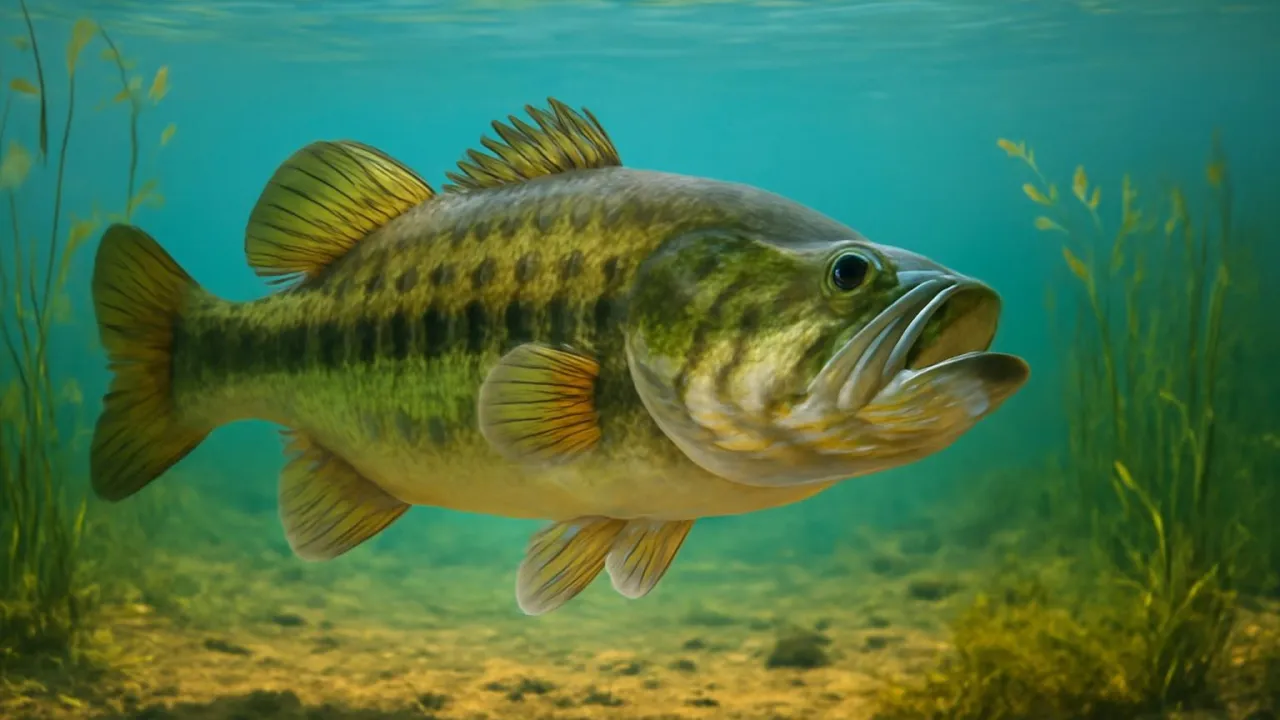
2. What does the largemouth bass use to catch food?
🤯 Mind-Blowing Fact • Grade 2
Largemouth bass can open their mouths as wide as their body length!
✨ Word Sparks (Grade 2 Glossary)
Tap 🔊 to hear
freshwater
Water that is not salty, like lakes or rivers.
prey
Animals that other animals eat for food.
plants
Green things that grow in water or on land.
🪝
Have you ever seen a fish open its mouth very wide to eat?
1
Where It Lives
The largemouth bass lives in lakes and rivers. It likes places with lots of and calm water. These plants help it hide from other animals and stay safe.
2
What It Eats
It eats smaller fish, insects, and tiny water animals. It swims quickly to catch its near . Its big mouth helps it grab food easily and swallow it whole.
3
How It Looks
This fish is greenish with dark stripes on its sides. It can grow up to two feet long and weigh several pounds. Its large mouth is its special feature for hunting.
1. Why do largemouth bass like places with plants?
2. What helps the largemouth bass catch its food?
🤯 Mind-Blowing Fact • Grade 3
Largemouth bass can open their mouths wider than their own heads to catch large prey!
✨ Word Sparks (Grade 3 Glossary)
Tap 🔊 to hear
camouflage
Colors or patterns that help animals hide.
prey
Animals that are hunted and eaten by others.
adaptation
A body part or behavior that helps survival.
🪝
Did you know largemouth bass use their big mouths to catch fast prey underwater?
1
Habitat and Camouflage
Largemouth bass live in freshwater lakes and slow rivers. Their greenish color helps them among plants. This keeps them hidden from predators. They often stay near underwater plants to ambush .
2
Diet and Hunting
They are carnivores and eat smaller fish, insects, and amphibians. Their large mouths allow them to swallow whole. They use quick bursts of speed to catch food. This hunting style helps them survive in competitive waters.
3
Physical Features
The largemouth bass has a wide mouth that extends past its eyes. This feature is rare among fish and helps catch bigger . Their bodies are strong and muscular for fast swimming. Dark stripes along their sides break up their outline.
4
Life Cycle and Growth
Largemouth bass lay eggs in shallow nests near plants. The male guards the eggs until they hatch. Young bass grow quickly by eating small insects. They mature after one year and can live up to 16 years.
2. What is special about the largemouth bass's mouth?
🤯 Mind-Blowing Fact • Grade 4
Largemouth bass can strike prey with bursts of speed reaching up to 20 miles per hour underwater!
✨ Word Sparks (Grade 4 Glossary)
Tap 🔊 to hear
ecosystem
All living and nonliving things in one place.
predator
An animal that hunts other animals for food.
reproduction
How animals have babies and make more animals.
🪝
How does the largemouth bass’s big mouth help it survive in watery ecosystems?
1
Ecosystem Role and Habitat
Largemouth bass live in freshwater lakes and rivers across North America, where they play a key role as . Their presence helps control populations of smaller fish and insects, maintaining a balanced food web. They prefer habitats with dense aquatic plants, which provide shelter and hunting grounds. These plants also support oxygen levels and water quality, benefiting the entire .
2
Physical Adaptations and Hunting
The largemouth bass’s wide mouth allows it to capture large prey, including fish and amphibians, by quickly engulfing them whole. Its powerful muscles and streamlined body enable rapid bursts of speed to ambush prey. This adaptation gives it an advantage over slower or smaller fish. The dark lateral stripes help break up its outline, providing camouflage in vegetated waters.
3
Life Cycle and Reproduction
During spring, males build shallow nests in warm, vegetated areas to attract females. After eggs are laid, the male guards the nest aggressively until the fry hatch and become free-swimming. Juvenile bass feed on insects before shifting to larger prey as they grow. This reproductive strategy ensures higher survival rates in competitive environments.
4
Human Impact and Conservation
Largemouth bass are popular among anglers, contributing to recreational fishing economies. However, habitat loss and pollution can threaten their populations. Conservation efforts focus on protecting freshwater habitats and maintaining water quality. Sustainable fishing practices help balance human use with health.
1. Why do largemouth bass prefer habitats with many plants?
2. What helps largemouth bass catch prey quickly?
🤯 Mind-Blowing Fact • Grade 5
Largemouth bass can accelerate to speeds of 20 miles per hour to ambush prey in just seconds underwater!
✨ Word Sparks (Grade 5 Glossary)
Tap 🔊 to hear
extensible
Able to stretch or open wide easily.
apex predator
Top animal that hunts others but is not hunted.
biodiversity
Many different kinds of living things in one place.
🪝
What makes the largemouth bass a top freshwater predator with unique hunting skills?
1
Scientific Classification and Distribution
The largemouth bass, scientifically named Micropterus salmoides, belongs to the family Centrarchidae. It is native to freshwater ecosystems across the eastern and central United States and has been introduced worldwide. This species thrives in lakes, ponds, rivers, and reservoirs with abundant vegetation. Its wide distribution reflects its adaptability to diverse freshwater habitats.
2
Physiological Mechanics of Feeding
Largemouth bass possess a highly jaw that can open wider than their head length, enabling them to engulf large prey whole. Their powerful jaw muscles and suction feeding mechanics create rapid water flow to pull prey inside. This feeding adaptation allows them to consume a variety of prey sizes, from small insects to sizeable fish and amphibians.
3
Reproductive Behavior and Growth Rates
During spawning, males construct and defend nests in shallow, vegetated waters to attract females. Fertilized eggs hatch in about three days, and males guard the fry until they become free-swimming. Juveniles grow rapidly, reaching maturity within one to two years depending on environmental conditions. Largemouth bass can live up to 16 years in the wild.
4
Ecological Importance and Human Interaction
As , largemouth bass regulate prey populations, maintaining ecosystem balance and . They are highly valued in recreational fishing, contributing significantly to local economies. However, habitat degradation and pollution threaten some populations, prompting conservation efforts focused on habitat restoration and sustainable fishing practices.
5
Quantitative Comparisons and Records
Adult largemouth bass typically measure 12 to 24 inches and weigh between 1 to 5 pounds, although some exceed 10 pounds. They can strike prey with bursts of speed up to 20 miles per hour underwater. Their mouth gape can reach over 6 inches wide, allowing them to consume prey nearly half their own body size. These remarkable traits make them efficient and formidable freshwater predators.