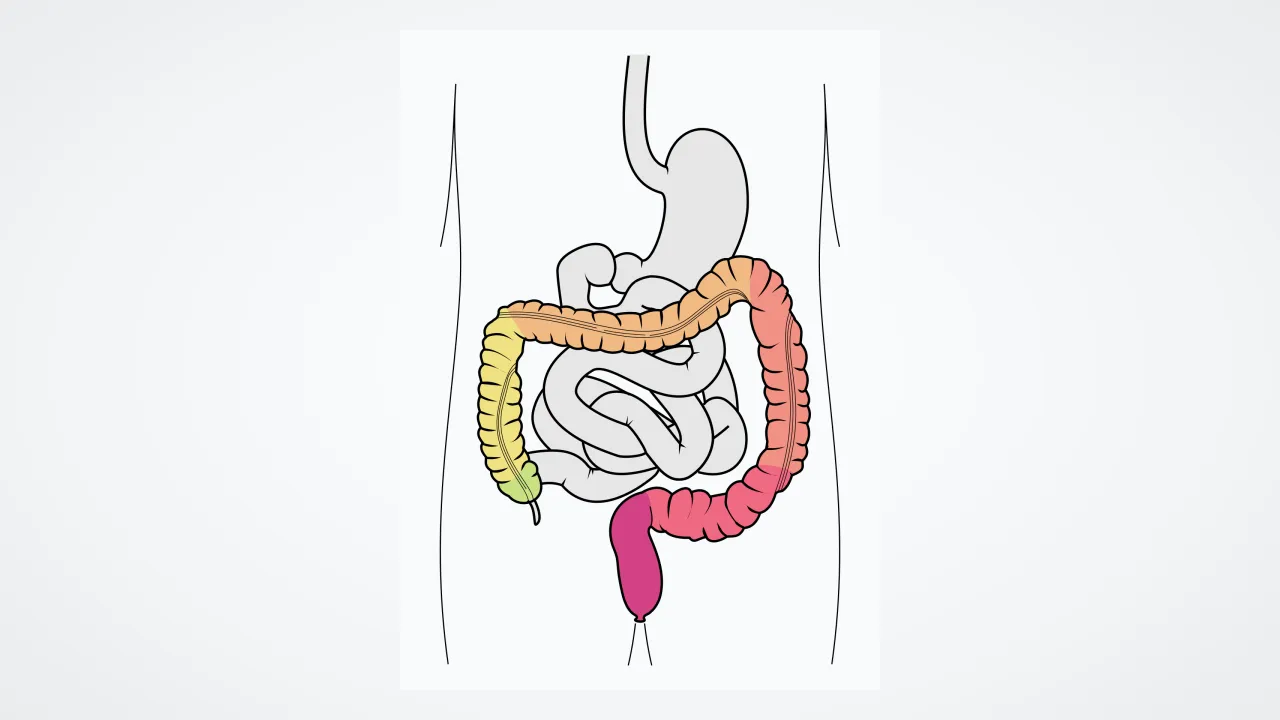
1. Why is the large intestine called 'large' if it is shorter than the small intestine?
2. What main thing does your colon soak back into your body?
🤯 Mind-Blowing Fact • Grade 2
Food spends only a few hours in your stomach, but it can take more than a full day to travel slowly through your colon!
✨ Word Sparks (Grade 2 Glossary)
Tap 🔊 to hear
Recycle
To save and use something helpful again
Fiber
Tough plant parts that keep digestion moving
Bacteria
Tiny living microbes that help inside your gut
🪝
How does a five-foot tube fit neatly inside your lower tummy?
1
Framing Your Belly
Imagine a wide, stretchy hose framing a picture inside your belly. After your small intestine takes nutrients from lunch, watery leftovers enter the large intestine. It climbs up your right side, crosses under your ribs, and slides down your left side.
2
The Water Recycler
Your body hates wasting precious water! As soupy leftovers travel slowly through the colon, the inner walls pull water and helpful salts back into your blood. Smooth muscles gently squeeze in waves to keep everything moving forward.
3
Friendly Helper Microbes
Billions of tiny, helpful live peacefully inside your colon. They snack on tough plant from apples, beans, and broccoli, making special vitamins that keep your tummy strong.
1. Which path does the colon take inside your abdomen?
2. What do the friendly bacteria inside your colon love to eat?
🤯 Mind-Blowing Fact • Grade 3
Every day, your colon rescues enough water to fill about three tall drinking glasses so you do not get dehydrated!
✨ Word Sparks (Grade 3 Glossary)
Tap 🔊 to hear
Cecum
Pouch where the large intestine first begins
Electrolytes
Important minerals like sodium that balance body fluids
Ferment
Break down plant fibers using tiny microbes
🪝
What would happen if your digestive system forgot how to save water every day?
1
The Final Stretch of Digestion
Picture a bustling recycling plant tucked neatly into your lower abdomen. By the time your meal finishes winding through the small intestine, almost all sugars, proteins, and fats have already been absorbed. What arrives at the large intestine is a liquid mixture of water, , and indigestible plant fiber.
2
Four Connected Zones
The large intestine begins at a pouch called the , where the tiny appendix hangs like a little tail. From there, the colon rises as the ascending colon, crosses as the transverse colon, and drops down as the descending and S-shaped sigmoid colon.
3
Slow Waves and Absorption
Unlike the speedy upper gut, the colon works at a calm, unhurried pace. Its muscular walls gather into small pouches called haustra that churn and press liquid against the lining. Little by little, over a liter of water returns to your bloodstream.
4
Vitamin Makers in the Dark
Trillions of harmless microbes call your colon home. As they plant fibers, they craft vitamin K and B vitamins that help your blood clot and give your cells steady energy.
1. What is the name of the starting pouch of the large intestine where the appendix attaches?
2. Which helpful nutrient do colon bacteria manufacture while breaking down fiber?
🤯 Mind-Blowing Fact • Grade 4
Three long bands of smooth muscle called taeniae coli are slightly shorter than the colon itself, bunching the tube up like a gathered drawstring bag!
✨ Word Sparks (Grade 4 Glossary)
Tap 🔊 to hear
Haustra
Pouch-like segments along the muscular colon wall
Osmosis
Movement of water across cells toward saltier areas
Mucus
Slippery protective coating made by goblet cells
🪝
Why does the widest part of your digestive tract have completely smooth walls instead of finger-like folds?
1
Built for Water Reclamation
Step inside the final five feet of your digestive highway, and you will notice an immediate change in scenery. While the small intestine bristles with millions of tiny finger-like villi for grabbing sugars and amino acids, the inner lining of the colon is smooth and dotted with deep microscopic wells called colonic crypts. Goblet cells inside these crypts coat the tunnel with slippery so material glides safely without scratching delicate tissues.
2
An Anatomical Picture Frame
Guarded by a one-way muscular doorway called the ileocecal valve, liquid chyme enters the cecum in the lower right abdomen. From there, it climbs the ascending colon toward the liver, turns sharply across the transverse colon beneath the stomach, turns again near the spleen, and travels down the descending and curved sigmoid colon toward the rectum.
3
Haustral Churning and Mass Movements
Three ribbon-like bands of lengthwise smooth muscle, known as taeniae coli, gather the colon into plump pockets called . Gentle contractions slosh liquid back and forth so sodium pumps in the lining can draw water across by . A few times a day, especially right after you eat a meal, a powerful wave called the gastrocolic reflex sweeps contents steadily forward.
4
Feeding the Lining From Within
Because dietary fiber resists human digestive enzymes, it reaches the colon intact. Resident bacteria ferment soluble fiber into short-chain fatty acids such as butyrate—the favorite fuel source of the colon's own lining cells!
1. What job does the ileocecal valve perform at the entrance of the large intestine?
2. How do goblet cells protect the inner wall of the colon?
🤯 Mind-Blowing Fact • Grade 5
Stem cells nestled at the bottom of your colonic crypts work so tirelessly that you grow a brand-new inner colon lining roughly once every week!
✨ Word Sparks (Grade 5 Glossary)
Tap 🔊 to hear
Colonocytes
Epithelial cells lining the inside of the colon
Anaerobic
Living and thriving in places without oxygen
Aquaporin
Tiny protein channel letting water cross cell walls
🪝
How do sodium pumps, smooth muscle ribbons, and trillions of anaerobic microbes collaborate to conserve over ninety percent of your gut's remaining water?
1
Precision Fluid Conservation
Every twenty-four hours, roughly 1.5 liters of watery chyme passes through the ileocecal sphincter into the large intestine, or intestinum crassum. Measuring approximately 1.5 meters (5 feet) in length and 7.6 centimeters (3 inches) in diameter, this muscular conduit performs a vital homeostatic task: reclaiming between 90 and 95 percent of incoming water alongside essential sodium, chloride, and potassium ions, leaving behind only about 100 to 150 milliliters of fluid in compacted waste.
2
Architecture of Crypts and Ribbons
Unlike the small intestine, the colon lacks circular folds and villi. Instead, its mucosal epithelium plunges inward to form millions of straight tubular glands called crypts of Lieberkühn, named after eighteenth-century German anatomist Johann Nathanael Lieberkühn. Stem cells at the base of each crypt divide rapidly, regenerating the entire colonic surface every five to seven days, while abundant goblet cells secrete a two-layered mucin shield.
3
Osmotic Gradients and Peristaltic Reflexes
actively pump sodium ions out of the lumen and into surrounding capillaries. Water effortlessly follows this osmotic gradient through specialized channels. Externally, three longitudinal muscle strips—the taeniae coli—create segmented pouches called haustra. Slow haustral contractions mix the contents every thirty minutes, whereas one to three times daily, the enteric nervous system triggers powerful mass peristalsis across the ascending, transverse, descending, and sigmoid segments.
4
An Oxygen-Free Bioreactor
Because oxygen levels inside the colonic lumen are nearly zero, obligate bacteria thrive in extraordinary density. Fermenting complex polysaccharides such as pectin, inulin, and resistant starch, these microbes synthesize menaquinone (vitamin K2), biotin, folate, and short-chain fatty acids—acetate, propionate, and butyrate—which supply up to 70 percent of the metabolic energy required by healthy .
5
Clinical Science and Preventive Health
Modern gastroenterologists study colonic motility, hydration, and fiber intake to understand how plant-rich diets nourish mucosal barriers, sustain microbial diversity, and keep human fluid balance remarkably resilient.