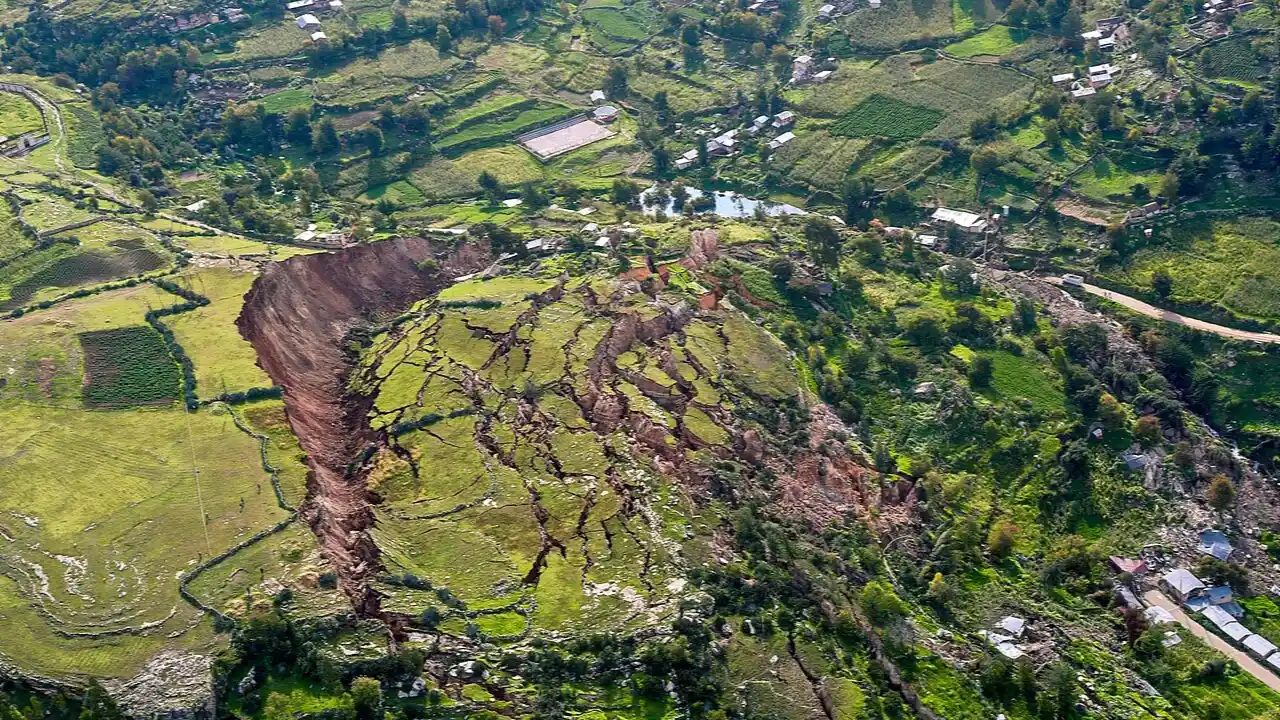
🌋 Where It FormsSteep Mountain Slopes, River Bluffs, Canyons & Submarine Shelves
💎 Key PropertiesGravity Exceeding Slope Friction via Heavy Rain, Quakes, or Wildfires
⚡ Planet Earth SparkReshapes whole mountain valleys in minutes—and tree roots act as nature's strongest hillside anchors
🤯 Mind-Blowing Fact • Grade 1
Deep tree roots weave through hillside dirt like a natural safety net that holds tons of soil in place during rainstorms!
✨ Word Sparks (Grade 1 Glossary)
Tap 🔊 to hear
landslide
Rocks and dirt sliding down a steep slope.
mudslide
Fast river of rain-soaked mud rushing downhill.
roots
Underground plant parts that hold soil firm.
🪝
What keeps dirt and rocks sitting on a steep hill—and what makes them suddenly slide down?
1
Gravity Pulls Down
Pile dry blocks too steep, and—crash!—down they tumble. Gravity pulls downward on every hill and mountain too. When rocks and soil slip downhill, that is a !
2
Add Lots of Rain
Heavy rain soaks deep into hillside dirt. Wet dirt turns heavy and slippery, rushing down like thick chocolate pudding in a !
3
Helpful Tree Roots
Strong tree and grass grip the soil tight like fingers, holding hillsides safely in place!
1. What force is always pulling downward on rocks and dirt along a steep hillside?
2. How do trees and plants help stop landslides and mudslides?
🤯 Mind-Blowing Fact • Grade 2
Fast-moving mudslides and debris flows are thick and dense enough to float cars and giant boulders right on top like corks!
✨ Word Sparks (Grade 2 Glossary)
Tap 🔊 to hear
debris
Loose pieces of rock, mud, and fallen branches.
terrace
Flat stair-like steps carved into a steep hill.
erosion
Wearing away and moving of soil and rock.
🪝
Why are bare hills after a wildfire much more likely to have mudslides when the next rainstorm arrives?
1
Friction vs. Gravity
Picture a sneaker resting on a slanted wooden board. Rough rubber friction holds the shoe still—until you tilt the board steeper or pour soapy water under it! Hillsides work the same way: rough rocks hold steady until something weakens their grip.
2
Three Big Triggers
Heavy rainstorms add weight and make clay layers slick. Strong earthquakes shake loose boulders free on mountain cliffs. Wildfires also burn away protective bushes and leave waxy ash on the soil so rainwater cannot soak in gently.
3
Smart Slope Safety
Engineers protect mountain roads by planting deep-rooted grasses, carving stair-step , and building drainpipes and wire rockfall nets!
1. Why do hillsides often experience mudslides in the rainy season right after a wildfire?
2. Which engineering project helps keep steep highway hillsides stable?
🤯 Mind-Blowing Fact • Grade 3
Tiny year-by-year 'soil creep' moves hillsides so slowly nobody sees it happening—yet you can spot its work where old tree trunks curve upward like J-hooks to stay pointed at the sun!
✨ Word Sparks (Grade 3 Glossary)
Tap 🔊 to hear
mass wasting
Downhill movement of rock and soil by gravity.
slump
Block of hillside slipping along a curved surface.
soil creep
Ultra-slow downhill inching of top hillside soil.
🪝
Did you know Earth's biggest landslides actually happen completely underwater?
1
Mass Wasting: Gravity's Family
Geologists use the umbrella term '' for every way gravity pulls rock and soil downhill without needing wind, rivers, or glaciers to carry it! Depending on speed and water content, mass wasting ranges from millimeter-per-year to roaring rockfalls and mudslides.
2
Falls, Slides, Slumps, and Flows
In a rockfall, frost wedging pries boulders off steep cliffs. In a , a curved block of hillside rotates neatly backward like a tilted chair. Add saturating rain to loose soil and ash, and solid ground transforms into a rushing mudflow or boulder-packed debris flow!
3
Natural Landslide Dams
In 1925 in Wyoming, the Gros Ventre landslide dumped 38 million cubic meters of rock across a valley in three minutes, damming a river to create three-mile-long Lower Slide Lake—still sparkling there today!
4
Submarine Giants
Even bigger slides happen unseen along continental slopes underwater, where collapsing sediment fans can stretch hundreds of kilometers across the abyssal plain!
1. How do curved, J-shaped tree trunks growing on a hillside reveal 'soil creep'?
2. Where on Earth do the largest landslides by volume actually take place?
🤯 Mind-Blowing Fact • Grade 4
Airborne LiDAR lasers can 'see' right between forest leaves to map bumpy ancient landslide scars hidden under thick woods for thousands of years!
✨ Word Sparks (Grade 4 Glossary)
Tap 🔊 to hear
pore-water pressure
Outward push of water filling spaces between grains.
debris flow
Dense, fast slurry of water, mud, and boulders.
LiDAR
Laser mapping technology revealing exact 3D ground shapes.
🪝
Why does a TINY bit of dampness help build a tall sandcastle, while TOO MUCH water makes both sandcastles and hillsides collapse?
1
The Sandcastle Secret: Pore-Water Pressure
Think about building a sandcastle at Virginia Beach! Bone-dry sand crumbles into a low pile; slightly damp sand stands in vertical castle walls because thin water films pull grains together by surface tension. Now dump a bucket of water onto that castle—splat! When water completely fills every tiny gap between soil grains, high '' pushes grains apart, destroys friction, and turns a stable hillside into a flowing mudslide!
2
Tilted Rock Layers and Undercutting
Water isn't the only culprit in Virginia SOL Earth science. When sedimentary rock layers—especially slick shale beds sandwiched beneath heavy sandstone—dip parallel to a steep valley wall, they form a natural 'slip-and-slide' plane! Rivers carving the base of a cliff, crashing coastal waves, or poorly planned road cuts that remove the supporting 'toe' of a slope can also trigger sudden translational slides.
3
Blue Ridge Cloudbursts and Debris Flows
In 1969 during Hurricane Camille's remnants, stalling mountain storms dropped over 60 centimeters of rain overnight on Virginia's Nelson County, triggering thousands of fast Blue Ridge that taught geologists how hurricanes interact with Appalachian valleys.
4
LiDAR Lasers Through the Trees
Today, aircraft bounce millions of laser pulses right through forest canopies to reveal hidden prehistoric landslide scars on bare-earth 3D maps—helping communities build safely out of harm's way!
1. Why does completely saturating hillside soil with heavy rain trigger mudslides?
2. Why is cutting away the bottom 'toe' of a steep hillside risky when building a road?
🤯 Mind-Blowing Fact • Grade 5
Intense wildfires vaporize natural oils inside chaparral bushes that re-condense inches underground as a waxy, waterproof layer—causing the next rainstorm to slide right off like water on a freshly waxed car hood!
✨ Word Sparks (Grade 5 Glossary)
Tap 🔊 to hear
Factor of Safety
Ratio comparing slope-holding strength against downward pull.
hydrophobic soil
Waxy post-wildfire soil layer that repels soaking rainwater.
colluvium
Loose weathered soil and rock resting on hillsides.
🪝
How do geotechnical engineers boil an entire mountainside's stability down into one single number called the 'Factor of Safety'?
1
Shear Strength vs. Shear Stress (`Fs`)
Every inclined slope on Earth hosts a continuous tug-of-war governed by Newtonian mechanics. Gravity acting on slope mass `mg` resolves into two components: normal stress (`g cos θ`) pressing material perpendicularly into the hill, and downslope shear stress (`g sin θ`) pulling it parallel to the slope. Geotechnical engineers express stability through the (`Fs = resisting shear strength / driving shear stress`). Whenever `Fs > 1.0`, the hillside stands firm; the instant steepening, seismic acceleration, or saturation drives `Fs < 1.0`, slope failure begins!
2
Mohr-Coulomb Failure and Effective Stress
Pioneering engineer Karl Terzaghi formulated the master equation explaining rainfall-induced mudslides: shear strength equals cohesion (`c`, from clay minerals and root fibers) plus effective normal stress multiplied by internal friction (`(σ - u) tan φ`), where `u` is pore-water pressure. As torrential rain raises the water table inside , pore pressure `u` climbs until `(σ - u)` approaches zero—canceling frictional resistance and liquefying loose regolith into a high-density Bingham-plastic debris flow.
3
Post-Fire Hydrophobicity and Oso 2014
Wildfires amplify debris-flow hazard twofold: root decay erases mechanical cohesion `c`, while vaporized plant waxes condense centimeters underground into a water-repellent ('hydrophobic') crust. Subsequent storms sheet-erode saturated ash above that barrier into canyon-scouring mudflows. Even without fire, glacial clay layers perched over groundwater—such as Washington's 2014 Oso landslide—demonstrate why LiDAR mapping of Holocene slide terraces is indispensable for land-use zoning.
4
Submarine Storegga Slide and Turbidity Currents
Around 8,200 years ago off Norway, 3,500 cubic kilometers of continental-slope sediment failed in the submarine Storegga Slide, launching turbidity currents across the North Atlantic basin and tsunamis onto Scotland.
5
InSAR Satellites and Slope Stabilization
Today, engineers combine rock bolts, shotcrete, horizontal weep drains, and satellite radar interferometry (InSAR)—capable of spotting millimeter-scale pre-failure creep from orbit—to safeguard mountain corridors.