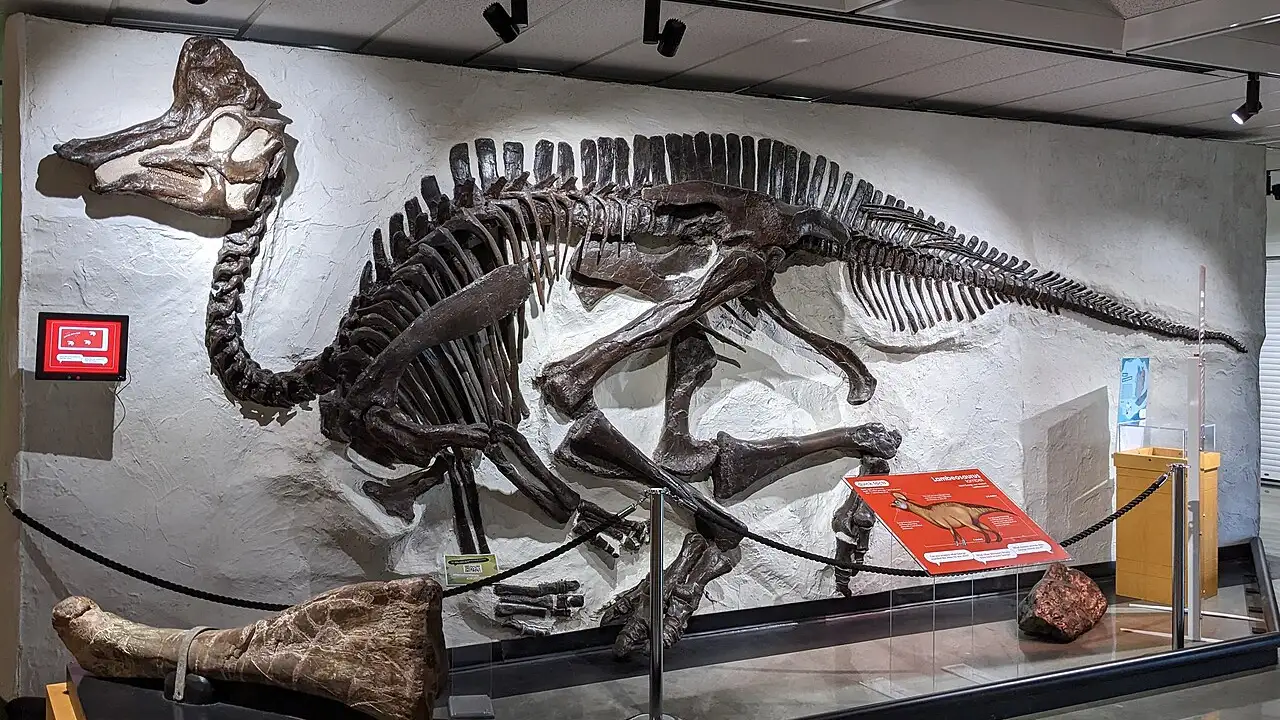
1. How many distinct parts made up the cool head crest of Lambeosaurus?
2. Which part of Lambeosaurus's two-part crest held hollow sound tubes?
🤯 Mind-Blowing Fact • Grade 2
Lambeosaurus could hold up to 700 teeth in its jaws at once, with three or four spare teeth stacked under every active chewing tooth!
✨ Word Sparks (Grade 2 Glossary)
Tap 🔊 to hear
Pioneering
Exploring new discoveries before anyone else
Prong
A long pointed projection sticking backward
Spare
An extra piece kept ready as replacement
🪝
Why is this famous Canadian dinosaur named 'Lambe's lizard twice'?
1
Double Tribute to a Scientist
Splash! Gentle ripples spread across a sunlit lagoon in Alberta 75.5 million years ago as a 30-foot Lambeosaurus wades ashore. Its full scientific name, Lambeosaurus lambei, honors Canadian paleontologist Lawrence Lambe not once, but twice!
2
Forward Blade, Backward Prong
While its neighbor Corythosaurus wore a smooth round helmet centered over its head, Lambeosaurus tilted a boxy, hollow hatchet blade forward above its eyes and grew a solid spike pointing straight back.
3
Built-In Grinding Machine
Even tough pine needles and woody stems stood no chance! Hundreds of stacked cheek teeth ground sideways and up-and-down like a living food processor.
1. How can you quickly tell Lambeosaurus apart from Corythosaurus?
2. Who is honored twice in the scientific name Lambeosaurus lambei?
🤯 Mind-Blowing Fact • Grade 3
Microscopic scratches on Lambeosaurus teeth revealed six different tissue layers of varying hardness, keeping every tooth self-sharpening and rough like a coarse rasp!
✨ Word Sparks (Grade 3 Glossary)
Tap 🔊 to hear
Subfamily
Branch of closely related genera inside family
Pavement
Flat grinding surface of tightly packed teeth
Rasp
Rough metal tool for filing tough wood
🪝
Why did three different species of Lambeosaurus wear slightly different hatchet hats across time?
1
Leader of the Hollow-Crests
Imagine walking through Dinosaur Provincial Park in Alberta 75.5 million years ago and hearing two totally different brass-band calls echoing from the woods! Lambeosaurus was so famous for its hollow trumpet crest that scientists named the entire hollow-crested duckbill —Lambeosaurinae—after it.
2
Changing Hats Over Time
Comparing rock layers showed how Lambeosaurus restyled its crest over hundreds of thousands of years! Lambeosaurus clavinitialis had a tiny rear bump, classic Lambeosaurus lambei grew a bold hatchet and long rear spike, and Lambeosaurus magnicristatus rocked a gigantic swooping fan crest with almost no rear spike!
3
Super-Complex Chewing
Unlike horned dinosaurs that only sliced vertically, duckbills like Lambeosaurus flexed their upper jaws outward slightly as they bit down—grinding tough plants across pebbled tooth better than modern horses!
4
Walking on Two Legs or Four
Balanced by a stiff, muscular tail, Lambeosaurus grazed calmly on all fours, then rose onto powerful hind legs to stride briskly.
1. What made Lambeosaurus magnicristatus ('big-crested') look distinct from Lambeosaurus lambei?
2. Why could Lambeosaurus grind tough plants even more thoroughly than horned dinosaurs?
🤯 Mind-Blowing Fact • Grade 4
Biomechanical tests in Science magazine crowned duckbill teeth—like those in Lambeosaurus—as the most complex grinding dentition ever evolved by any vertebrate animal, beating horses, elephants, and bison!
✨ Word Sparks (Grade 4 Glossary)
Tap 🔊 to hear
Premaxilla
Front upper jawbone stretched tall into crests
Dentine
Bone-like inner tooth layer softer than enamel
Dentition
Arrangement and structure of an animal's teeth
🪝
How did complex six-tissue teeth and evolving acoustic crests make Lambeosaurus an evolutionary powerhouse?
1
Replacing Corythosaurus in Alberta
Just as Styracosaurus succeeded Centrosaurus in the upper rock layers of Alberta's Dinosaur Park Formation around 75.6 million years ago, Lambeosaurus stepped directly onto center stage right as Corythosaurus faded out! Measuring roughly nine meters long and weighing four metric tons, this graceful herbivore dominated the lush coastal lowlands bordering the Western Interior Seaway.
2
Anatomy of a Two-Part Crest
Built from dramatic upward extensions of the and nasal bones, Lambeosaurus's signature crest tilted strongly forward over the snout rather than standing centered over the braincase. Inside the boxy anterior 'hatchet' looped paired S-curved air chambers for deep acoustic resonance, whereas the narrow posterior prong projecting behind the skull roof consisted entirely of solid premaxillary and nasal bone—likely framing skin sails for unmistakable visual silhouette.
3
Most Complex Teeth in Dinosauria
In 2012, biomechanical engineer Gregory Erickson and paleontologists discovered why hadrosaurs like Lambeosaurus thrived globally: whereas mammal teeth combine four tissue types, duckbill dental batteries wove six distinct tissues! As wear stripped softer faster than hard enamel ridges, each multi-hundred-tooth block maintained sharp grinding crests for chopping horsetails, conifers, and angiosperms.
4
Sorting Out Growth Stages
Like Corythosaurus, tiny round-skulled Lambeosaurus youngsters looked so different from hatchet-crested adults that early hunters named them 'Tetragonosaurus' until growth series connected the family album!
1. How many distinct tissue types made up the self-sharpening grinding teeth of hadrosaurs like Lambeosaurus?
2. How does Lambeosaurus fit chronologically with Corythosaurus in Dinosaur Provincial Park?
🤯 Mind-Blowing Fact • Grade 5
Instead of sliding its lower jaw sideways like a cow, Lambeosaurus used 'pleurokinesis'—hinging its upper cheek bones outward slightly on every bite so hundreds of teeth ground plants automatically!
✨ Word Sparks (Grade 5 Glossary)
Tap 🔊 to hear
Pleurokinesis
Upper jaw flexing outward slightly during chewing
Biostratigraphy
Dating rock layers using the fossils inside
Anterodorsally
Angled upward and forward toward the snout
🪝
What do pleurokinetic jaw mechanics, six-tissue dental histology, and stratigraphic succession reveal about Lambeosaurus?
1
Eponym of Lambeosaurinae
After Canadian paleontologist Lawrence Lambe described perplexing crested skull material from Alberta's Red Deer River as Stephanosaurus in 1914—and passed away in 1919—William Parks honored his colleague in 1923 by erecting Lambeosaurus lambei, which simultaneously became the type genus of the subfamily Lambeosaurinae. Spanning 76 to 75 million years ago across the upper Dinosaur Park Formation, this nine-meter (30-foot), four-metric-ton herbivore succeeded Corythosaurus as the dominant crested hadrosaurid on northern Laramidia's coastal floodplains.
2
Bipartite Cranial Crest Evolution
Constructed from hypertrophied premaxillary and nasal elements, the adult Lambeosaurus crest projected ahead of the orbits in a sub-rectangular 'hatchet' housing paired S-looped respiratory diverticula, counterbalanced posteriorly by a solid, caudodorsally directed nasal-premaxillary spine. High-precision by David Evans and Robert Reisz documented sequential species replacement: transitional L. clavinitialis gave way to classic L. lambei, culminating in rare uppermost-zone L. magnicristatus (~75.2 MYA), which inflated an immense, forward-arcing premaxillary sail while shrinking its posterior spine.
3
Pleurokinesis and Six-Tissue Dental Batteries
Hadrosaurid evolutionary dominance rested equally on oral mechanics. Lacking a mobile lower-jaw side-swing like mammals, Lambeosaurus employed : as the lower mandibles adducted upward, hinged maxillae rotated slightly outward along streptostylic quadrate joints, driving upper and lower dental pavements in a power-shearing and transverse-grinding stroke! In 2012, Gregory Erickson, Brandon Krick, and colleagues demonstrated that hadrosaurid teeth integrated six distinct tissues (enamel, orthodentine, secondary dentine, coronal cementum, giant tubules, and mantle dentine), surpassing even equids and proboscideans in wear-induced surface complexity.
4
Ontogenetic Allometry and Acoustic Ecology
Endocranial CT scans confirm juvenile Lambeosaurus—historically misclassified as 'Tetragonosaurus'—lacked external crests until reaching roughly half adult body length, when positive premaxillary allometry tuned species-specific low-frequency calls matched to elongated cochlear lagenae.
5
Skin Impressions and Locomotor Balance
Preserved integumentary molds document uniform, small polygonal basement tubercles across the neck, flanks, and deep, tendon-latticed tail, completing a vivid portrait of one of Late Cretaceous North America's most vocally and dentally sophisticated megaherbivores.