1. How did Kronosaurus push itself through the ocean?
2. Was Kronosaurus a dinosaur?
🤯 Mind-Blowing Fact • Grade 2
The largest teeth in a Kronosaurus jaw grew up to eleven inches long, including their deep roots!
✨ Word Sparks (Grade 2 Glossary)
Tap 🔊 to hear
inland sea
A shallow ocean covering part of a continent
pliosaur
A short-necked, big-headed prehistoric sea reptile
ammonite
An ancient squid relative with a coiled shell
🪝
How could an ocean hunter swim fast with a short tail and four flippers?
1
Swimming Over Ancient Australia
Splash into the Early Cretaceous Period! Over one hundred million years ago, a cool covered much of Australia. Through those sunlit waters glided Kronosaurus, one of the largest short-necked sea reptiles ever found.
2
Built Like an Underwater Jet
Unlike long-necked plesiosaurs, Kronosaurus had a thick, muscular neck and a massive head nearly nine feet long. Four wing-shaped flippers powered its barrel-shaped body forward in smooth, sweeping strokes, while its short tail helped steer.
3
Lunch in the Inland Sea
Because it was an air-breathing reptile, Kronosaurus rose to the surface for fresh breaths. Then it dived deep to snatch fast squid, coiled , and large fish with its sturdy cone-shaped teeth.
1. Where did Kronosaurus live during the Early Cretaceous Period?
2. Why did Kronosaurus have to swim up to the ocean surface?
🤯 Mind-Blowing Fact • Grade 3
Unlike shark teeth with sharp cutting edges, Kronosaurus teeth were round and ridged like sturdy cones designed to grip and crush shells!
✨ Word Sparks (Grade 3 Glossary)
Tap 🔊 to hear
propulsion
The force that pushes something forward
gastroliths
Swallowed stones kept inside an animal's stomach
buoyancy
How easily an object floats or sinks
🪝
What happens when a marine reptile swaps a long swan neck for a nine-foot skull?
1
Terror of the Eromanga Sea
Picture central Australia covered not by red desert sand, but by a cool, bustling inland ocean called the Eromanga Sea. Around 110 million years ago, Kronosaurus patrolled these waters as the undisputed top predator, stretching roughly thirty-three feet from snout to tail.
2
Pliosaur Power Design
Kronosaurus belonged to a group of marine reptiles called pliosaurs. While their cousins, the plesiosaurs, had tiny heads on snake-like necks, pliosaurs flipped that blueprint completely. Kronosaurus carried a gigantic triangular skull anchored to a short, powerful neck built to handle heavy prey.
3
Four-Winged Propulsion
Scientists tested robot flippers in water tanks to solve how four-flippered reptiles swam so swiftly. When the front flippers flapped, they left swirling water currents behind. By timing its back flippers to catch those currents, Kronosaurus gained an extra burst of forward thrust!
4
Fossil Clues Inside the Belly
Fossilized stomach contents found in Queensland reveal that Kronosaurus hunted turtles, sharks, squid, and even smaller plesiosaurs. Smooth rounded stones called also rested inside its ribs, possibly helping adjust during deep dives.
1. How did Kronosaurus differ from its long-necked plesiosaur cousins?
2. How did the back flippers boost Kronosaurus's swimming speed?
🤯 Mind-Blowing Fact • Grade 4
Harvard's famous Kronosaurus mount earned the playful nickname 'Plasterosaurus' after researchers realized extra plaster vertebrae had stretched its spine!
✨ Word Sparks (Grade 4 Glossary)
Tap 🔊 to hear
hydrofoils
Wing-shaped surfaces that lift and slice through water
apex predator
A top hunter with no natural predators
vertebrae
Individual interlocking bones that form a spine
🪝
Why did a famous museum skeleton once trick scientists into thinking Kronosaurus was bigger than it really was?
1
Apex Hunter of High-Latitude Waters
Beneath the chilly waves of Early Cretaceous Australia, Kronosaurus queenslandicus reigned as an . During that era, Australia sat much closer to the South Pole than it does today, meaning the shallow Eromanga Sea experienced cool seasonal temperatures. Measuring thirty to thirty-six feet long and weighing roughly eleven tons, Kronosaurus likely maintained an elevated body temperature to power active chases through cold water.
2
Biomechanics of Underwater Flight
Rather than undulating its spine side to side like a mosasaur or shark, Kronosaurus practiced subaqueous flight. All four limbs formed stiff, tapered supported by tightly packed finger and toe bones. Massive pectoral and pelvic bone plates anchored layers of muscle on the underside of its torso, driving synchronized strokes that launched this ten-ton hunter swiftly toward unsuspecting prey.
3
Conical Fangs and Crushing Jaws
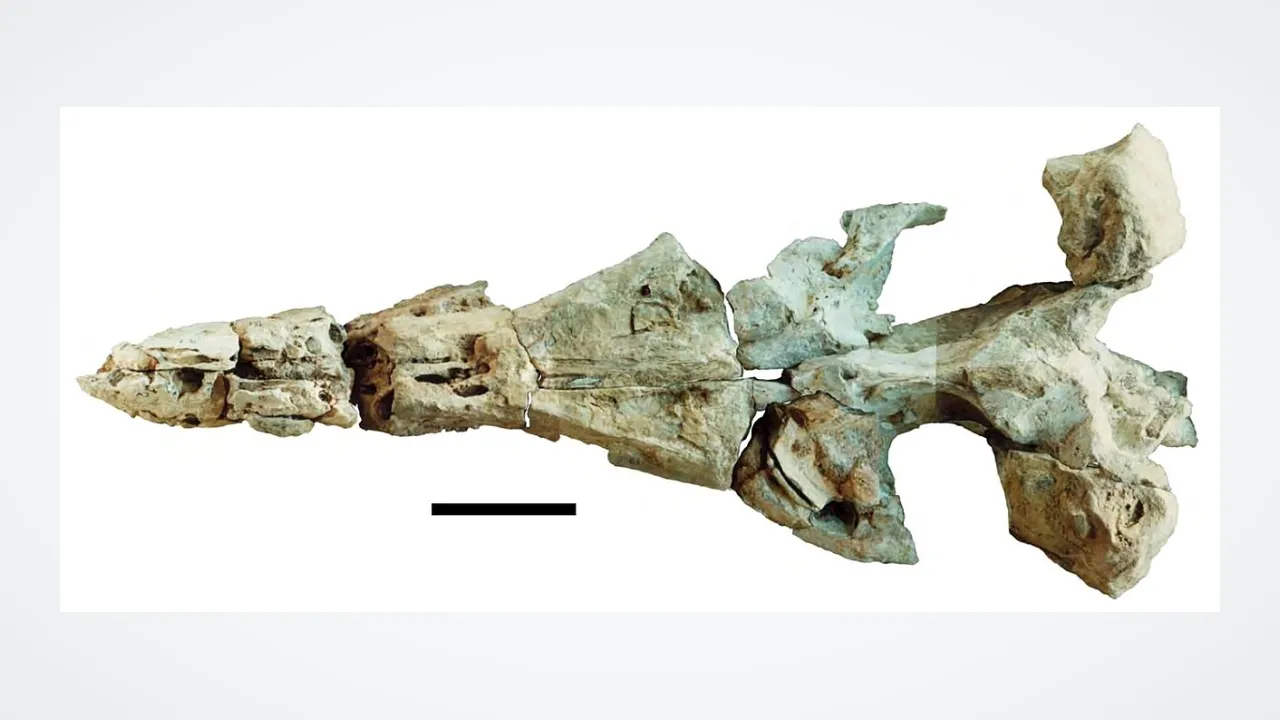
Measuring up to nine feet long, a Kronosaurus skull took up more than a quarter of its total body length. Its jaws held conical teeth lacking serrated slicing blades; instead, distinct enamel ridges strengthened each tooth against snapping. Bite marks preserved on fossilized elasmosaur skulls and sea turtle shells prove Kronosaurus relied on immense jaw muscles to clamp and shake large targets.
4
The Mystery of Plaster Vertebrae
For decades, books listed Kronosaurus at forty-two feet long based on a famous skeleton mounted at Harvard University in the 1950s. Later paleontologists inspected the display closely and discovered restorers had added too many plaster backbone segments to fill missing gaps! Modern fossil comparisons trim its true length to about thirty-three feet—still a colossal ruler of Cretaceous seas.
1. Why did older books overestimate Kronosaurus at forty-two feet long?
2. What feature made Kronosaurus teeth suited for gripping hard shells without breaking?
🤯 Mind-Blowing Fact • Grade 5
Isotope studies of Eromanga Sea fossils suggest Kronosaurus hunted in waters where winter sea ice occasionally formed, making it an ancient polar-zone super-predator!
✨ Word Sparks (Grade 5 Glossary)
Tap 🔊 to hear
endothermy
Generating internal body heat to stay warm
hyperphalangy
Having extra finger bones inside a flipper
vortices
Swirling rings of spinning water or air
🪝
How did four-flippered propulsion and thermal adaptations let Kronosaurus dominate near-polar Cretaceous seas?
1
Cold Seas of Ancient Gondwana
Imagine diving into the Eromanga Sea 110 million years ago, when Australia remained tethered near Antarctica along the southern margin of Gondwana. Chemical isotopes locked inside fossil shells reveal these waters dropped near freezing during winter months. Yet Kronosaurus queenslandicus thrived here at lengths of nine to eleven meters and masses approaching twelve metric tons, using probable —internal body heat generated by active muscles—to outpace sluggish cold-blooded prey.
2
Tandem-Hydrofoil Fluid Dynamics
Kronosaurus belonged to Brachaucheniinae, the final evolutionary branch of giant pliosaurids that survived into the Cretaceous after Jurassic relatives vanished. Its locomotion relied on four elongated paddles strengthened by , an evolutionary multiplication of finger bones that created rigid hydrofoils. Biofluid experiments demonstrate that tandem flippers can boost thrust efficiency by up to forty percent when the hind pair intercepts swirling shed by the foreflippers, granting explosive ambush acceleration.
3
Cranial Architecture and Trophic Role
Stretching roughly 2.7 meters, the skull of Kronosaurus functioned as a biological hydraulic press. Huge temporal fenestrae—openings behind the eye sockets—provided anchor space for massive jaw-closing musculature. Unlike Jurassic pliosaurs such as Pliosaurus, which possessed trihedral cutting teeth, Kronosaurus evolved robust conical teeth with longitudinal enamel ridges. This dentition excelled at puncturing armored ammonites, protostegid turtles, and elasmosaurid plesiosaurs.
4
Discovery in Queensland Limestone
Science first met Kronosaurus in 1899 when Andrew Crombie unearthed a fragment of jawbone bearing six giant teeth near Hughenden, Queensland. Initially mistaken for an ichthyosaur by museum director Heber Longman until fuller fossils emerged in 1924, the genus gained global fame after a 1931–1932 Harvard expedition blasted four tons of limestone nodules containing an almost complete skeleton from Army Downs.
5
Revising a Paleontological Icon
When preparators reconstructed that Harvard specimen in the 1950s, they sculpted missing spinal segments with plaster, inflating the vertebral count and stretching the mount to 12.8 meters. Subsequent discoveries of complete articulated Queensland fossils allowed paleontologist Colin McHenry to recalibrate Kronosaurus to roughly ten meters with fewer dorsal vertebrae, proving how fresh fossil evidence continually sharpens scientific accuracy.