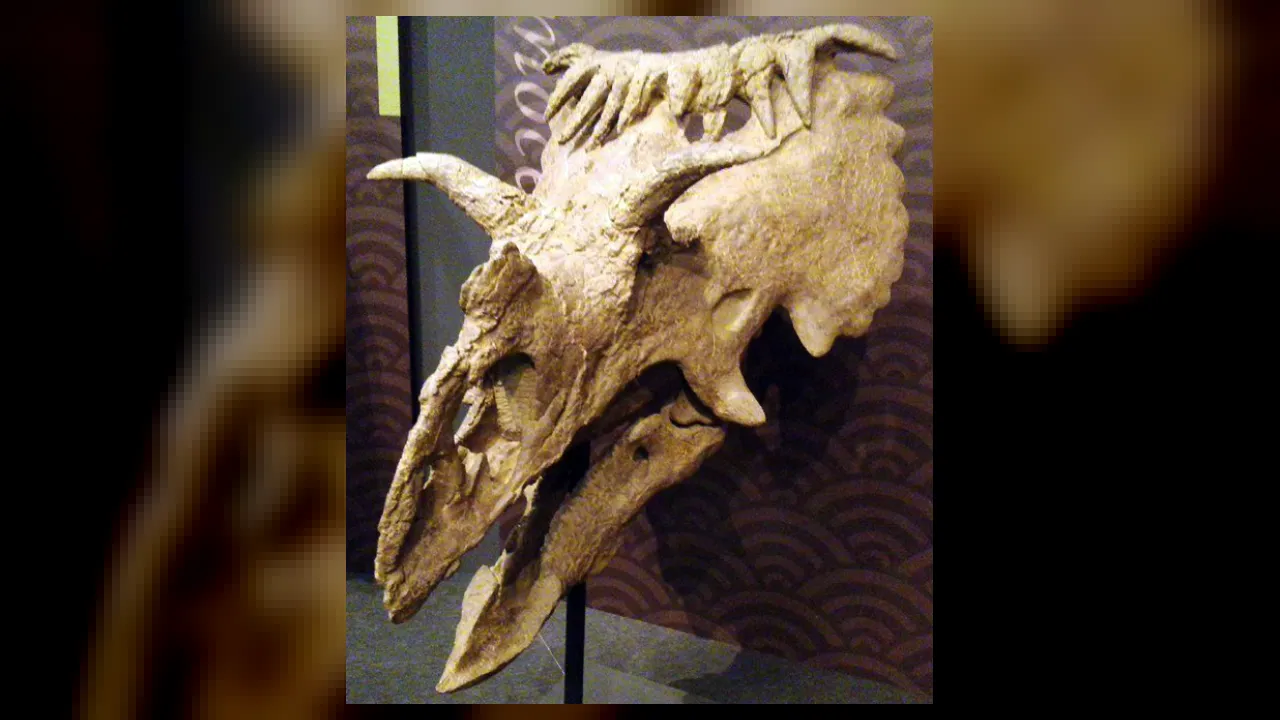
1. How many horns and horn-like hooks decorated a Kosmoceratops skull?
2. Which way did the ten hooks at the top of Kosmoceratops's frill curl?
🤯 Mind-Blowing Fact • Grade 2
Its skull was so heavy and precious in Utah's roadless wilderness that a helicopter had to airlift the plaster-wrapped fossil off the cliff!
✨ Word Sparks (Grade 2 Glossary)
Tap 🔊 to hear
Wilderness
Wild natural land far away from roads
Jousting
Pushing or clashing horns head-to-head
Airlift
To carry heavy cargo through air by helicopter
🪝
Why did Kosmoceratops grow horns pointing sideways and hooks curling down like bangs?
1
Fanciest Face in Utah
Rustle! Giant palm fronds part in a steamy Utah wetland 76 million years ago to reveal the flashiest face of the Cretaceous Period. Meet Kosmoceratops, whose name means 'ornate horned face'! Measuring 15 feet long, it carried 15 bony points on one skull.
2
Useless for Jousting, Great for Bragging
Look where its horns aimed: two slender brow horns stuck straight out sideways, and ten claw-like hooks folded forward across its wide, short frill! Because they pointed away from predators, scientists know this fancy headgear was meant for showing off to other Kosmoceratops.
3
Adding Up All Fifteen
Ten frill hooks, two sideways brow horns, two spiky cheekbones, and one flat blade-shaped nose horn completed its dazzling look!
1. Which direction did the brow horns above Kosmoceratops's eyes point?
2. Why do scientists think Kosmoceratops's 15 horns were mainly for visual display?
🤯 Mind-Blowing Fact • Grade 3
Volunteer fossil hunter Scott Richardson found two Kosmoceratops skulls on the same trip, earning the species name Kosmoceratops richardsoni in his honor!
✨ Word Sparks (Grade 3 Glossary)
Tap 🔊 to hear
Volunteer
Helper who gives time freely to science
Blade
A flat, narrow edge rather than round
Jugal
Pointed cheekbone framing the side of face
🪝
How did Kosmoceratops hide inside the long-frilled dinosaur family while wearing a short, wide frill?
1
A Surprise in the Family Tree
When Scott Richardson spotted two skulls poking out of Utah's Grand Staircase-Escalante rocks in 2007, scientists expected something familiar. Once cleaned in the lab, Kosmoceratops richardsoni left everyone speechless with 15 separate horns and hooks!
2
Widest Short Frill in Town
Even more surprising, Kosmoceratops belonged to the chasmosaurines—the 'long-frilled' family! Yet its frill was twice as wide as it was long, with small windows and ten forward-curling hooks draped over the top rim like bangs.
3
Counting Every Point
Starting from the front, it wore a flat -shaped nose horn, two sideways-sweeping brow horns, two pointed cheek spikes, eight central hooks folded forward over its frill, and two outer hooks pointing sideways!
4
Sharing Swamps With Neighbors
Bold headgear worked like a team jersey in misty Utah swamps, helping Kosmoceratops recognize its own species instantly alongside neighbors Nasutoceratops and Utahceratops.
1. What surprised paleontologists about the proportions of Kosmoceratops's chasmosaurine frill?
2. Who discovered the two original skulls of Kosmoceratops in Utah?
🤯 Mind-Blowing Fact • Grade 4
Despite belonging to the 'long-frilled' chasmosaurine subfamily, Kosmoceratops actually had the shortest frill relative to width and the smallest frill openings of any chasmosaurine!
✨ Word Sparks (Grade 4 Glossary)
Tap 🔊 to hear
Transversely
Measured sideways across from left to right
Epijugal
Horn-like bone capping the pointed cheek
Selection
Evolution favoring traits that boost mating success
🪝
What drove Kosmoceratops to evolve the most flamboyant fifteen-horned skull in dinosaur history?
1
Runaway Sexual Selection
Unveiled in 2010 by paleontologist Scott Sampson, Mark Loewen, and colleagues, Kosmoceratops richardsoni hails from a narrow 100,000-year slice of Utah's Kaiparowits Formation (~76 million years ago). Weighing about 1.3 metric tons and measuring 4.5 meters long, it showcases runaway sexual —the same evolutionary force that gave peacocks extravagant tails and Irish elk giant antlers to win mates and intimidate rivals without bloodshed.
2
Anatomy of Fifteen Ornaments
Every region of its skull carried modified ornaments. A laterally compressed, flat-topped nasal blade sat behind an upturned snout; elongated postorbital brow horns jutted straight laterally at 90 degrees before dipping at the tips; and prominent spikes flared from both cheeks. Crowning its remarkably short, wide parietal-squamosal shield—twice as broad as anteroposteriorly—curled ten fused hook-like processes: eight draped anteriorly like bangs and two angled outward.
3
Why Not Built for Combat?
Pointing brow horns sideways left its forehead open, while folding parietal hooks forward flush against the frill neutralized them as spears. Clearly, visual impact when bowing its head took top evolutionary priority!
4
Growth Rate Clues
Histological studies of Kaiparowits ceratopsids confirmed Kosmoceratops grew rapidly like warm-blooded animals, fueled by year-round subtropical wetland vegetation along southern Laramidia.
1. How does sexual selection explain why Kosmoceratops evolved fifteen weirdly angled horns?
2. How was the nasal horn of Kosmoceratops shaped compared to Centrosaurus's round cone?
🤯 Mind-Blowing Fact • Grade 5
Evolutionary family trees revealed that slightly younger Vagaceratops up in Canada was Kosmoceratops's closest cousin—showing descendants of Utah's fancy chasmosaurines eventually marched north!
✨ Word Sparks (Grade 5 Glossary)
Tap 🔊 to hear
Episquamosal
Decorative bone fused along outer side of frill
Procurved
Curving forward toward the front of head
Gracile
Slender and graceful in build rather than thick
🪝
How did Kosmoceratops richardsoni challenge hypotheses of dinosaur growth, island metabolism, and cranial evolution?
1
Discovery in the Kaiparowits Badlands
In 2007, volunteer crew member Scott Richardson discovered two ceratopsid skulls—an adult holotype (UMNH VP 17000) and a disarticulated subadult—high in the roadless badlands of southern Utah's Grand Staircase-Escalante National Monument. Airlifted out by helicopter and formally named Kosmoceratops richardsoni in 2010 by Scott Sampson, Mark Loewen, Andrew Farke, and colleagues (from the Greek kosmos, 'ornamented'), this 4.5-meter (15-foot), 1.3-ton herbivore lived roughly 76.0 to 75.9 million years ago.
2
Fifteen Homologous Cranial Processes
Holding the undisputed record as the most ornate dinosaur skull known to science, Kosmoceratops carried fifteen well-developed horns and horn-like structures: one laterally compressed, flat-topped nasal blade; two postorbital horncores projecting laterally from the skull roof; two prominent epijugal cheek bosses; and ten strongly recurved marginal hooks (six epiparietals, two spanning the parietal-squamosal suture, and two ) folded anteriorly across a short frill twice as wide transversely as long.
3
Socio-Sexual Signaling Over Antipredator Defense
Paradoxically nested well inside Chasmosaurinae—closely allied to Alberta's Vagaceratops irvinensis—Kosmoceratops reversed classic chasmosaurine geometry by shrinking its parietal fenestrae and shortening its shield. Because laterally directed brow horns and dorsal frill hooks offered negligible mechanical utility against tyrannosaurids like Teratophoneus, researchers interpret this extreme ornamentation as the product of intense socio-sexual selection within crowded subtropical habitats.
4
Testing Island-Continent Metabolism
Why could narrow Laramidia sustain so many multi-ton horned species simultaneously? Some researchers wondered if ceratopsids had lower, ectothermic-leaning food needs; however, 2019 osteohistological analyses by Carolyn Levitt-Bussian and colleagues revealed dense fibrolamellar bone without slowed island dwarfing, proving Kosmoceratops maintained rapid, high-metabolism growth rates.
5
Latitudinal Turnover and Migration
Close kinship between Utah's Kosmoceratops and slightly younger Alberta Vagaceratops suggests physical or climatic barriers across central Laramidia periodically relaxed, allowing ornate southern chasmosaurines to disperse northward around 75.5 million years ago.