🧬 HUMAN BODY
🧬 Patella • Appendicular Skeletal System (Sesamoid Bone)
VA Science & Health SOL 1.1, 3.1, 4.2, 5.1 (Cells, Organs & Body Systems)
Kneecap (Patella)
Your Built-In Pulley Shield Boosting Leg Power
Grade 1 • Early Reader • 72 words
🩺 Body System & LocationAnterior Knee Joint • Embedded Inside the Quadriceps Tendon
🔬 Size / Cell Count~2 in (5 cm) rounded triangle • Largest sesamoid bone in the body
⚙️ Core JobShields the front knee joint and acts as a pulley lever for thigh muscles
⚡ Body SuperpowerBoosts your quadriceps kicking and jumping power by ~30–50%!
🤯 Mind-Blowing Fact • Grade 1
You were born without hard bony kneecaps—yours started as soft squishy pads and turned into hard bone between ages two and six!
✨ Word Sparks (Grade 1 Glossary)
Tap 🔊 to hear
Patella
Science name for your triangular kneecap bone
Shield
Strong cover guarding what sits behind it
Groove
Smooth track where your kneecap glides neatly
🪝
Sit down, relax your leg, and gently wiggle the little shield on your knee!
1
A Little Heart Shield
Touch the front of your knee! Feel that smooth, rounded bone shaped like a tiny upside-down triangle? Doctors call your kneecap the .
2
Soft Cartilage for Babies
Guess what? Newborn babies do not have hard bony kneecaps yet! Babies crawl around on soft, squishy pads that slowly harden into bone as toddlers walk.
3
Super Jumping Helper
Tucked inside a strong leg strap, your kneecap slides up and down in a smooth to help you kick and jump high!
1. What are a newborn baby's kneecaps made of when they are first born?
2. What shape is a human patella (kneecap)?
🤯 Mind-Blowing Fact • Grade 2
The glossy cartilage behind your kneecap is up to five times more slippery than two cubes of wet ice sliding across each other!
✨ Word Sparks (Grade 2 Glossary)
Tap 🔊 to hear
Tendon
Tough cord attaching muscle firmly to bone
Sesamoid
Special bone growing wrapped inside a tendon
Pulley
Wheel-like guide making ropes pull much easier
🪝
How can a two-inch bone wrapped inside a tendon make your kicks way stronger?
1
A Bone Inside a Strap!
Most bones link directly to another bone, but your kneecap is special! It grows right inside the tough strap of your big front thigh muscles. Scientists call bones wrapped inside tendons '' bones—because tiny ones in your feet look like sesame seeds!
2
Working Like a Pulley
Imagine pulling a rope straight across a sharp corner—it rubs and loses strength! By propping the slightly forward away from the knee hinge, your patella acts like a smooth wheel, boosting your leg's straightening power.
3
Slippery As Wet Ice
Behind your kneecap sits the thickest, slickest cartilage in your whole body so it glides effortlessly!
2. How does your kneecap help your front thigh muscles when you kick a ball?
🤯 Mind-Blowing Fact • Grade 3
During a doctor's 'knee-jerk' patellar reflex check, the nerve signal zips to your spinal cord and kicks your foot out before the message even finishes reaching your brain!
✨ Word Sparks (Grade 3 Glossary)
Tap 🔊 to hear
Ligament
Tough fibrous strap linking bone to bone
Leverage
Mechanical advantage multiplying your muscle pulling force
Reflex
Automatic fast movement controlled by spinal cord
🪝
What happens when a doctor taps gently right below your kneecap with a little rubber triangle?
1
Tendon Above, Ligament Below
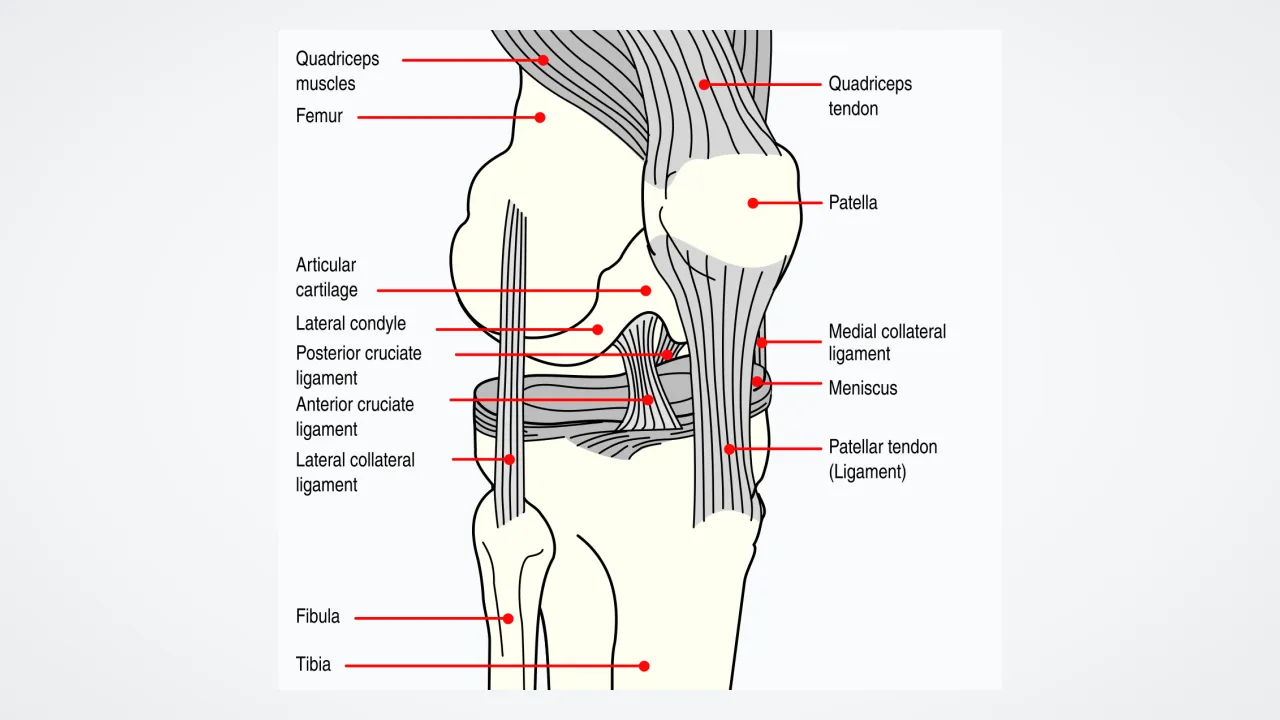
Trace the front of your knee from top to bottom! Four powerful quadriceps muscles in your thigh merge into the quadriceps tendon, wrapping right around your patella. Continuing downward from the bottom point of your kneecap, a super-tough strap called the patellar anchors firmly onto a bump at the top of your shinbone (tibia).
2
Thirty Percent More Power!
Why not just run a plain strap straight over the knee? Without a patella pushing that strap forward, the tendon would flatten tightly against the femur whenever you bent your knee! Acting as a spacer and fulcrum, the patella boosts quadriceps by roughly 30 percent—essential for climbing stairs or leaping for a rebound.
3
The Famous Knee-Jerk Reflex
When your pediatrician taps the strap just below your patella, it stretches your thigh muscle slightly. Instantly, a lightning-fast arc through your spinal cord kicks your lower leg forward—before your brain even notices!
4
Built-In Armor
Plus, whenever you kneel on a gym floor to tie your shoe, your patella shields the delicate inner knee joint.
1. Roughly how much extra leverage and straightening power does your patella give your quadriceps muscles?
2. Why does your foot kick out so fast when a doctor taps just below your patella?
🤯 Mind-Blowing Fact • Grade 4
Backed by cartilage up to a quarter-inch (7 mm) thick and lubricated by joint fluid, your patella has twenty times less friction than modern Teflon-coated cookware!
✨ Word Sparks (Grade 4 Glossary)
Tap 🔊 to hear
Trochlear
Pulley-shaped V-groove on front of lower femur
Torque
Rotational turning force produced around a hinge
Bursae
Tiny fluid sacs reducing friction near joints
🪝
Why does the back of your two-inch kneecap wear the thickest coat of cartilage anywhere in the human skeleton?
1
Extreme Forces on a Tiny Track
Do a deep squat to pick up your backpack, and feel your knees bend deeply! Every time you climb stairs, forces pressing the back of your patella into the femur's V-shaped groove reach three times your body weight—and during deep squats or jump landings, up to seven times your body weight! To handle that colossal pressure without wearing down, the rear surface of your patella wears hyaline articular cartilage up to 6 or 7 millimeters thick—the thickest in the entire human body!
2
Physics of the Moment Arm
In physics, rotational turning force () equals muscle pull multiplied by the 'moment arm'—the distance from the joint's pivot center to the pulling cable. By wedging between the femur and the quadriceps tendon, the patella increases that moment arm, especially during the last 30 degrees of straightening your leg while walking or sprinting.
3
Staying Centered on the Track
Because human femurs slant slightly inward from wide hips, thigh pull tends to tug the patella slightly outward. Nature solves this with a taller outer ridge on the femur's groove and diagonal inner quad fibers (vastus medialis) pulling inward to keep the kneecap gliding dead-center!
4
Friction-Free Bursae
Tiny fluid-filled pillows called cushion skin and tendons around the patella so bending stays silky smooth.
1. Why does the back of the patella need articular cartilage up to 7 millimeters thick?
2. What keeps the patella from slipping off the outer side of the femur's groove when your quads pull hard?
🤯 Mind-Blowing Fact • Grade 5
Wait—marsupials like kangaroos hop across Australia mostly without bony kneecaps, using thick fibrocartilage pads instead, proving mammals evolved bony patellae more than once!
✨ Word Sparks (Grade 5 Glossary)
Tap 🔊 to hear
Monosynaptic
Single-connection nerve reflex needing zero middleman neurons
Lubricin
Ultra-slick protein making knee cartilage glide effortlessly
Apex
Pointed bottom tip of the triangular patella
🪝
How did Leonardo da Vinci use mechanical pulleys five hundred years ago to prove how the patella multiplies human leg torque?
1
Anatomy of the Largest Sesamoid Bone
Named from the Latin diminutive for 'shallow dish,' the patella is a flat, inverted-triangular sesamoid bone measuring roughly 5 centimeters wide that develops within the conjoined tendon of the quadriceps femoris muscle group (rectus femoris, vastus lateralis, vastus medialis, and vastus intermedius). Remaining radiolucent hyaline cartilage at birth, it ossifies from multiple centers between ages 3 and 6. Its broad superior base receives the quadriceps tendon, its pointed inferior anchors the patellar ligament inserting onto the tibial tuberosity, and its posterior facets articulate strictly with the femoral trochlea—never touching the tibia or fibula!
2
Leonardo da Vinci and Extensor Biomechanics
Around 1508, Renaissance anatomist-engineer Leonardo da Vinci rigged cords and weights onto human leg skeletons and recognized the patella as a dynamic mechanical spacer! By displacing the extensor tendon anteriorly away from the tibiofemoral instant center of rotation, the patella enlarges the perpendicular lever arm (`r`), boosting extensor torque (`τ = r × F`) by 30 to 50 percent near terminal knee extension while converting concentrated tendon-on-bone friction into low-friction rolling-gliding compression.
3
Superlubricity of Articular Cartilage
During stair climbing and jumping, patellofemoral contact forces surge to 3.3–7.6 times body weight. To survive millions of cycles, retro-patellar hyaline cartilage reaches 6 to 7 millimeters thick—laden with water-binding aggrecan proteoglycans and boundary-lubricated by synovial hyaluronic acid and glycoproteins to achieve a kinetic coefficient of friction near `μ = 0.002`!
4
Monosynaptic Myotatic Reflex (L2–L4)
Clinically, tapping the patellar ligament triggers the body's classic stretch reflex: muscle spindles inside the quadriceps fire sensory impulses along Ia afferent fibers into spinal segments L2–L4, synapsing directly—with zero interneurons—onto alpha motor neurons to extend the leg while reciprocally relaxing opposing hamstrings!
5
Evolution Across Tetrapods
Evolving independently in placental mammals, birds, and several lizards, bony kneecaps represent convergent biomechanics perfected for high-speed sprinting and leaping.