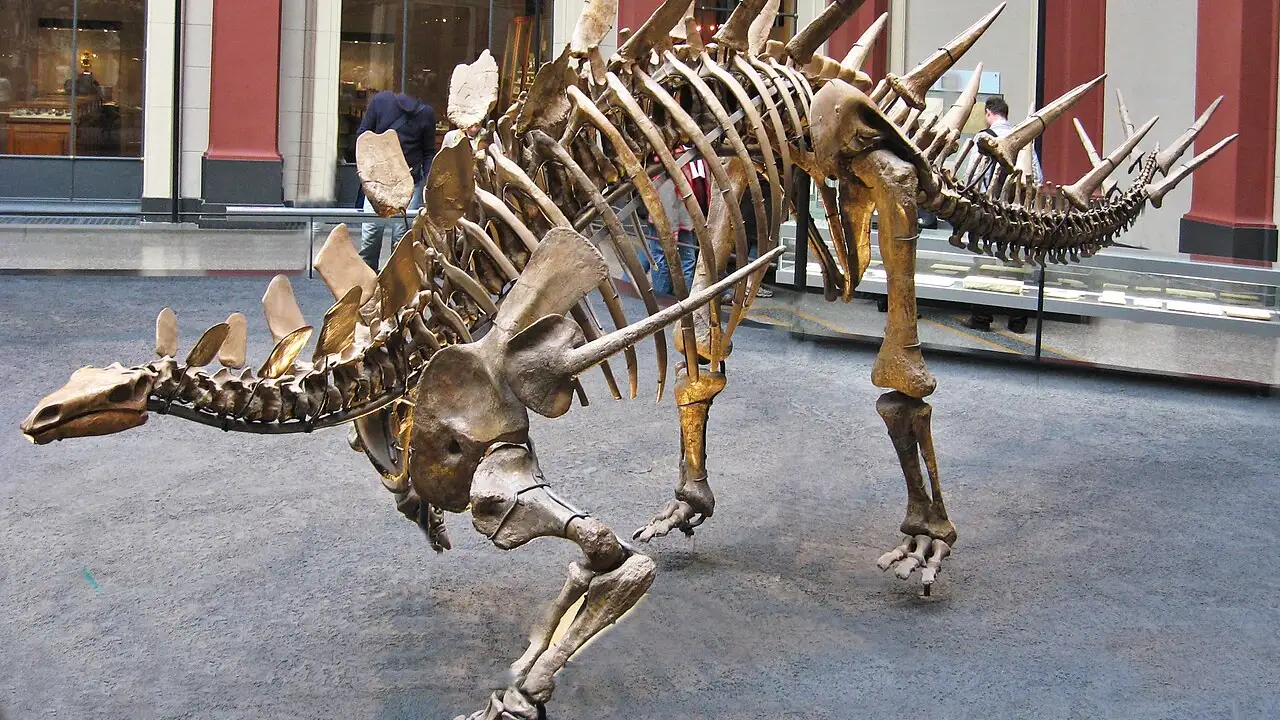
1. How was Kentrosaurus's back different from its famous cousin Stegosaurus?
2. Where did two extra-long sideways spikes stick out on Kentrosaurus?
🤯 Mind-Blowing Fact • Grade 2
Computer tests show Kentrosaurus could whip the spiky tip of its tail faster than 30 miles per hour in a wide half-circle behind it!
✨ Word Sparks (Grade 2 Glossary)
Tap 🔊 to hear
prickly
covered in sharp points that warn attackers
horn
tough outer sheath making bone spikes sharper
arc
a wide, curved path swung through air
🪝
How fast could this fifteen-foot spiky dinosaur whip its armored tail?
1
Meet the Sharp-Point Lizard
Beneath the giant feet of Giraffatitan in ancient East Africa trotted a neighbor! Scientists named it Kentrosaurus, Greek for 'sharp-point lizard,' after uncovering over a thousand of its bones in Tanzania.
2
Plates in Front, Spears in Back
Narrow bony plates guarded its neck, then transformed over its hips into seven pairs of two-foot spikes! Covered in tough in life, each spike was even longer and sharper than the fossil bone alone.
3
Thirty-Mile-Per-Hour Tail Swings
Forty flexible tail bones let Kentrosaurus whip its spiked tail in wide at over thirty miles per hour—faster than most people ride a bicycle!
2. What made Kentrosaurus's spikes even longer in real life than their stone fossils look today?
🤯 Mind-Blowing Fact • Grade 3
Because its center of balance sat right over its hips, Kentrosaurus could pivot rapidly on its hind legs like a turret so predators could never reach its head!
✨ Word Sparks (Grade 3 Glossary)
Tap 🔊 to hear
pivot
turn quickly around a steady center point
turret
a rotating tower aimed in any direction
thagomizer
scientific nickname for spikes on stegosaur tails
🪝
Why did an African cousin half the length of Stegosaurus pack twice as many spikes?
1
Sharing Tendaguru With Giants
In the lush coastal forests of Late Jurassic Tanzania 150 million years ago, towering Giraffatitan ate high in the treetops while fifteen-foot Kentrosaurus trimmed low ferns and cycads near the ground. Because adult Kentrosaurus weighed roughly one ton, hungry predators like Allosaurus cousins posed a serious threat!
2
Unearthed by the Hundreds
German paleontologist Edwin Hennig described Kentrosaurus aethiopicus in 1915 after Tanzanian and German crews excavated over 1,200 bones from dozens of individuals at Tendaguru—enough to mount a famous skeleton in Tübingen, Germany.
3
Built for Pivot-and-Strike Defense
Long hind legs and short sturdy forelegs placed Kentrosaurus's center of weight right over its strong hips. That balance let it spin quickly in place on its back feet, always keeping its armored rear pointed straight at attackers!
1. How did having its weight balanced right over its strong back legs help Kentrosaurus defend itself?
2. About how long was an adult Kentrosaurus?
🤯 Mind-Blowing Fact • Grade 4
Scientific naming rules saved the name Kentrosaurus by a single letter—because 'Centrosaurus' with a C was already taken by a famous horned dinosaur!
✨ Word Sparks (Grade 4 Glossary)
Tap 🔊 to hear
parascapular
positioned beside the shoulder blade area
keratin
tough horn material covering claws and spikes
deterrence
armor and weapons discouraging predators from attacking
🪝
How did 3D physics simulations prove Kentrosaurus wasn't a clumsy lumbering plodder, but a lightning-fast defensive fencer?
1
Double Rows of Armor
Unlike North America's Stegosaurus, whose broad alternating plates mostly served display and heat control, East Africa's Kentrosaurus aethiopicus dressed from neck to tail for active . Paired small plates along its neck transitioned at mid-back into seven pairs of sleek, backward-curving spikes up to 73 centimeters (two and a half feet) long, flanked by an unmistakable pair of spines jutting horizontally from its shoulders or hips.
2
Unusual Backward-Tilted Tail Joints
Look closely at a Kentrosaurus skeleton and something jumps out along the front two-thirds of its tail: the top bony projections (neural spines) tilt forward instead of backward! In 2011, paleontologist Heinrich Mallison built a 3D biomechanical model of its forty-vertebra tail and discovered those forward-tilted levers unlocked immense side-to-side muscle power without binding joints.
3
Fifty-Kilometer-Per-Hour Strikes
Simulations showed Kentrosaurus could whip its tail across a 180-degree rear arc at speeds reaching fifty kilometers per hour (over thirty-one miles per hour)! Covered in razor-sharp sheaths, its tail spikes could puncture hide or shatter bone on a charging Veterupristisaurus or Ceratosaurus.
4
Naming Narrow-Scrape Victory
Funny enough, Edwin Hennig coined Kentrosaurus in 1915 just months before discovering a beetle already had the Greek name Centrosaurus—and a horned dinosaur already claimed Centrosaurus too—surviving under naming rules by just that single initial letter K!
1. Why did the neural spines along the front two-thirds of Kentrosaurus's tail tilt forward instead of backward?
2. How did Kentrosaurus narrowly keep its scientific name under zoological rules?
🤯 Mind-Blowing Fact • Grade 5
Braincase casts of Kentrosaurus revealed unexpectedly large smell centers (olfactory bulbs), showing this spiky defender relied on a keen sense of smell to find choice plants and detect stalking predators early!
✨ Word Sparks (Grade 5 Glossary)
Tap 🔊 to hear
kinematics
physics studying motion of joints and limbs
olfactory bulbs
brain regions dedicated to processing scents
acetabulum
cup-shaped hip socket holding the thigh bone
🪝
How did Tendaguru bonebeds, World War II archival survival, and 3D inverse kinematics reveal the lethal tail-whip mechanics of Kentrosaurus aethiopicus?
1
Tendaguru Excavations and Wartime Losses
First spotted on July 24, 1909, by Werner Janensch during the German Tendaguru Expedition in southeastern Tanzania and formally named Kentrosaurus aethiopicus by Edwin Hennig in 1915, this 4.5-meter stegosaurid is known from more than 1,200 disarticulated elements representing over fifty individuals across Kimmeridgian–Tithonian coastal mudstones. Tragically, Allied bombing of Berlin's Museum für Naturkunde during World War II destroyed many Tendaguru specimens, making Karl Wilhelm von Huene's composite mount preserved at the University of Tübingen and surviving Berlin braincases priceless scientific treasures.
2
Paired Osteoderm Transition and Parascapular Spines
Unlike the staggered, broad-plated dermal array of Stegosaurus, Kentrosaurus arranged roughly fourteen pairs of symmetrical osteoderms from neck to tail tip: flattened rectangular cervical plates shifted abruptly near the sacrum into elongated, sub-conical osseous cores up to 731 millimeters long—extended further in life by grooved keratinous sheaths. Additionally, two massive, broad-based spines projected laterally from either the shoulder girdle (parascapular) or iliac region to foil flank attacks.
3
Biomechanics of a Lethal Caudal Arc
In 2011, Heinrich Mallison applied 3D CAD kinematic modeling to Kentrosaurus's 40-vertebra tail, noting how anteriorly inclined neural spines on caudals 1 through 28 maximized caudofemoralis and epaxial muscle leverage. Rather than sluggishly wagging, the tail accelerated to ~14 meters per second (50 km/h) across a sweeping 180-degree horizontal arc—delivering impact energies capable of fracturing theropod ribs or femora.
4
Center of Mass and Rapid Hindlimb Pivoting
Because femur-to-humerus length ratios (~1.6:1) positioned the center of mass directly anterior to the , Kentrosaurus shifted minimal weight onto its splayed forelimbs—allowing rapid rotational pivoting on pillar-like hindlegs and even brief bipedal rearing.
5
Olfactory Acuity and Low-Level Browsing
Endocranial casts of well-preserved Kentrosaurus braincases reveal surprisingly enlarged alongside a narrow, tooth-lined predentary beak suited for selective ground-level cropping under one meter high beneath Giraffatitan canopies.