What if you could walk through a forest made of stone?
1
A Forest of Columns
Huge stone columns stand tall like trees, reaching high above your head. Sunlight peeks through the tops, making patterns on the ground. Visitors walk between the pillars, feeling very small. The columns are covered with pictures and .
2
Guardians of the Path
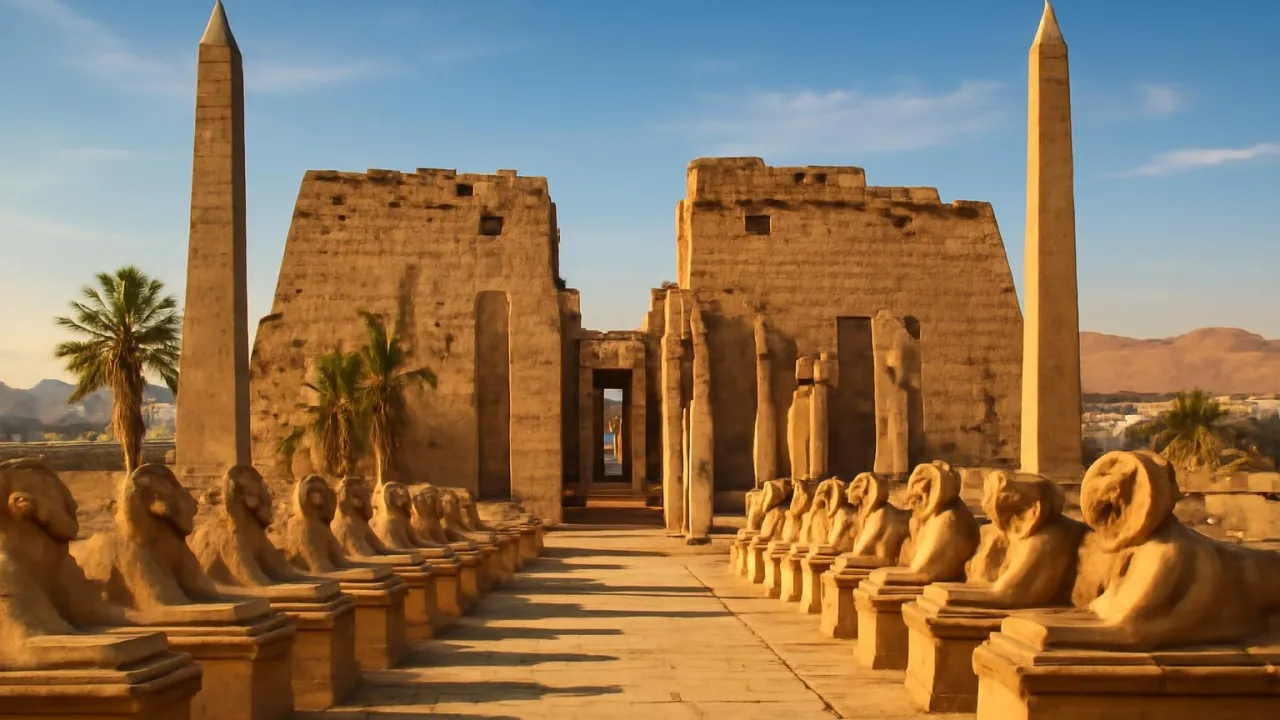
Long rows of sphinx statues guard the walkway leading to the . Each sphinx has a lion’s body and a person’s face, watching everyone who passes. People take photos with these ancient . The statues have stood here for thousands of years.
3
Echoes and Shadows
When you clap, your sound bounces back as an echo. The stone walls and columns make the sound travel around you. Shadows dance on the ground as the sun moves. It feels like stepping into a story from long ago.
The tallest obelisk at Karnak stands almost 100 feet high!
✨ Word Sparks (Grade 3 Glossary)
Tap 🔊 to hear
obelisk
A tall, four-sided stone pillar.
hieroglyph
A picture symbol from ancient Egypt.
acoustic
How sound moves in a space.
🪝
Can you imagine your footsteps echoing where pharaohs once walked?
1
The Great Hypostyle Hall
The Hypostyle Hall is filled with 134 massive stone columns, each carved with ancient stories. These columns create a stone forest, and sunlight streams through the high spaces above. The vibration of footsteps and voices bounces off the smooth stone, creating a deep echo. Visitors feel tiny among the towering pillars, just as ancient Egyptians did.
2
Avenue of Sphinxes
A long avenue lined with sphinx statues leads to the temple’s entrance. Each sphinx has the body of a lion and the head of a person or ram, showing the power of the pharaohs. The sphinxes were meant to protect the temple from harm. Walking between them feels like stepping into a living legend.
3
Building with Stone and Sun
Ancient builders used huge sandstone blocks to create Karnak’s halls and . They used simple tools and ramps to lift heavy stones, showing great engineering skill. The temple is covered with carvings and that tell stories of gods and kings. The sun’s rays light up the carvings, making the pictures shine.
4
Echoes of Ancient Worship
Karnak was a sacred place for worshipping Egyptian gods, especially Amun-Ra. Priests and pharaohs held ceremonies here, filling the halls with music and chanting. The design made their voices echo, adding mystery to the rituals. Today, people from around the world visit to explore its wonders.
The Karnak complex is so large that entire cathedrals could fit inside its main hall!
✨ Word Sparks (Grade 4 Glossary)
Tap 🔊 to hear
resonance
When sound vibrates and grows louder.
procession
A group walking in a special order.
capital
The top part of a column.
🪝
What would it feel like to step into Karnak’s maze of sunlight and shadows?
1
A Journey Through Stone and Time
Imagine entering a maze of towering columns, sunlight flickering across sandstone and ancient carvings all around you. The Karnak Temple Complex stretches wider than twenty football fields, with halls, sanctuaries, and statues at every turn. As you walk, your footsteps echo through the Great Hypostyle Hall, where 134 columns rise like a petrified forest. Every stone seems to whisper stories of pharaohs, gods, and builders from thousands of years ago.
2
Guardians of the Sacred Way
A grand avenue lined with sphinx statues once connected Karnak to Luxor Temple, nearly two miles away. Each sphinx, with a lion’s body and a human or ram’s head, symbolized strength and royal protection. For centuries, of priests and pharaohs passed between these silent guardians during religious festivals. Today, visitors marvel at the avenue’s symmetry and the artistry of the stone sculptures.
3
Engineering Wonders of the Pharaohs
Constructing Karnak required advanced knowledge of physics and engineering, as builders used levers, ramps, and manpower to move massive sandstone blocks. The temple’s obelisks, some nearly 100 feet tall, were precisely balanced to stand upright for thousands of years. The columns’ were designed to support heavy stone roofs while allowing sunlight to filter through. These features demonstrate the Egyptians’ mastery of both strength and beauty in architecture.
4
Echoes Across Millennia
Karnak’s vast stone halls were built with acoustic in mind, amplifying the sounds of chanting and music during ceremonies. The temple complex served as a spiritual center for more than 1,500 years, influencing religious practices throughout the ancient world. Today, archaeologists study its carvings to learn about Egyptian beliefs, rituals, and daily life. Karnak remains a powerful symbol of human creativity and devotion.
If you lined up all of Karnak’s stone columns, they would stretch for over a mile!
✨ Word Sparks (Grade 5 Glossary)
Tap 🔊 to hear
pylon
A massive stone gateway or entrance.
lintel
A horizontal stone above a doorway.
erosion
When wind or water slowly wears away stone.
🪝
If you stood at sunrise in Karnak’s Hypostyle Hall, what stories would the stones whisper to you?
1
An Architectural Marvel Through the Ages
The Karnak Temple Complex, built and expanded over nearly two millennia, stands as the largest religious structure ever constructed by humans. Its vast layout includes a series of monumental , sanctuaries, obelisks, and the iconic Great Hypostyle Hall, whose 134 papyrus-shaped columns soar up to 69 feet (21 meters) high. The main axis aligns precisely with the rising sun during the winter solstice, demonstrating the Egyptians’ mastery of astronomical engineering. Successive pharaohs from the Middle Kingdom through the Ptolemaic era contributed to Karnak’s ever-growing grandeur, each leaving their mark in stone.
2
Engineering Feats and Construction Techniques
Ancient builders employed ingenious methods to transport and erect blocks weighing up to 70 tons, utilizing mudbrick ramps, wooden sledges, and coordinated labor teams. The obelisks, carved from single pieces of Aswan granite, required advanced knowledge of leverage, balance, and friction reduction to stand upright and remain stable for millennia. The columns’ capitals, modeled after blooming papyrus plants, not only supported massive stone but also distributed weight evenly, preventing collapse. Hieroglyphic inscriptions and carved reliefs on every surface record the technical and ceremonial achievements of Egypt’s greatest builders.
3
Acoustics and Ritual Soundscapes
The temple’s architecture was designed with acoustic resonance in mind, amplifying chants, music, and ritual sounds to create an awe-inspiring atmosphere. The stone surfaces reflect and blend sound waves, allowing a single voice to echo throughout the Hypostyle Hall. During religious festivals, processions of priests, musicians, and dancers would fill the air with rhythmic vibrations, connecting worshippers to the divine. This intentional acoustic engineering enhanced the spiritual experience for all who entered the sacred precinct.
4
Historical and Cultural Significance
Karnak served as the spiritual heart of ancient Thebes and the principal sanctuary of the god Amun-Ra, shaping Egyptian religion and society for over 1,500 years. The annual Opet Festival, which celebrated the renewal of kingship, saw thousands gather in processions along the avenue of sphinxes. The temple’s inscriptions provide a primary source for understanding Egyptian mythology, royal lineage, and daily life. Today, Karnak is a UNESCO World Heritage Site, drawing scholars and visitors from around the globe to study its enduring mysteries.
5
Preservation and Modern Exploration
Ongoing archaeological excavations and conservation efforts are vital for protecting Karnak’s fragile sandstone structures from , flooding, and human impact. Modern technologies such as 3D laser scanning and ground-penetrating radar help researchers uncover hidden chambers and reconstruct collapsed sections. The temple complex continues to inspire architects, engineers, and artists, serving as a testament to human ingenuity and the enduring power of belief. Every year, new discoveries at Karnak deepen our understanding of ancient Egypt’s achievements and its influence on world history.