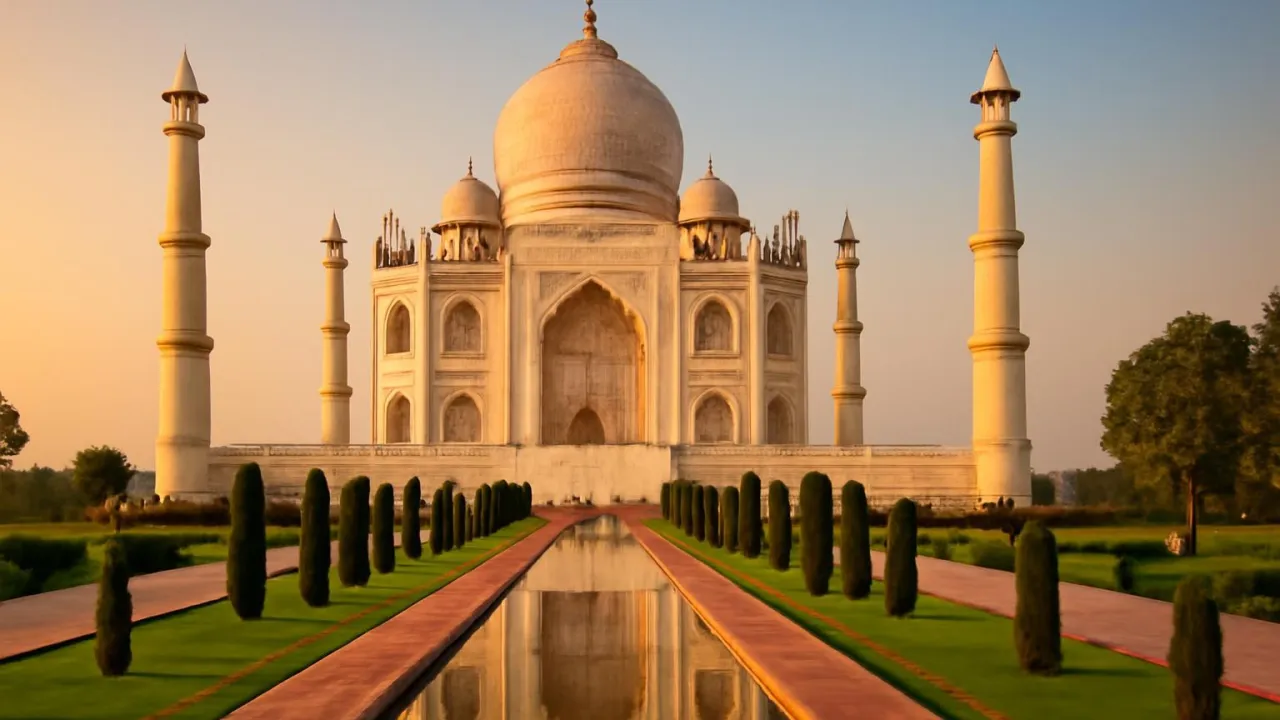
It took about 22 years and 20,000 workers to build the Taj Mahal!
✨ Word Sparks (Grade 2 Glossary)
Tap 🔊 to hear
emperor
A powerful king or ruler
reflect
To show an image like a mirror
garden
A place with flowers and trees
🪝
Have you ever seen a building that changes color?
1
Shining in the Sun
The Taj Mahal shines bright in the sun and glows in moonlight. Its white marble walls the sky’s colors, making it look magical. Many visitors come to watch the colors change.
2
A Gift of Love
Long ago, an built the Taj Mahal for his beloved queen. It took thousands of workers over twenty years to finish. Today, people from all over the world visit to see this palace.
3
Beautiful Gardens and Pools
The Taj Mahal has lovely and a long, clear pool in front. The pool the palace like a giant mirror, making it look even more amazing. People love to take photos here.
2. What does the pool in front of the Taj Mahal do?
🤯 Mind-Blowing Fact • Grade 3
The Taj Mahal’s marble can appear to change color up to three times a day!
✨ Word Sparks (Grade 3 Glossary)
Tap 🔊 to hear
symmetrical
The same on both sides
minaret
A tall, thin tower
monument
A building made to remember someone or something
🪝
Can you imagine a building that glows pink at sunrise and silver at night?
1
A Palace Made of Marble
The Taj Mahal is built from white marble that sparkles in sunlight. This special stone reflects the changing colors of the sky throughout the day. Visitors see the palace glow pink at dawn, golden at sunset, and silver under the moon. The marble’s smooth surface helps create this magical effect.
2
A Monument of Love
Emperor Shah Jahan built the Taj Mahal as a tomb for his wife Mumtaz Mahal. Over 20,000 workers and artists helped create the , using precious stones and detailed carvings. The building is perfectly , with four tall at each corner. Its main dome rises high above the gardens and pool.
3
Engineering Wonders
The Taj Mahal’s architects used arches and domes to make it strong and beautiful. The main dome is nearly 115 feet tall and sits on a square base. The are slightly tilted outward to protect the main building if an earthquake happens. Engineers planned the gardens and reflecting pool to create a sense of calm and balance.
4
A World Treasure
The Taj Mahal is a UNESCO World Heritage site, meaning it is protected for everyone to enjoy. Millions of people visit every year from all over the world. The is a symbol of love, art, and amazing engineering. Its beauty and history inspire people of all ages.
1. Why are the minarets of the Taj Mahal tilted outward?
2. What makes the Taj Mahal’s marble look magical?
🤯 Mind-Blowing Fact • Grade 4
The Taj Mahal’s marble can reflect ultraviolet light, helping it glow even on moonless nights!
✨ Word Sparks (Grade 4 Glossary)
Tap 🔊 to hear
mausoleum
A special building for a tomb
inlay
Decorations made by setting stones into a surface
charbagh
A garden divided into four parts
🪝
What secrets do you think a glowing marble palace might hold?
1
A Masterpiece of Marble and Light
The Taj Mahal’s white marble was brought from distant quarries and carefully carved by skilled artisans. This marble has unique properties that allow it to reflect and refract sunlight, causing the monument to appear pink at sunrise, golden at sunset, and silver under the moon. The changing colors are not just beautiful—they also reveal the stone’s purity and the builders’ understanding of light. The palace’s smooth surfaces and large domes help spread the glow across its entire structure.
2
A Symbol of Eternal Love
The Mughal emperor Shah Jahan commissioned the Taj Mahal as a for his wife, Mumtaz Mahal, who died in 1631. Construction began in 1632 and took over two decades, involving more than 20,000 workers and craftsmen from across Asia. The monument’s perfect symmetry, intricate work with precious stones, and detailed carvings make it a masterpiece of Mughal architecture. The Taj Mahal’s central dome rises 115 feet above the tomb chamber, surrounded by four minarets that frame the site.
3
Engineering and Design Genius
The architects used advanced engineering techniques, including a raised foundation to protect against flooding and minarets designed to lean slightly outward for earthquake safety. The gardens follow the Persian style, divided into four parts by water channels that symbolize paradise. The reflecting pool mirrors the monument, creating a breathtaking visual effect that doubles its beauty. Each part of the Taj Mahal was planned for both strength and harmony.
4
A Global Wonder
Recognized as a UNESCO World Heritage site, the Taj Mahal attracts millions of visitors each year and is considered one of the New Seven Wonders of the World. Its influence can be seen in art, literature, and architecture around the globe. The monument stands as a symbol of love, creativity, and the incredible achievements of human engineering. Preserving the Taj Mahal is important for future generations to learn from its history and beauty.
1. How does the Taj Mahal’s marble create its glowing effect?
2. What style are the Taj Mahal’s gardens designed in?
🤯 Mind-Blowing Fact • Grade 5
The Taj Mahal’s marble can reflect both visible and ultraviolet light, making it glow even under starlight!
✨ Word Sparks (Grade 5 Glossary)
Tap 🔊 to hear
pietra dura
Stone art made with colorful inlaid gems
bilateral symmetry
Both sides are exactly the same
acoustic resonance
How sound echoes inside a space
🪝
Imagine standing before a palace so perfectly built that its marble seems to capture the colors of the sky itself—how did people create such a wonder nearly 400 years ago?
1
Engineering the Marble Wonder
The Taj Mahal’s construction required transporting over 1,000 elephants and thousands of laborers to move white Makrana marble from Rajasthan, more than 200 miles away. This marble is renowned for its high calcite content, which enhances its ability to reflect and refract visible and ultraviolet light, creating the palace’s famous color-changing effect. The monument stands on a raised platform to prevent flooding from the Yamuna River, and its foundation incorporates wells filled with packed rubble for stability. The main dome, rising 115 feet above the tomb, is double-shelled, allowing for both structural strength and within the central chamber.
2
Architectural Symmetry and Innovation
The Taj Mahal is a masterpiece of Mughal architecture, characterized by its perfect and harmonious proportions. The four minarets, each standing 130 feet tall, are intentionally tilted slightly outward—an advanced engineering precaution so they would fall away from the central tomb in the event of an earthquake. The intricate inlay work, using semi-precious stones like lapis lazuli, jade, and turquoise, decorates the marble surfaces with elaborate floral and geometric patterns. The monument’s design integrates Persian, Islamic, and Indian architectural traditions, symbolizing unity and balance.
3
Gardens and Reflecting Pools: Symbolism and Science
The Taj Mahal’s gardens are laid out in the Persian charbagh style, divided into quadrants by water channels that represent the four rivers of paradise in Islamic tradition. The central reflecting pool is aligned precisely with the main entrance and the mausoleum, doubling the visual impact and enhancing the monument’s symmetry. The water channels not only serve an aesthetic purpose but also help cool the air and irrigate the lush plantings. The garden’s layout is based on precise geometric planning, demonstrating advanced knowledge of landscape architecture and irrigation.
4
Historical and Cultural Impact
Commissioned by Emperor Shah Jahan in 1632 as a mausoleum for his wife Mumtaz Mahal, the Taj Mahal was completed in 1653 after more than two decades of work by over 20,000 artisans, architects, and laborers. The monument is widely recognized as a symbol of enduring love and artistic achievement, influencing architecture and art worldwide. It became a UNESCO World Heritage site in 1983 and is considered one of the New Seven Wonders of the World. The Taj Mahal attracts over 7 million visitors annually, contributing significantly to India’s cultural heritage and tourism industry.
5
Preservation and Modern Challenges
Despite its enduring beauty, the Taj Mahal faces threats from air pollution, acid rain, and the rising water table of the Yamuna River. Conservation efforts include restricting vehicle traffic nearby, regular cleaning of the marble, and scientific monitoring of structural stability. Engineers and historians collaborate to preserve the monument’s intricate details, using modern technology to study its materials and construction methods. The Taj Mahal stands not only as a testament to past ingenuity but also as a reminder of the importance of protecting world heritage sites for future generations.