1. Which two words were blended together to make the name Juneteenth?
2. In which Texas city did soldiers announce the freedom news on June 19, 1865?
🤯 Mind-Blowing Fact • Grade 2
At age eighty-nine, Texas teacher Opal Lee walked miles in city after city to help make Juneteenth a national holiday!
✨ Word Sparks (Grade 2 Glossary)
Tap 🔊 to hear
emancipation
Setting people free from slavery by law
enforce
To make sure people follow a law
jubilee
A joyful celebration of freedom and hope
🪝
Why did it take more than two years for news of freedom to reach enslaved families in Texas?
1
Waiting for Word of Freedom
Imagine waiting two whole years to hear the most important news of your life! President Abraham Lincoln signed the Proclamation in 1863 during the Civil War, but faraway Texas had very few Union troops to the law.
2
June 19, 1865 in Galveston
After the Civil War ended in spring 1865, General Gordon Granger sailed into Galveston, Texas, with about two thousand soldiers. On June 19, he read General Order No. 3 aloud, announcing that more than 250,000 enslaved Texans were free.
3
From Jubilee Day to National Holiday
Freed families first called the holiday Day and later Juneteenth. In 2021, Juneteenth officially became a national holiday across the entire United States.
1. About how many enslaved people in Texas learned they were free on June 19, 1865?
2. In what year did Juneteenth become an official U.S. federal holiday?
🤯 Mind-Blowing Fact • Grade 3
In 1872, formerly enslaved community leaders in Houston pooled $800 of their own savings to buy Emancipation Park specifically for Juneteenth celebrations!
✨ Word Sparks (Grade 3 Glossary)
Tap 🔊 to hear
proclamation
An official public announcement by a leader
reunion
Bringing separated family members back together again
milestone
An important turning point in history
🪝
What happened on Galveston Island on June 19, 1865, and how did freed Texans preserve their history?
1
Why Freedom Was Delayed
Salt breezes blew off the Gulf of Mexico on June 19, 1865, as Union ships docked at Galveston Island, Texas. Two and a half years earlier, on January 1, 1863, President Abraham Lincoln's Emancipation had declared enslaved people in Confederate territory free, yet Texas remained out of reach of Union armies until after Robert E. Lee surrendered at Appomattox Court House in Virginia.
2
Reading General Order No. 3
Major General Gordon Granger stepped ashore with roughly two thousand federal soldiers and issued General Order No. 3. Messengers posted and read the across town, declaring 'absolute equality of personal rights' for more than 250,000 enslaved Texans.
3
Buying Emancipation Park
One year later, in 1866, formerly enslaved Texans organized the first Jubilee Day gatherings with prayer services, readings, songs, and family . In 1872, four Black community leaders in Houston pooled $800 to purchase ten acres of parkland—naming it Emancipation Park—so families always had a welcoming place to celebrate.
4
Opal Lee and National Recognition
Texas made Juneteenth a state holiday in 1980, and retired educator Opal Lee campaigned tirelessly for nationwide recognition. On June 17, 2021, Juneteenth National Independence Day became a federal holiday.
1. Which announcement did Major General Gordon Granger issue in Galveston on June 19, 1865?
2. Why did four community leaders in Houston pool $800 in 1872?
🤯 Mind-Blowing Fact • Grade 4
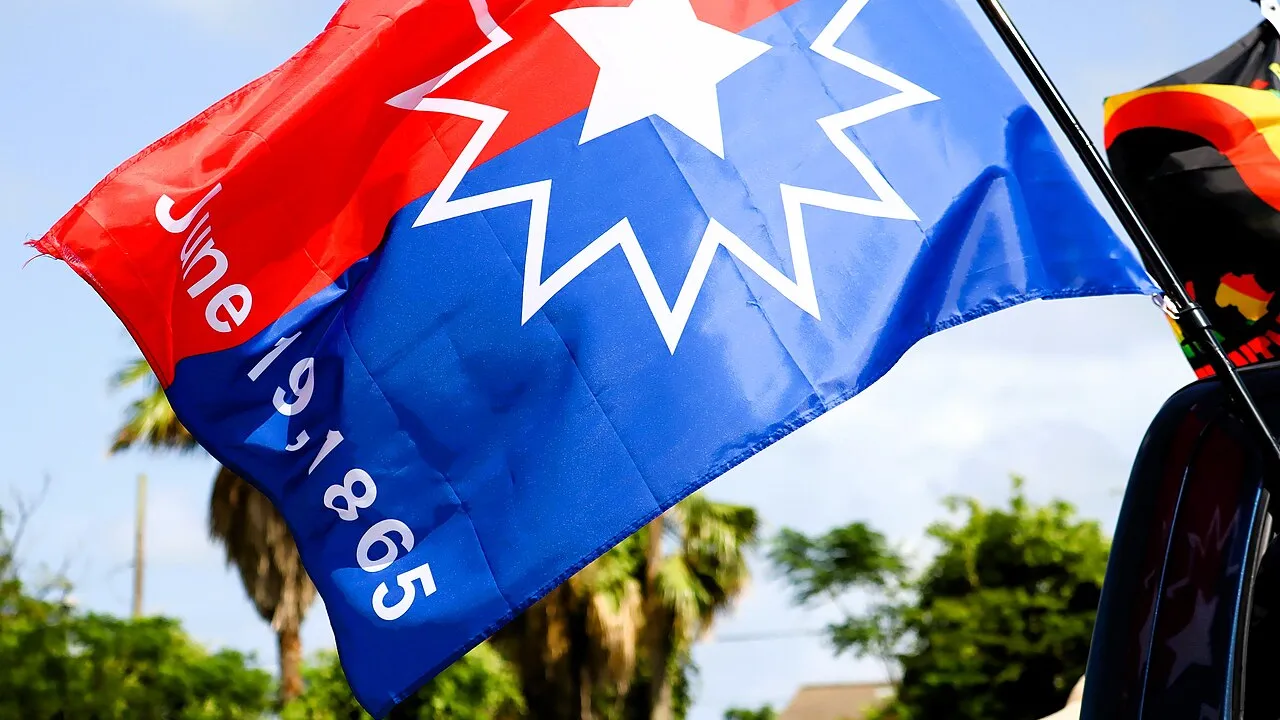
The bursting five-pointed star at the center of the official Juneteenth flag represents both Texas—the Lone Star State—and new freedom shining across all fifty states!
✨ Word Sparks (Grade 4 Glossary)
Tap 🔊 to hear
ratify
To vote officially to approve an amendment
abolition
The complete legal ending of slavery
advocate
Someone who speaks up for an important cause
🪝
How do the Emancipation Proclamation, Appomattox, Galveston's General Order No. 3, and the 13th Amendment fit together in the story of American freedom?
1
A Two-and-a-Half-Year Gap
Picture harbor bells echoing across Galveston Island on the morning of June 19, 1865, as federal soldiers marched down the dusty wharves. Although President Abraham Lincoln's Emancipation Proclamation had taken effect on January 1, 1863, freedom could not take hold where Confederate forces still controlled local courts and plantations. Because Texas saw few major Civil War battles, enslavers from neighboring states even moved thousands of enslaved families westward into Texas.
2
From Virginia's Surrender to Texas Enforcement
Even after Confederate General Robert E. Lee surrendered to Ulysses S. Grant at Appomattox Court House, Virginia, in April 1865, fighting and delayed communication lingered in the Trans-Mississippi West. When Union Major General Gordon Granger arrived in Galveston with 2,000 troops, many soldiers belonging to the United States Colored Troops stood proudly in the ranks as General Order No. 3 proclaimed freedom for more than 250,000 Texans.
3
The 13th Amendment Completes Legal Abolition
While Juneteenth brought emancipation to the final Confederate state, slavery still existed legally in a few border states that had not seceded. Freedom across every state became permanent constitutional law six months later, in December 1865, when the states ratified the 13th Amendment to the U.S. Constitution.
4
Symbols and Civic Legacy
As Black Texans migrated across America during the twentieth century, they carried Juneteenth music, historical readings, and community festivals nationwide. Inspired by like Opal Lee—known affectionately as the 'Grandmother of Juneteenth'—Congress overwhelmingly passed legislation in June 2021 establishing Juneteenth National Independence Day, symbolized by a red, white, and blue flag featuring a bursting star of new beginnings.
1. Which constitutional amendment permanently abolished slavery throughout every state in December 1865?
2. Why were many enslaved people moved into Texas during the Civil War?
🤯 Mind-Blowing Fact • Grade 5
Regiments of the United States Colored Troops—many of them formerly enslaved men themselves—sailed into Galveston alongside General Granger to help deliver the freedom order in June 1865!
✨ Word Sparks (Grade 5 Glossary)
Tap 🔊 to hear
broadside
Large printed notice posted in public places
bipartisan
Supported together by both major political parties
commemorate
To honor and remember an important event
🪝
Why was freedom in America a multi-step constitutional and military journey rather than a single overnight event?
1
Galveston Harbor, June 19, 1865
Stand beside Osterman Building headquarters in Galveston, Texas, on June 19, 1865, as federal couriers post printed across brick storefronts and church doors. Two months after General Robert E. Lee surrendered the Army of Northern Virginia at Appomattox Court House on April 9, 1865, Union Major General Gordon Granger arrived with approximately 2,000 federal troops—including regiments of the United States Colored Troops (USCT)—to establish federal authority over the Department of Texas.
2
Understanding General Order No. 3
Granger's General Order No. 3 opened with unmistakable clarity: 'The people of Texas are informed that, in accordance with a proclamation from the Executive of the United States, all slaves are free.' Issued thirty months after Abraham Lincoln's Emancipation Proclamation took effect on January 1, 1863, the order liberated more than 250,000 enslaved African Americans in the Confederacy's westernmost state, proving that wartime proclamations required federal enforcement on the ground.
3
Constitutional Completion and Early Jubilee Traditions
Even after June 19, 1865, enslaved people in Union border states such as Delaware and Kentucky—regions exempt from Lincoln's wartime proclamation—awaited nationwide abolition until the 13th Amendment was ratified on December 6, 1865. Beginning on June 19, 1866, freed Texans commemorated 'Jubilee Day' with voter-registration rallies, spirituals, readings of the Emancipation Proclamation, and quests to reunite families separated before the war. Denied access to segregated municipal parks, Black leaders led by Reverend Jack Yates raised $800 in 1872 to buy Houston's ten-acre Emancipation Park.
4
The Great Migration and State-by-State Momentum
During the Great Migration of the twentieth century, millions of Black families carried Juneteenth from Texas to cities from Los Angeles and Chicago to Washington, D.C., and Richmond, Virginia. In 1979, Texas State Representative Al Edwards sponsored House Bill 1016, making Texas the first state to establish Juneteenth as a paid state holiday starting in 1980. Designer Ben Haith later created the Juneteenth flag in 1997, pairing an arched horizon with a bursting white star.
5
A Unifying National Milestone
In 2016, eighty-nine-year-old retired Fort Worth teacher Opal Lee launched a walking campaign of 2.5-mile treks—symbolizing the 2.5 years Texans waited for word of freedom—all the way to Washington, D.C. On June 17, 2021, majorities in Congress and presidential signature established Juneteenth National Independence Day as the first new federal holiday since Martin Luther King Jr. Day in 1983.