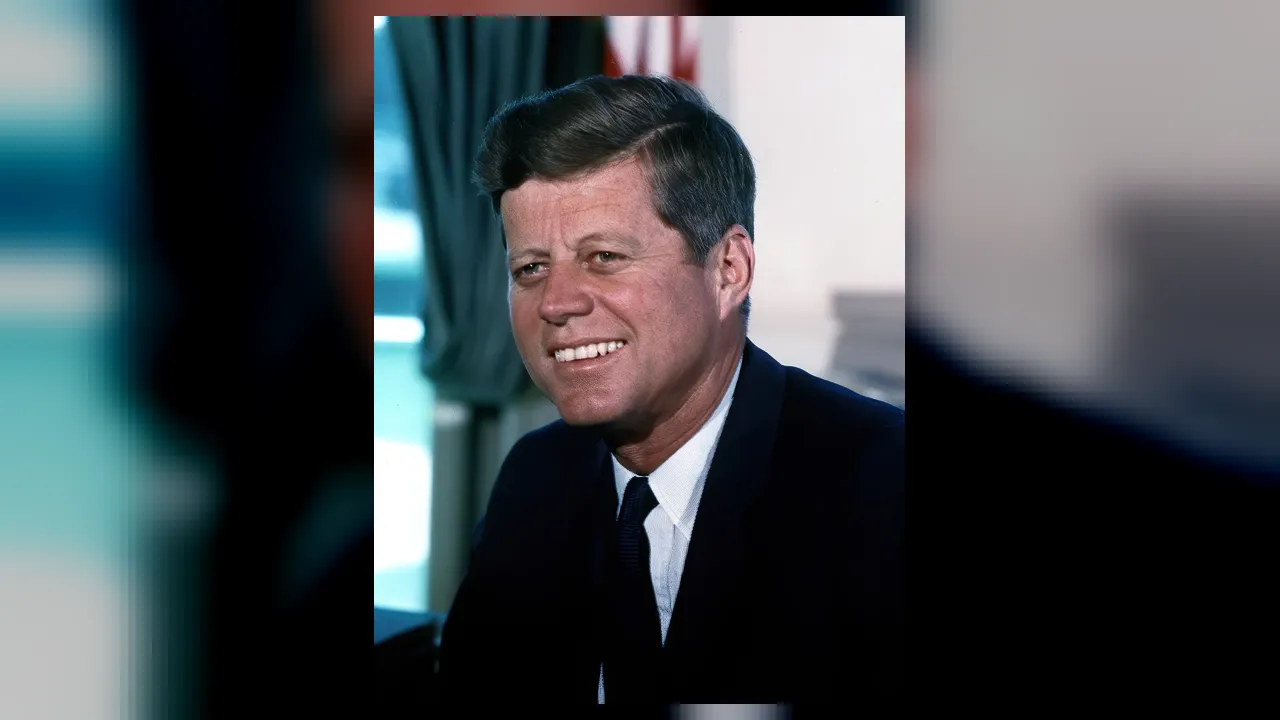
⚡ Historical SparkInspired Americans to serve others and set the bold goal of landing astronauts on the Moon
🤯 Mind-Blowing Fact • Grade 1
During World War II, future president John F. Kennedy carved a rescue message onto a real coconut shell to save his stranded Navy crew in the Pacific Ocean—and later kept that coconut on his Oval Office desk!
✨ Word Sparks (Grade 1 Glossary)
Tap 🔊 to hear
crew
The team of sailors working on a boat
astronaut
A trained explorer who travels into outer space
stranded
Stuck somewhere with no easy way home
🪝
What if a president dared scientists to fly people all the way to the Moon?
1
A Brave Sailor
Splash, swim! Long before becoming president, young Jack Kennedy commanded a small Navy boat in World War II. When his boat sank, he swam for hours to save his !
2
Ask How You Can Help
At age forty-three, JFK became the youngest person ever elected U.S. president! On a snowy day in 1961, he asked citizens how they could help their country.
3
Aiming for the Moon
He started the Peace Corps so volunteers could teach and help abroad. He also challenged NASA to land safely on the Moon before 1970!
1. What unusual object did Navy Lieutenant John F. Kennedy carve a rescue message on during World War II?
2. Where did President Kennedy challenge American astronauts to land safely before the 1960s ended?
🤯 Mind-Blowing Fact • Grade 2
John F. Kennedy's young children, Caroline and John Jr., turned the White House into a lively family home—Caroline rode a pony named Macaroni across the South Lawn!
✨ Word Sparks (Grade 2 Glossary)
Tap 🔊 to hear
inauguration
The ceremony where a president takes the oath
standoff
A tense moment where two sides face off
Peace Corps
American volunteers helping communities learn and grow abroad
🪝
Why do people still repeat one famous sentence spoken by our thirty-fifth president on a freezing January morning?
1
Sailboats, Books, and Courage
Whoosh! Growing up near the ocean in Massachusetts, young Jack Kennedy loved sailing, reading adventure books, and competing with his eight brothers and sisters. In World War II, he earned medals for towing an injured sailor for miles by gripping a life-jacket strap in his teeth!
2
A New Generation of Service
Elected at forty-three in 1960 as our thirty-fifth president, John F. Kennedy spoke without a coat on a snowy Day: 'Ask not what your country can do for you—ask what you can do for your country.' Thousands of volunteers soon joined his new !
3
Choosing the Moon and Peace
In 1961, JFK set the daring goal of sending humans to the Moon and returning them safely to Earth. He also kept the world peaceful during a tense in 1962 and supported new laws protecting equal civil rights.
1. What did President Kennedy inspire citizens to think about in his famous 1961 Inaugural Address?
2. What organization did JFK launch in 1961 so Americans could volunteer as teachers, nurses, and builders in developing countries?
🤯 Mind-Blowing Fact • Grade 3
John F. Kennedy is the only U.S. president ever to win a Pulitzer Prize, awarded in 1957 for his biography book Profiles in Courage about brave U.S. Senators!
✨ Word Sparks (Grade 3 Glossary)
Tap 🔊 to hear
quarantine
Stopping ships carrying dangerous weapons from passing through
decade
A period of ten years in a row
Pulitzer
A prestigious American award for outstanding writing
🪝
Why did President Kennedy say America chose to go to the Moon 'not because they are easy, but because they are hard'?
1
PT-109 Hero and Pulitzer Author
Imagine swimming four hours in pitch-dark ocean water while towing an injured crewmate to safety! Born in Brookline, Massachusetts, in 1917, John Fitzgerald Kennedy showed that grit when his Navy patrol boat PT-109 was struck in 1943. Later, while serving in Congress, he won a Prize for his book Profiles in Courage.
2
Televised Debates and Youthful Energy
In 1960, seventy million Americans watched the very first televised presidential debates between Senator Kennedy and Vice President Richard Nixon. Winning a close election at age forty-three, JFK became the youngest person ever elected president and the first Catholic U.S. president.
3
Space Race and Peaceful Diplomacy
After astronaut Alan Shepard flew into space in May 1961, Kennedy challenged Congress to land an American on the Moon before the ended. In October 1962, during the thirteen-day Cuban Missile Crisis, JFK used a calm naval and diplomacy to prevent war and signed a nuclear test-ban treaty in 1963.
4
Championing Equal Rights
In June 1963, Kennedy addressed the nation on television proposing a sweeping Civil Rights bill to end segregation. Though his life ended tragically in Dallas in November 1963, astronauts reached the Moon in 1969 and Congress passed the Civil Rights Act in his memory.
1. What communication milestone happened for the first time during the 1960 presidential campaign?
2. How did President Kennedy resolve the dangerous thirteen-day Cuban Missile Crisis in October 1962?
🤯 Mind-Blowing Fact • Grade 4
With help from First Lady Jacqueline Kennedy's historic White House restoration, more than fifty million viewers watched a televised tour of the White House's American history treasures in February 1962!
✨ Word Sparks (Grade 4 Glossary)
Tap 🔊 to hear
reconnaissance
Careful observation from aircraft or satellites to gather facts
atmospheric
Happening up inside Earth's surrounding layer of air
comprehensive
Thorough and covering nearly every important part
🪝
How did John F. Kennedy's thousand days in the White House spark breakthroughs in civic service, space exploration, peaceful diplomacy, and civil rights?
1
Courage in War and Public Life
Despite lifelong back pain and illness, Harvard graduate John F. Kennedy volunteered for combat patrol boats in the South Pacific during World War II. In August 1943, after a Japanese destroyer sliced his torpedo boat PT-109 in half, twenty-six-year-old Lieutenant Kennedy rescued his surviving crew and carved a distress message onto a coconut shell—heroism that earned the Navy and Marine Corps Medal. Serving fourteen years in the U.S. House and Senate from Massachusetts, he won the 1957 Pulitzer Prize for Profiles in Courage.
2
The 'New Frontier' and the Race to the Moon
Elected in November 1960 at forty-three—making him the youngest elected president (Theodore Roosevelt was slightly younger when succeeding McKinley) and the first Roman Catholic president—Kennedy summoned a new generation to public duty. Within months he established the Peace Corps by executive order and addressed Congress on May 25, 1961, proposing to land an astronaut on the Moon and return safely before 1970. Speaking at Rice University in 1962, he explained that tackling hard scientific challenges would organize the very best of American engineering and education.
3
Thirteen Days in October and Test Ban Treaty
Kennedy's gravest test arrived in October 1962 when photographs revealed Soviet nuclear missiles under construction ninety miles off Florida in Cuba. Resisting calls for an immediate airstrike that could trigger global war, Kennedy ordered a naval 'quarantine' to give Soviet Premier Nikita Khrushchev room for negotiation. After thirteen tense days, both sides reached a peaceful settlement—followed in 1963 by a Washington-Moscow 'hotline' and the Limited Nuclear Test Ban Treaty ending nuclear testing.
4
Civil Rights Commitment and Lasting Legacy
Moved by peaceful civil-rights marches and constitutional justice, Kennedy spoke to the nation on June 11, 1963, framing equal rights as a moral as well as legal promise and sending a Civil Rights bill to Congress. After his assassination in Dallas, Texas, on November 22, 1963—and burial across the Potomac at Arlington National Cemetery in Virginia—the nation carried both his Civil Rights Act (1964) and Apollo 11 Moon landing (1969) to completion.
1. What important treaty did President Kennedy sign in 1963 after learning lessons from the Cuban Missile Crisis?
2. How is Theodore Roosevelt's age record slightly different from John F. Kennedy's age record?
🤯 Mind-Blowing Fact • Grade 5
NASA's Langley Research Center in Hampton, Virginia—where mathematicians like Katherine Johnson calculated orbital trajectories—played an essential engineering role in fulfilling JFK's 1961 Moon landing challenge on July 20, 1969!
✨ Word Sparks (Grade 5 Glossary)
Tap 🔊 to hear
catalyzed
Sparked rapid progress, invention, or major change
miscalculation
A mistaken judgment that leads to unintended danger
idealism
Pursuing noble goals to make the world better
🪝
Why did John F. Kennedy's 1,036-day presidency leave an imprint on science, diplomacy, and civic idealism far larger than its length?
1
Wartime Crucible and Historical Perspective
A sense of history shaped John Fitzgerald Kennedy from youth. Born in Brookline, Massachusetts, in May 1917, he wrote his 1940 Harvard senior thesis analyzing why democracies had reacted slowly before World War II, then lived wartime peril firsthand when Japanese destroyer Amagiri rammed his patrol torpedo boat PT-109 in Blackett Strait in August 1943. Swimming four hours with a burned crewmate's strap clenched in his teeth despite chronic spinal injury and Addison's disease, Kennedy entered postwar politics—serving three House terms and eight Senate years while authoring the Pulitzer Prize-winning Profiles in Courage (1956).
2
The 1960 Campaign and Civic Idealism
Harnessing live television during four historic 1960 debates with Vice President Richard M. Nixon, forty-three-year-old Kennedy won one of the closest popular votes in U.S. history (by roughly 118,000 votes out of 68.8 million cast), becoming the youngest elected president and breaking a longstanding barrier as the first Roman Catholic chief executive. His crisp January 20, 1961 Inaugural Address challenged citizens at home and abroad to serve freedom, swiftly translating rhetoric into action via Executive Order 10924 establishing the Peace Corps and signing the Equal Pay Act of 1963.
3
Apollo and the Scientific Mobilization
Stung by Soviet cosmonaut Yuri Gagarin's April 1961 orbital flight, Kennedy consulted scientists and Vice President Lyndon B. Johnson before addressing a joint session of Congress on May 25, 1961: proposing that before the decade closed, America commit itself to 'landing a man on the Moon and returning him safely to the Earth.' Mobilizing 400,000 engineers, mathematicians, and technicians—including pioneering researchers at NASA's Langley Research Center in Hampton, Virginia—Apollo breakthroughs in integrated circuits, telecommunications, and materials science.
4
Crisis Restraint and the American University Speech
After early Cold War setbacks at the Bay of Pigs and erection of the Berlin Wall in 1961, Kennedy demonstrated remarkable executive judgment during the thirteen-day Cuban Missile Crisis (October 16–28, 1962). Convening ExComm advisers to weigh every consequence of , he combined a measured naval quarantine with secret diplomatic assurances to win peaceful removal of Soviet missiles. Eight months later, his landmark June 10, 1963 American University speech urged both superpowers to reexamine Cold War distrust for the sake of future generations, paving the way for the August 1963 Limited Nuclear Test Ban Treaty.
5
Moral Commitment to Civil Rights and Arlington Eternal Flame
On the evening of June 11, 1963, following confrontations in Alabama, Kennedy delivered a televised national address declaring equal civil rights 'primarily a moral issue... as old as the Scriptures and... as clear as the American Constitution,' introducing the sweeping bill that became the Civil Rights Act of 1964. Following his tragic assassination in Dallas on November 22, 1963, First Lady Jacqueline Kennedy lit the Eternal Flame at his gravesite on the Virginia hills of Arlington National Cemetery—an enduring emblem of unfinished civic promise.