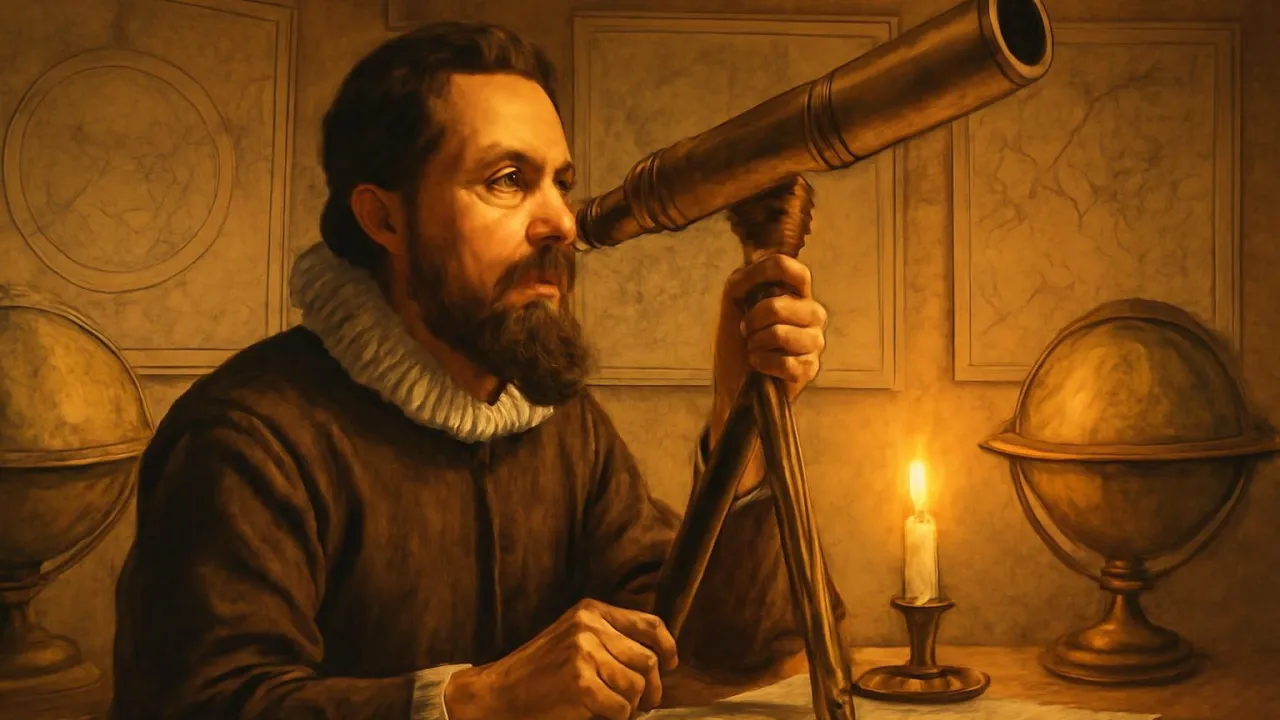
Kepler’s math helped people send rockets into space hundreds of years later!
✨ Word Sparks (Grade 2 Glossary)
Tap 🔊 to hear
solar system
Our sun and its planets
curiosity
Wanting to learn new things
discovery
Finding out something new
🪝
Have you ever wondered how planets move in the sky?
1
A Boy With Big Questions
Johannes Kepler always wondered about the stars above. He loved to draw the shapes he saw at night. His made him ask, 'Why do planets move the way they do?'
2
Tools for Stargazing
Johannes used a telescope and special math to study space. He worked hard to watch the planets every night. Sometimes, he stayed up late to write down what he saw.
3
A New Path for Planets
Kepler discovered that planets move in oval paths, not circles. His big idea changed how people understood the . Today, scientists still use Kepler’s rules to study space.
Kepler’s Laws helped NASA send astronauts to the Moon by predicting rocket paths!
✨ Word Sparks (Grade 3 Glossary)
Tap 🔊 to hear
ellipse
A stretched-out, oval shape
orbit
The path something takes around another
astronomy
The study of stars and planets
🪝
Imagine watching the night sky and solving a space mystery—what would you discover?
1
A Curious Mind Under the Stars
As a child, Johannes Kepler gazed at the stars, sketching their patterns in his notebook. He was fascinated by the way planets seemed to wander across the sky. Kepler always asked, 'What rules do the planets follow?' His curiosity made him want to solve the secrets of space.
2
Learning With Light and Numbers
Kepler studied math and in school, learning to use telescopes and charts. He worked with Tycho Brahe, a famous astronomer, to collect careful notes about planet positions. Using math, Kepler tried to find patterns in the planets’ movements. He never gave up, even when his ideas seemed strange to others.
3
The Oval Orbits Discovery
Kepler made a breakthrough when he realized planets travel in , or oval paths, not perfect circles. This was a new idea that changed how people thought about the solar system. His three laws of planetary motion explained how planets speed up and slow down as they the sun. Scientists still use Kepler’s laws to study space today.
4
A Legacy That Reaches Space
Kepler’s discoveries helped launch the science of into the future. His work made it possible for people to predict planet paths and send spacecraft to other worlds. Kepler showed that asking big questions and using careful math can change what we know about the universe.
NASA named the Kepler Space Telescope after Johannes Kepler to honor his discoveries about planets.
✨ Word Sparks (Grade 4 Glossary)
Tap 🔊 to hear
constellation
A group of stars that forms a picture
gravity
A force that pulls things together
satellite
An object that moves around a planet
🪝
What would you do if you noticed the planets didn’t move as everyone expected?
1
A Stargazer’s Curiosity Sparks Change
As a child in Renaissance Germany, Johannes Kepler was mesmerized by the night sky, sketching and pondering their mysteries. He grew up during a time when most people believed planets moved in perfect circles around the Earth. Kepler’s relentless curiosity pushed him to question these old ideas and search for the true patterns of the heavens.
2
Turning Observations Into Discovery
Kepler studied mathematics and astronomy, eventually working with Tycho Brahe, who kept the best records of planet positions in Europe. Using Brahe’s detailed data, Kepler tested many theories, spending years calculating and checking his results. He realized that math and careful observation could reveal hidden truths about how planets move.
3
The Laws That Changed Astronomy
Kepler’s breakthrough came when he discovered that planets travel in ellipses, not circles, around the sun. He wrote three laws of planetary motion, showing how planets speed up when closer to the sun and slow down farther away. These laws replaced old beliefs and became the foundation for modern astronomy, allowing scientists to predict orbits and understand .
4
A Lasting Legacy Across the Universe
Kepler’s work transformed how people see the universe, inspiring scientists for centuries. His laws made it possible to send spacecraft to other planets and understand the motion of moons and . Kepler’s story reminds us that asking questions and searching for answers can lead to discoveries that reach far beyond our world.
1. What did most people believe about planet paths before Kepler?
2. Why are Kepler’s laws important for space travel?
🤯 Mind-Blowing Fact • Grade 5
Kepler’s calculations were so precise that scientists still use his laws to guide interplanetary missions today.
✨ Word Sparks (Grade 5 Glossary)
Tap 🔊 to hear
trajectory
The path something follows through space
evidence
Facts that help prove something is true
revolution
A big change in the way people think
🪝
If you noticed that the planets didn’t follow anyone’s rules, would you dare to rewrite the laws of the universe?
1
A Young Dreamer Under Renaissance Skies
Johannes Kepler grew up in a small German town, where the night sky was his greatest teacher. As a child, he was captivated by lunar eclipses and the strange paths of wandering planets, sketching their patterns and asking questions no one else dared. Living during the Renaissance, Kepler was surrounded by new ideas in science and mathematics, but he struggled with poor eyesight and illness. Despite these challenges, his curiosity and determination pushed him to explore the mysteries of the cosmos.
2
From Student to Scientific Pioneer
Kepler’s academic journey led him to study mathematics and astronomy at the University of Tübingen, where he learned about the sun-centered model of the solar system. After joining Tycho Brahe, the leading astronomer of the time, Kepler gained access to the most accurate planetary observations ever recorded. He spent years analyzing Brahe’s data, testing countless mathematical models, and refusing to accept simple answers when the didn’t fit. His perseverance and critical thinking set him apart from other scientists of his era.
3
Rewriting the Rules: The Laws of Planetary Motion
Kepler’s greatest breakthrough came when he realized that planets move in ellipses, not perfect circles, around the sun. He formulated three laws of planetary motion: first, that planets orbit in ellipses with the sun at one focus; second, that planets sweep out equal areas in equal times, meaning they move faster when closer to the sun; and third, that the time a planet takes to orbit the sun depends on its distance. These laws replaced centuries-old beliefs and became the mathematical foundation for modern astronomy and physics.
4
A Legacy That Reaches the Stars
Kepler’s discoveries changed how humanity understands the universe and made space exploration possible. His laws allowed later scientists, like Isaac Newton, to explain gravity and helped engineers design spacecraft trajectories. The Kepler Space Telescope, named in his honor, has discovered thousands of planets orbiting other stars, proving that Kepler’s curiosity still inspires new generations. His work shows that careful observation, bold questions, and mathematical thinking can unlock the secrets of the cosmos.
5
Inspiration for Future Explorers
Johannes Kepler’s life is a story of resilience, imagination, and scientific . Despite personal hardships and opposition from those who clung to old beliefs, he never stopped searching for truth in the stars. His willingness to challenge accepted ideas and his dedication to -based discovery paved the way for modern science. Kepler’s journey encourages us to look up, ask questions, and believe that our curiosity can change the world.