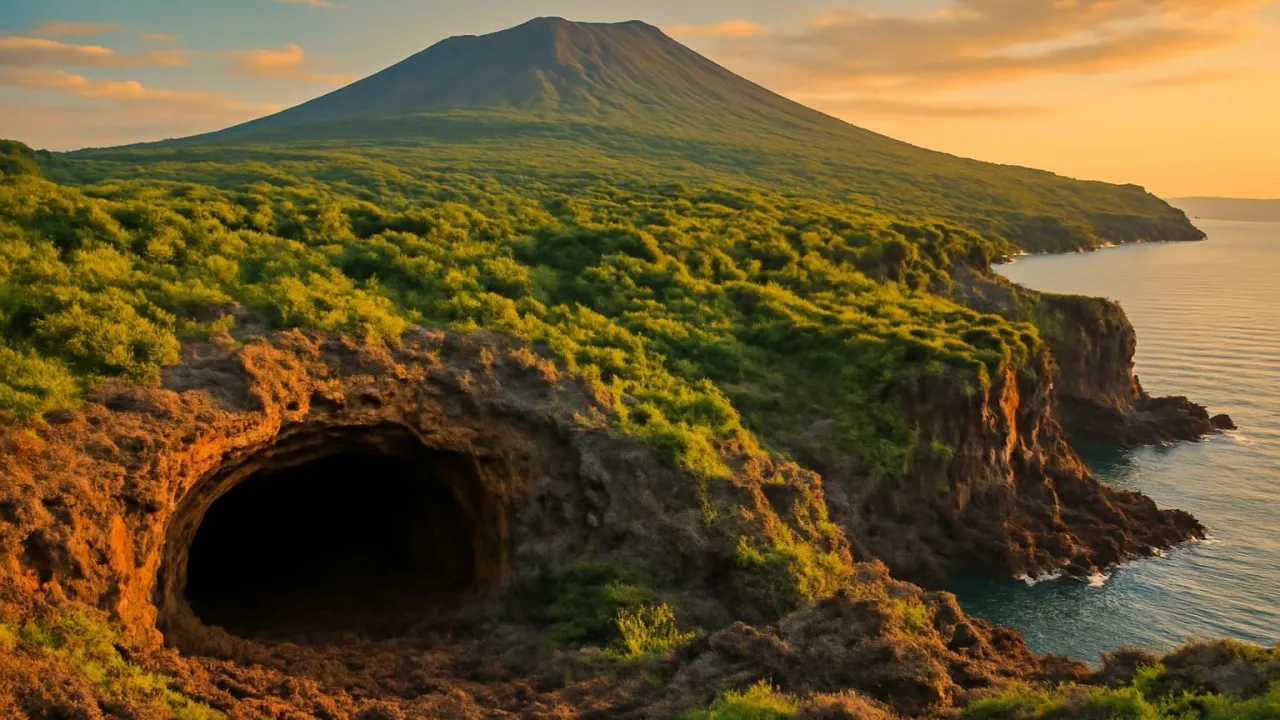
Manjanggul Cave on Jeju is over 5 miles long and filled with lava shapes!
✨ Word Sparks (Grade 2 Glossary)
Tap 🔊 to hear
lava tube
A tunnel made by flowing lava
echo
A sound that bounces back to you
cliff
A high, steep rock wall
🪝
Have you ever heard your voice echo inside a dark cave?
1
A Volcano Island Adventure
Jeju is a large island with a giant volcano in the middle. The volcano is called Hallasan and it is the tallest mountain in Korea. Black lava rocks are everywhere, showing Jeju’s fiery past. Many people visit Jeju to hike and explore.
2
Secret Tunnels Below
Under Jeju, there are long made by flowing lava. Some tubes are so big you can walk through them and hear . The famous Manjanggul Cave is one of the longest lava tubes in the world. It feels cool and a little spooky inside.
3
Nature’s Wind and Water Show
Jeju’s coast has high where waves crash loudly. The wind blows through forests and fields of flowers. People come to see waterfalls, caves, and the blue sea. Jeju is a place full of nature’s surprises.
Jeju’s Manjanggul Cave has a lava column that stands 24 feet tall!
✨ Word Sparks (Grade 3 Glossary)
Tap 🔊 to hear
basalt
A hard, dark volcanic rock
erosion
When wind or water wears rocks away
habitat
A home for plants and animals
🪝
Can you imagine walking where hot lava once flowed beneath your feet?
1
A Volcano Shaped by Fire
Jeju Island was formed long ago by eruptions from Hallasan, a massive shield volcano. The volcano’s eruptions created layers of black rock that cover the island today. Hallasan rises 6,398 feet, making it the tallest mountain in South Korea. The island’s shape and rocky soil are proof of its volcanic origins.
2
Exploring Lava Tubes
When lava flowed underground, it formed huge tunnels called lava tubes. Manjanggul Cave is one of the longest lava tubes on Earth, stretching over five miles. Inside, you’ll see strange rock shapes called lava stalactites and lava columns. These tubes are cool, dark, and echo with every step.
3
Nature’s Forces at Work
Jeju’s cliffs, waterfalls, and caves were shaped by wind, water, and volcanic activity. from waves carved the island’s famous coastal cliffs. Rainwater seeps into the ground, feeding forests and wildflowers. The mix of volcanoes, caves, and sea makes Jeju a unique natural wonder.
4
A Place for People and Animals
Jeju is home to rare plants and animals that thrive in its mild climate. People visit to hike Hallasan, explore caves, and enjoy the beaches. Farmers grow oranges in the rich volcanic soil. Jeju’s special landforms and are protected for everyone to enjoy.
Manjanggul Cave’s lava column stands 24 feet tall—the tallest ever found in a lava tube!
✨ Word Sparks (Grade 4 Glossary)
Tap 🔊 to hear
tuff
Soft rock made from volcano ash
crater
A bowl-shaped hole at a volcano’s top
erosion
When wind or water slowly wears away land
🪝
What mysteries would you discover if you could journey deep inside a volcanic island?
1
A Volcanic Island Born of Fire and Time
Jeju Volcanic Island began forming nearly two million years ago, shaped by repeated eruptions from Hallasan, a shield volcano. Each eruption layered the land with basalt and , creating Jeju’s unique rocky landscape and fertile soil. Hallasan, rising 6,398 feet, dominates the island’s center and is South Korea’s highest peak. The mountain’s and gentle slopes attract hikers and scientists from around the world.
2
Lava Tubes: Nature’s Underground Tunnels
As molten lava flowed beneath Jeju’s surface, it hollowed out massive tunnels called lava tubes. Manjanggul Cave, a UNESCO World Heritage site, stretches over five miles and contains the world’s tallest known lava column. These tubes are cool, dark, and filled with volcanic features like stalactites, lava shelves, and echoing chambers. Scientists study these caves to learn about volcanic activity and Earth’s history.
3
Forces That Shape the Island
Jeju’s dramatic cliffs, waterfalls, and caves were carved by the combined forces of volcanic eruptions, wind, and water . The pounding ocean waves sculpt the island’s famous coastal cliffs and sea caves. Rainwater seeps through volcanic rock, creating underground rivers and lush forests above. This ongoing process makes Jeju a living example of how landforms evolve over time.
4
A Natural and Cultural Treasure
Jeju’s unique environment supports many rare plants and animals, some found nowhere else on Earth. Local people have adapted to the island’s volcanic soil, growing citrus fruits and developing special stone houses. Jeju’s natural wonders, traditional culture, and protected habitats attract millions of visitors each year, making it a global treasure worth preserving.
Jeju’s Manjanggul Cave is so long that it could fit over 400 soccer fields end to end!
✨ Word Sparks (Grade 5 Glossary)
Tap 🔊 to hear
basalt
A hard, dark volcanic rock formed from lava
succession
How plants and animals slowly return after change
UNESCO
A world group that protects special places
🪝
What would you discover if you explored the world’s longest lava tubes beneath a towering volcano?
1
Jeju’s Fiery Origins: A Geological Timeline
Jeju Volcanic Island began forming nearly two million years ago during the Cenozoic era, as repeated eruptions from the shield volcano Hallasan built layer upon layer of and volcanic tuff. Hallasan, now dormant, rises 6,398 feet (1,950 meters) and is the tallest mountain in South Korea. The island’s formation involved both explosive eruptions and slow lava flows, resulting in a landscape of craters, cones, and rugged lava fields. Geologists study Jeju’s volcanic strata to understand the island’s complex history and the processes that shaped its terrain.
2
Manjanggul Cave: The Lava Tube Wonder
Beneath Jeju’s surface lies Manjanggul Cave, one of the world’s longest and most scientifically significant lava tubes, stretching over 5 miles (8 kilometers). Lava tubes form when the surface of a lava flow cools and hardens, while molten lava continues to flow beneath, eventually draining away to leave a hollow tunnel. Inside Manjanggul, visitors encounter features such as lava stalactites, lava shelves, and the world’s tallest lava column, which stands an impressive 24 feet (7.6 meters) high. The cave’s stable temperature and humidity create a unique underground habitat for rare species like Jeju cave spiders and bats.
3
Dynamic Landforms: Erosion, Weather, and Water
Jeju’s landscape continues to change as wind, rain, and ocean waves erode its volcanic rock, carving dramatic coastal cliffs, sea caves, and waterfalls. The island’s porous allows rainwater to filter underground, forming springs and supporting lush forests above. Erosion and weathering reveal layers of volcanic history, while the interplay of land and sea creates habitats for diverse plants and animals. Scientists use Jeju as a living laboratory to study erosion, landform development, and ecological .
4
Cultural Heritage and Environmental Protection
Jeju’s volcanic soils are exceptionally fertile, enabling farmers to grow citrus fruits, tea, and unique crops adapted to the island’s climate. Traditional stone houses, called 'choga,' are built with porous to withstand strong winds and earthquakes. Jeju’s natural and cultural sites are protected as a World Heritage Site, preserving its biodiversity and traditional ways of life. Local legends and festivals celebrate the island’s volcanic origins, connecting people to the land’s ancient history.
5
A Global Treasure for Science and Adventure
Today, Jeju attracts millions of visitors eager to hike Hallasan, explore lava tubes, and experience its stunning biodiversity. Ecotourism and scientific research help protect Jeju’s unique habitats, including endangered species and rare volcanic features. The island’s combination of geological wonders, rich cultural traditions, and commitment to conservation make it a model for sustainable tourism. Jeju’s living volcanoes, caves, and coastal landscapes continue to inspire curiosity and discovery for people around the world.