🇺🇸 U.S. HISTORY
🏛️ 4th President of the United States (1809–1817) • Father of the Constitution
VA History & Social Science SOL K.1, 1.2, 2.4, VS.1–VS.10, USI & USII
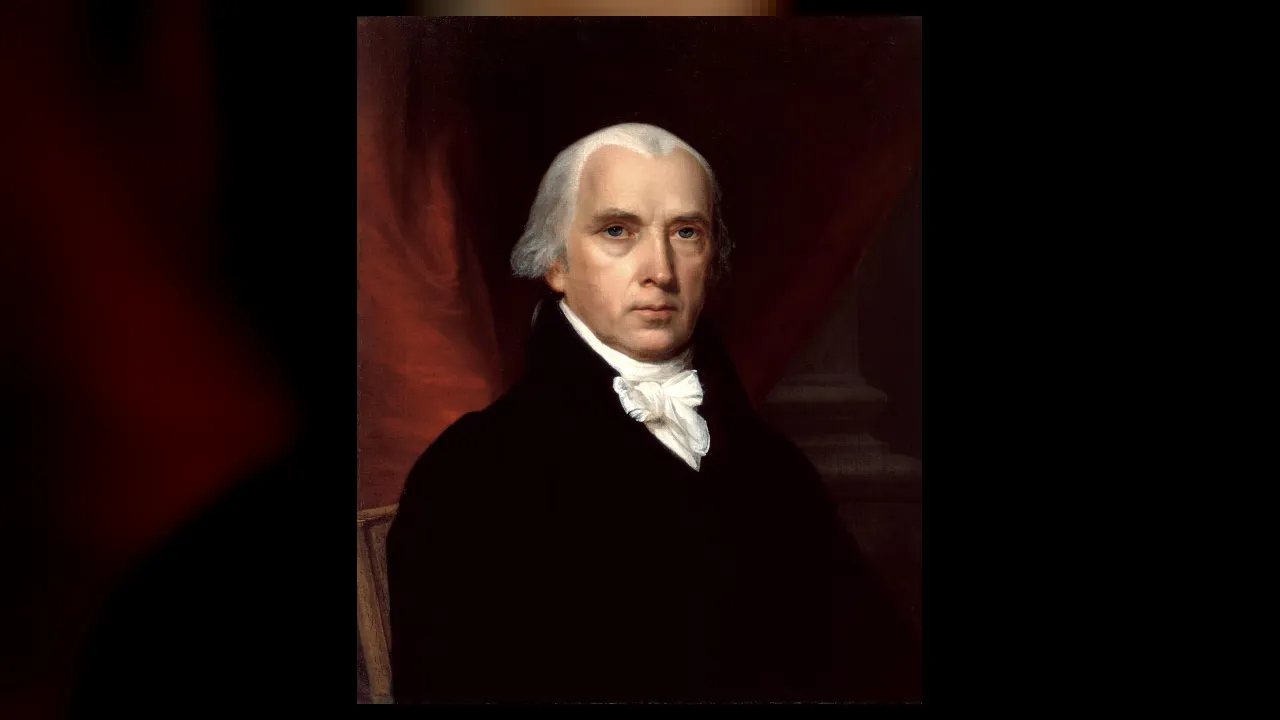
James Madison
Father of the Constitution and Bill of Rights
Grade 2 • Developing • 116 words
⏳ Era / StatehoodPresidency: March 4, 1809 – March 4, 1817 (1751–1836)
🗺️ Region / CapitalMontpelier • Orange County, Commonwealth of Virginia
📜 Key MilestoneVirginia Plan architect (1787), Federalist Papers co-author, Bill of Rights drafter, and 4th President
⚡ Historical SparkSmallest president in stature (5 ft 4 in), yet giant mastermind of checks, balances, and the Bill of Rights
🤯 Mind-Blowing Fact • Grade 1
Standing five feet four inches tall and weighing only about one hundred pounds, James Madison was the shortest and lightest president in U.S. history!
✨ Word Sparks (Grade 1 Glossary)
Tap 🔊 to hear
Constitution
highest written rulebook of the United States
rights
important freedoms protected for every citizen
branch
one working part of our national government
🪝
How did our shortest president build the biggest plan for America's laws?
1
Big Ideas in Books
Quietly turning pages by candlelight, James Madison studied how fair countries work! Though only five feet four inches tall, he had giant ideas.
2
Father of the Constitution
He arrived early in Philadelphia with a smart plan for three of government. Friends called him the 'Father of the '!
3
Protecting Our Rights
Later he wrote the Bill of and served as our fourth president beside brave First Lady Dolley Madison!
1. What proud title did James Madison earn for designing the plan behind America's government?
2. Which famous list of ten citizen freedoms did James Madison write for the Constitution?
🤯 Mind-Blowing Fact • Grade 2
Dolley Madison was the very first person regularly called 'First Lady'—and she hosted lively ice-cream gatherings at the White House where rival lawmakers could talk as friends!
✨ Word Sparks (Grade 2 Glossary)
Tap 🔊 to hear
balance
sharing power evenly so nobody rules alone
portrait
painted picture of a real person
First Lady
title honoring the host of the White House
🪝
Why did James Madison unpack crates of two hundred history books before heading to Philadelphia in 1787?
1
Doing His Homework for America
Thump! Wooden crates packed with history books from Paris landed on the porch of Montpelier, James Madison's home in Virginia. Sent by his best friend Thomas Jefferson, those books helped Madison study why older democracies succeeded or failed. Arriving eleven days early in Philadelphia in 1787, he brought the 'Virginia Plan' for three balanced branches of government!
2
Taking Every Note and Writing Rights
Sitting right up front, Madison never missed a single day and wrote down every speech so future Americans would know how the Constitution was made. Next, in Congress, he wrote the Bill of Rights!
3
Fourth President and Dolley's Rescue
During the War of 1812 while Madison was our fourth president, Dolley Madison bravely saved George Washington's before British troops burned the White House.
1. How did James Madison prepare before delegates wrote the U.S. Constitution in 1787?
2. What treasure did First Lady Dolley Madison rescue from the White House in August 1814?
🤯 Mind-Blowing Fact • Grade 3
Because delegates kept the windows of Independence Hall shut for privacy during the hot summer of 1787, James Madison's handwritten daily notes were our main record of how the U.S. Constitution was debated!
✨ Word Sparks (Grade 3 Glossary)
Tap 🔊 to hear
checks and balances
rules letting each government branch limit others
interpret
explain the clear meaning of a law
amendment
official addition improving the written Constitution
🪝
How do 'checks and balances' stop any one leader from grabbing too much power?
1
Three Branches Checking Each Other
Imagine a three-legged stool—take one leg away and it tips right over! In May 1787, soft-spoken Virginian James Madison arrived at Philadelphia's Constitutional Convention with the Virginia Plan. Instead of one weak Congress under the old Articles of Confederation, Madison proposed dividing power among three branches: Congress to make laws, a President to carry them out, and Federal Courts to them—each able to 'check' the others!
2
Explaining the Plan to Citizens
Before the Constitution could become law, nine states had to ratify it. Teaming up with Alexander Hamilton and John Jay, Madison wrote clear newspaper essays called 'The Federalist Papers' explaining why a balanced republic would protect liberty across a large country.
3
Keeping His Promise on the Bill of Rights
Listening carefully to citizens who wanted written guarantees of personal freedom, Congressman Madison drafted that became the ten-amendment Bill of Rights in 1791.
4
Steady Leadership in the War of 1812
As fourth president (1809–1817), Madison guided the nation through the War of 1812—when Fort McHenry's flag inspired 'The Star-Spangled Banner'—confirming American independence at sea.
1. What was the main idea of James Madison's 'Virginia Plan' at the 1787 Constitutional Convention?
2. Which famous collection of essays did James Madison write alongside Alexander Hamilton and John Jay to explain the Constitution?
🤯 Mind-Blowing Fact • Grade 4
During the War of 1812, James Madison never once suspended constitutional civil liberties or postponed an election—even after enemy soldiers burned the Capitol and White House!
✨ Word Sparks (Grade 4 Glossary)
Tap 🔊 to hear
federalism
sharing governing power between nation and states
faction
group pushing its own narrow interest
Great Compromise
1787 agreement balancing big and small states
🪝
Why did thinkers once believe a republic had to be tiny—until James Madison proved a big country could protect freedom even better?
1
From Virginia's Piedmont to Constitutional Mastermind
Growing up at Montpelier in Orange County, Virginia, within sight of the Blue Ridge Mountains, James Madison (1751–1836) graduated from Princeton in just two years and helped George Mason shape Virginia's 1776 guarantee of free religious exercise. By 1786, trade quarrels and empty national coffers under the Articles of Confederation convinced Madison that the Union would fracture unless states formed an energetic yet strictly limited federal framework.
2
The Virginia Plan and Federalist No. 10
At Philadelphia in 1787, Madison's Virginia Plan set the convention's agenda, leading to the —pairing a population-based House of Representatives with an equal-state Senate—plus , which shares authority between national and state governments. In 'Federalist No. 10' and 'Federalist No. 51' ('If men were angels, no government would be necessary'), Madison flipped old European theory upside down: in a large, diverse republic, so many different groups and opinions exist that no single selfish can easily bully everyone else!
3
Championing the Bill of Rights
Originally, Madison wondered whether listing rights on paper might accidentally leave unlisted rights unprotected—a worry he solved with the Ninth Amendment! Honoring his pledge to Virginia voters, Representative Madison sifted nearly two hundred state suggestions in 1789 into concise amendments safeguarding speech, religion, press, assembly, jury trials, and reserved state powers, ratified in December 1791 as the Bill of Rights.
4
Wartime President Without Canceling Civil Liberties
After eight years as Jefferson's Secretary of State, Madison served two terms as fourth president (1809–1817). Even when British forces invaded Chesapeake Bay during the War of 1812, Madison refused to suspend constitutional elections or silence newspapers, seeing the nation emerge peacefully united under the 1814 Treaty of Ghent.
1. In 'Federalist No. 10,' why did James Madison argue that a large, diverse republic actually protects liberty better than a tiny town-state?
2. How did the Ninth Amendment solve Madison's early worry about writing down a Bill of Rights?
🤯 Mind-Blowing Fact • Grade 5
As a twenty-five-year-old newcomer in Virginia's 1776 convention, James Madison changed history with just a few words—convincing lawmakers to replace religious 'toleration' (a favor government could take back) with the 'free exercise of religion' as an equal natural right!
✨ Word Sparks (Grade 5 Glossary)
Tap 🔊 to hear
counteract
push back equally to keep power balanced
impressment
forcing captured sailors into foreign naval service
posthumously
published or honored after the author's lifetime
🪝
How did 'ambition must be made to counteract ambition' become the engineering principle of American constitutional government?
1
Piedmont Scholar of Ancient and Modern Confederacies
Educated at the College of New Jersey (Princeton) under John Witherspoon, James Madison (1751–1836) entered public service on Virginia's 1776 revolutionary convention, where the twenty-five-year-old delegate persuaded George Mason to replace mere religious 'toleration' with the full natural right to 'free exercise of religion.' Watching the Confederation Congress struggle without taxation or interstate commerce authority in the 1780s, Madison immersed himself at Montpelier in two trunkloads of Enlightenment treatises and classical histories shipped from Paris by Thomas Jefferson—producing his analytical 'Vices of the Political System of the United States' on the eve of the 1787 Philadelphia Convention.
2
Philadelphia Blueprint, Compound Republic, and Publius
Presented by Governor Edmund Randolph on May 29, 1787, Madison's fifteen-resolution Virginia Plan shifted delegates from patching the Articles to framing a sovereign constitutional government derived directly from 'We the People.' Refined through the Connecticut (Great) Compromise, the resulting charter created what Madison in 'Federalist No. 51' termed a 'double security' for citizen rights: power is first divided vertically between federal and state governments (federalism) and then subdivided horizontally across legislative, executive, and judicial branches ('Ambition must be made to ambition'). Writing twenty-nine of the eighty-five 'Federalist' essays as 'Publius' and debating Patrick Henry line-by-line at Richmond's June 1788 ratifying convention, Madison helped secure Virginia's crucial tenth-state ratification.
3
Architect of the Bill of Rights
Elected to the First U.S. House of Representatives in 1789—and simultaneously advising President George Washington on his inaugural address—Madison overcame congressional reluctance by synthesizing state ratifying proposals into constitutional amendments. Ratified on December 15, 1791, the ten-amendment Bill of Rights transformed skeptical Anti-Federalists into loyal defenders of the Constitution.
4
Secretary of State, War of 1812, and Constitutional Fidelity
Following his 1794 marriage to charismatic widow Dolley Payne Todd and eight years overseeing diplomacy—including the 1803 Louisiana Purchase—as Jefferson's Secretary of State, Madison served as fourth president (1809–1817). Confronted with British maritime of American sailors and trade blockades, Congress declared war in June 1812. Despite early setbacks and the August 1814 burning of federal buildings in Washington—where Dolley Madison saved Gilbert Stuart's Washington portrait and cabinet archives—naval victories on Lake Erie and Lake Champlain, Baltimore's defense of Fort McHenry, and the Treaty of Ghent (followed by New Orleans) secured America's 'Second War of Independence' while Madison scrupulously upheld wartime press and electoral freedoms.
5
Last Founding Father at Montpelier
Retiring to Montpelier—where he succeeded Jefferson as Rector of the University of Virginia while wrestling unsuccessfully with the economic entanglement of plantation slavery—Madison outlived every signer and fellow delegate of 1787. published in 1840, his meticulous 'Notes of Debates in the Federal Convention' remain the single richest primary window into the birth of the U.S. Constitution.