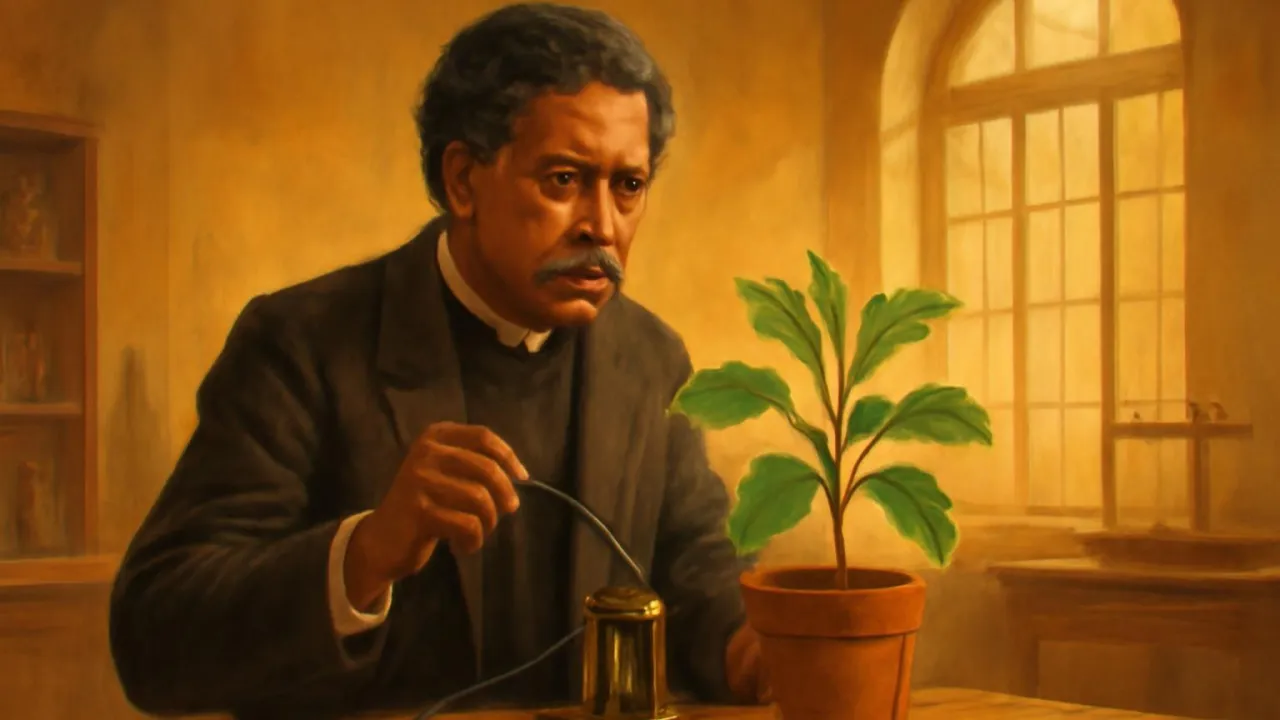
Jagadish’s inventions helped show that plants can respond to music and light!
✨ Word Sparks (Grade 2 Glossary)
Tap 🔊 to hear
invent
To make something new that helps people.
react
To do something when something else happens.
discovery
Finding out something new.
🪝
Have you ever wondered if plants can feel things?
1
A Child With Questions
Jagadish grew up asking many questions about nature. He loved watching plants grow and wondered if they could feel things. He was curious about the world around him.
2
Inventing New Tools
He worked hard to build special machines to study plants. These machines showed that plants move and to light or touch. His experiments helped people see plants in a new way.
3
A Big Discovery
Jagadish proved that plants are alive and sensitive. He shared his discoveries with scientists everywhere. His work changed how people think about plants.
Jagadish’s crescograph could measure plant growth as tiny as one millionth of an inch!
✨ Word Sparks (Grade 3 Glossary)
Tap 🔊 to hear
crescograph
A tool to see tiny plant movements.
physiology
The study of how living things work.
pioneer
A person who does something first.
🪝
What if you could build a machine to hear a plant’s heartbeat?
1
A Boy Who Loved Nature
Young Jagadish Chandra Bose spent hours outside, watching plants and animals. He wondered if plants could feel pain or happiness like people do. His questions made him want to become a scientist. He believed that every living thing had its own secret life.
2
Inventing the Crescograph
Jagadish invented a tool called the to study plant movements. This machine made tiny movements big enough to see and measure. He carefully tested how plants reacted to light, heat, and touch. His experiments showed that plants respond to their environment.
3
Changing Science Forever
Many people did not believe plants could sense things. Jagadish’s discoveries surprised scientists all over the world. He proved that plants are sensitive and alive in special ways. His work helped start a new field called plant .
4
A Scientist Who Shared
Jagadish wanted everyone to learn from his inventions. He gave away his ideas instead of keeping them secret. He inspired other scientists to explore the hidden world of plants. Today, people remember him as a in both physics and biology.
Jagadish was the first to show that plants can feel pain, using his own inventions!
✨ Word Sparks (Grade 4 Glossary)
Tap 🔊 to hear
instrument
A special tool for science experiments.
sensitivity
How much something can feel or react.
legacy
What someone leaves for the future.
🪝
Imagine discovering that plants can feel and respond just like animals—would you believe it?
1
Early Curiosity in Colonial India
Growing up in Bengal during British rule, Jagadish Chandra Bose was fascinated by the natural world around him. He often asked questions about how plants and animals lived and grew, even when others ignored such mysteries. His father encouraged him to explore science and respect all living things, which shaped his lifelong curiosity. This early support helped him become one of India’s greatest scientific minds.
2
Inventing Tools to Reveal Plant Secrets
Jagadish designed the crescograph, an that magnified the tiniest movements of plants so they could be measured. Using this device, he showed that plants react to light, heat, sound, and touch, just as animals do. His careful experiments revealed that plants have a sensitive life, challenging what scientists believed at the time. These discoveries opened up the new field of plant physiology.
3
Facing Doubt and Changing Minds
Many scientists in Europe doubted Jagadish’s results because few believed plants could sense their surroundings. Despite this skepticism, he published his findings and traveled to explain his experiments to audiences around the world. His work eventually convinced others that plants are far more alive and responsive than anyone had guessed. This breakthrough changed how people understood the plant kingdom.
4
Legacy in Science and Education
Jagadish Chandra Bose not only made discoveries but also shared his inventions freely to help other scientists. He founded a research institute in India, where students could learn and experiment with new ideas. Today, his work in both physics and biology inspires scientists everywhere to look deeper into the natural world. His teaches us to be curious, generous, and open-minded.
1. What did Jagadish’s experiments prove about plants?
2. Why did some scientists doubt Jagadish’s findings?
🤯 Mind-Blowing Fact • Grade 5
Bose’s experiments proved plants send electrical signals, just like animal nerves, changing biology forever!
✨ Word Sparks (Grade 5 Glossary)
Tap 🔊 to hear
electromagnetic waves
Invisible energy used in radios and science.
stimuli
Things like light or touch that cause a reaction.
prejudice
Unfair treatment because of who someone is.
🪝
What if the silent world of plants held secrets that could change science forever?
1
A Childhood of Wonder in Bengal
As a young boy in colonial Bengal, Jagadish Chandra Bose spent countless hours exploring the forests and rivers near his home, asking questions about every living thing he saw. His father, a respected educator, encouraged him to value both Indian traditions and Western science, nurturing his son’s curiosity and respect for nature. Despite facing discrimination in British-run schools, Jagadish excelled in his studies, developing a passion for physics and botany. This early blend of cultural pride and scientific wonder would shape his entire career. His childhood experiences inspired him to investigate the mysteries of life that others overlooked.
2
Inventing the Crescograph and Exploring Plant Physiology
Jagadish Chandra Bose’s most famous invention, the crescograph, could amplify and record plant movements as small as one millionth of an inch, a feat never achieved before. With this instrument, he conducted rigorous experiments to observe how plants respond to such as light, heat, sound, and touch, revealing that plants have a remarkable sensitivity similar to animals. His findings demonstrated that plants transmit electrical impulses and can even experience shock or fatigue, revolutionizing the field of plant physiology. By combining engineering, biology, and physics, Bose introduced a new way of understanding the secret lives of plants.
3
Challenging Scientific Beliefs and Facing Prejudice
When Bose first presented his discoveries to the scientific community in Europe, many experts dismissed his results, partly because he was an Indian scientist during a time of colonial . Despite this skepticism, he meticulously published his data, repeated his experiments, and traveled internationally to demonstrate his instruments and methods. Gradually, his careful work changed minds and won respect around the world. His persistence not only advanced plant science but also challenged unfair attitudes in global science communities.
4
Pioneering Wireless Communication and Giving Back
In addition to his botanical research, Bose was a pioneer in wireless communication, conducting some of the earliest experiments with radio waves even before Guglielmo Marconi. He invented devices that could detect invisible , laying the groundwork for modern wireless technology. Rather than patenting his inventions for profit, Bose freely shared his knowledge and devices, believing science should benefit all humanity. He also established the Bose Institute in Kolkata, India, to support future generations of researchers.
5
A Lasting Legacy of Curiosity and Generosity
Jagadish Chandra Bose’s legacy endures in both the scientific discoveries he made and the spirit of curiosity he inspired. His work bridged cultures and disciplines, showing that true science welcomes new ideas from everywhere. Today, plant physiologists, physicists, and inventors around the world build on his groundbreaking research and generous example. Bose’s life reminds us that the most important discoveries often begin with a single question and a willingness to listen—even to the quietest voices in nature.