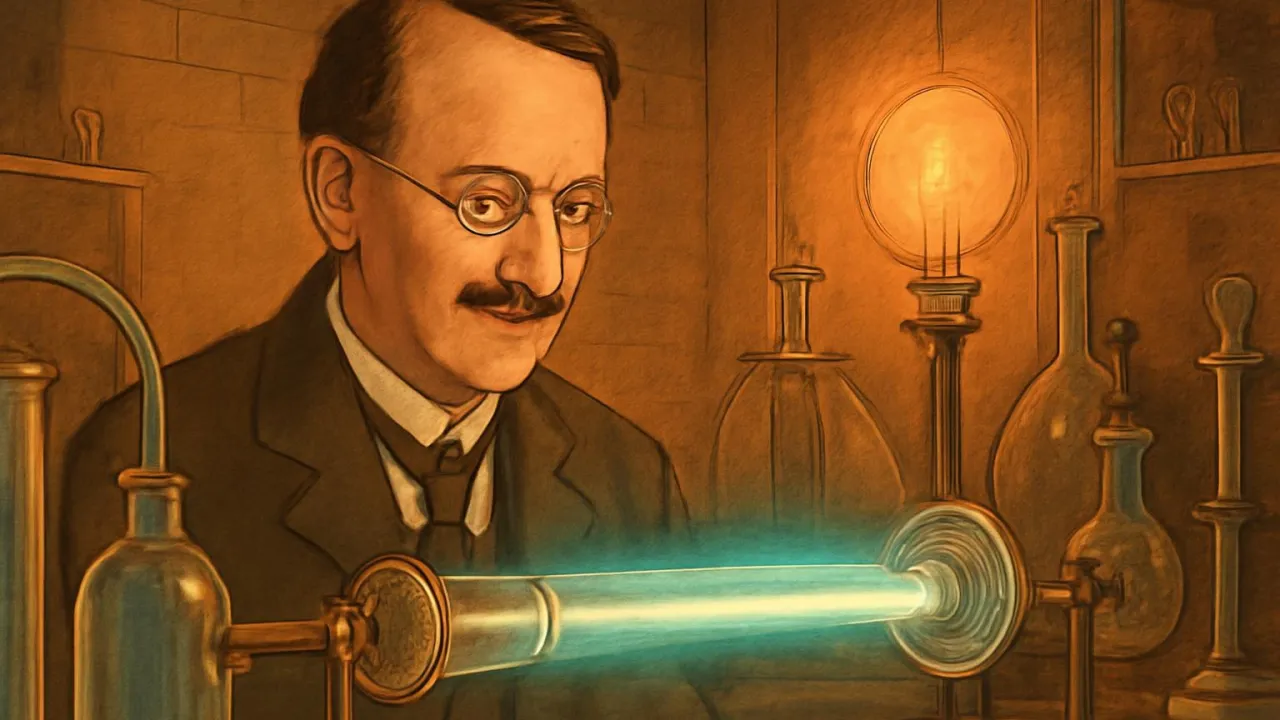
J. J. Thomson’s discovery showed that atoms have even smaller parts inside.
✨ Word Sparks (Grade 2 Glossary)
Tap 🔊 to hear
particle
A very tiny piece of something
electricity
Energy that makes lights and machines work
atom
The smallest part of any thing
🪝
Have you ever wondered what makes up everything around you?
1
Curious Young Scientist
J. J. Thomson loved asking questions and exploring how things worked. As a boy, he read science books and dreamed of discovering something new. He liked to build things and watch what happened.
2
Hard Work in the Lab
J. J. spent hours experimenting with glass tubes and . He watched green lights and tried different ways to test his ideas. He never gave up, even when it was hard.
3
A Big Discovery
One day, J. J. found a tiny called the electron. Scientists were amazed because no one knew about it before. His discovery helped people understand what are made of.
J. J. Thomson’s students included Ernest Rutherford, who later discovered the nucleus of the atom.
✨ Word Sparks (Grade 3 Glossary)
Tap 🔊 to hear
cathode ray tube
A glass tube that glows with electricity
negatively charged
Having an electrical force that is negative
matter
Anything that takes up space
🪝
Imagine finding something so tiny, no one had ever seen it before!
1
A Curious Mind
As a child, J. J. Thomson loved puzzles and science books. He often wondered what made up the world around him. His curiosity led him to study physics and ask big questions about .
2
The Power of Experiments
J. J. became a scientist who loved experimenting with electricity and magnetism. He used special glass tubes called in his laboratory. By testing and observing, he searched for clues about the building blocks of atoms.
3
The Electron Discovery
In 1897, J. J. noticed a strange beam in his tube experiments. He realized the beam was made of tiny, particles. These particles were named electrons, and they were smaller than atoms themselves.
4
Changing Science Forever
J. J. Thomson’s discovery of the electron changed how scientists understood . He showed that atoms were not solid, but had parts inside. His work inspired new research and helped create modern physics.
1. What tool did J. J. Thomson use in his experiments?
2. Why was the electron important?
🤯 Mind-Blowing Fact • Grade 4
J. J. Thomson’s son, George, also won a Nobel Prize for discovering the wave nature of electrons.
✨ Word Sparks (Grade 4 Glossary)
Tap 🔊 to hear
Nobel Prize
A famous award for big discoveries
structure
How something is built or put together
magnetism
A force that pulls or pushes metal
🪝
What would you do if you discovered a hidden part of every atom?
1
A World Full of Questions
Growing up in Victorian England, J. J. Thomson was fascinated by the mysteries of nature and science. He often read about electricity and , which were exciting new fields at the time. His curiosity led him to study at Cambridge University, where he became known for his careful experiments and creative thinking.
2
Inventing New Experiments
In his laboratory, J. J. Thomson designed experiments using cathode ray tubes to explore the unknown. He passed electricity through glass tubes with almost no air inside, making mysterious green rays appear. By adding magnets and measuring how the rays bent, he realized these rays were made of tiny particles he called electrons.
3
A Turning Point in Science
Before J. J. Thomson’s discovery, most scientists believed atoms were solid and indivisible. Thomson’s experiments proved that atoms contained even smaller parts, changing the entire field of physics. His work inspired other scientists to explore atomic , leading to discoveries like the nucleus and the proton.
4
A Lasting Legacy
J. J. Thomson’s electron discovery earned him the in Physics in 1906, and his students went on to make their own major discoveries. Today, electronics, computers, and much of modern technology depend on understanding electrons. Thomson’s curiosity and experiments helped build the foundation for modern science.
J. J. Thomson’s discovery of the electron led to inventions like television, computers, and X-ray machines.
✨ Word Sparks (Grade 5 Glossary)
Tap 🔊 to hear
mass-to-charge ratio
How heavy something is for its electric charge
quantum mechanics
The science of tiny particles and energy
atomic structure
How the parts inside atoms are arranged
🪝
Can you imagine revealing a new building block of the universe with a simple glass tube?
1
A Childhood of Wonder and Inquiry
Long before the world knew his name, young Joseph John Thomson was captivated by the invisible forces of nature. Growing up in industrial Manchester, he spent hours reading about electricity and magnetism, two mysterious powers that fascinated Victorian scientists. His early curiosity was matched by determination, as he built small gadgets and performed home experiments, always seeking to understand what lay beneath the surface of everyday things.
2
Inventing Experiments and Defying Expectations
As a professor at Cambridge University’s Cavendish Laboratory, J. J. Thomson designed creative experiments to probe the secrets of the atom. He used cathode ray tubes—glass tubes with almost all the air removed—to study strange glowing beams produced by electricity. By applying electric and magnetic fields, he observed that the rays curved in ways that depended on their charge and mass, leading him to conclude that the rays were streams of tiny, negatively charged particles.
3
The Discovery of the Electron
In 1897, after carefully measuring how the rays bent, Thomson calculated the of these particles. He realized they were over a thousand times lighter than a hydrogen atom, proving that atoms themselves contained smaller parts. He named these particles electrons, overturning the long-held belief that atoms were indivisible, and publishing results that electrified the scientific community.
4
Legacy and Impact on Modern Science
Thomson’s discovery of the electron marked a turning point in physics, inspiring a new understanding of and the birth of . He received the Nobel Prize in Physics in 1906, and his laboratory became a training ground for future Nobel laureates, including Ernest Rutherford and his own son, George. Today, knowledge of electrons is essential for everything from chemistry to electronics, computers, and medical imaging.
5
Inspiration for Future Explorers
J. J. Thomson’s story shows how curiosity, careful observation, and creative experiments can change the world. His willingness to question old ideas and invent new tools opened the door to discoveries that shape our lives today. He reminds us that even the tiniest mysteries can unlock enormous possibilities for science and technology.