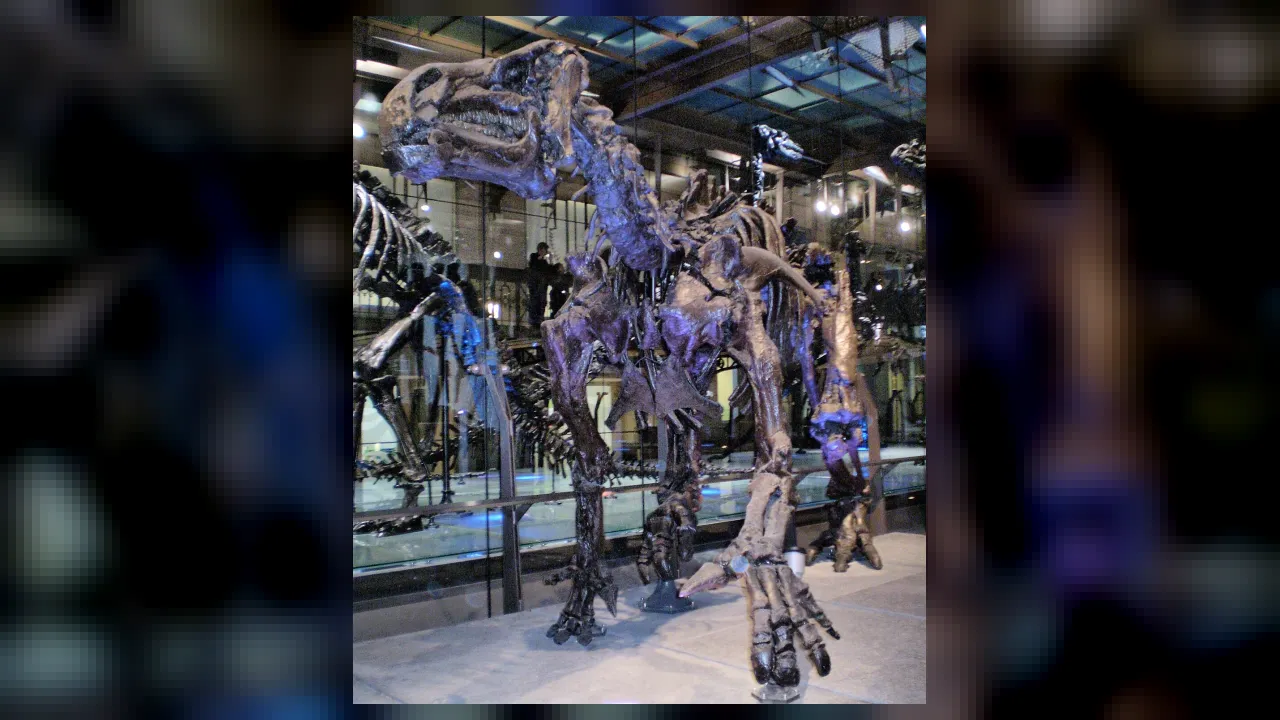
⚡ Survival SuperpowerFive-fingered Swiss-army hand with a sharp thumb spike, three walking hooves, and a grasping pinky
🤯 Mind-Blowing Fact • Grade 1
When the first Iguanodon bone spike was found in England, scientists accidentally glued it onto the dinosaur's nose like a rhino horn before realizing it was actually a thumb!
✨ Word Sparks (Grade 1 Glossary)
Tap 🔊 to hear
Spike
Hard pointed cone of bone on each thumb
Hooves
Tough blunt nail coverings built for walking
Iguana
Modern green plant-eating lizard with ridged teeth
🪝
What dinosaur gave a permanent 'thumbs-up' with sharp spikes on both hands?
1
Sharp Thumbs Up!
Crunch, step! Across a misty green marsh walks a big peaceful plant-eater. Check out its front hands—each thumb is a sharp, pointed cone ! Meet clever Iguanodon.
2
Three-Tool Hands
Its middle three fingers wore hard for walking on four legs. Its flexible little pinky finger bent sideways to grab leafy branches!
3
Teeth Like an Iguana
Long ago, people found its ridged teeth in England. Because they looked like giant teeth, they named it Iguanodon!
1. Where did scientists accidentally put Iguanodon's thumb spike on early statues?
2. What could Iguanodon do with its bendable fifth 'pinky' finger?
🤯 Mind-Blowing Fact • Grade 2
In 1853, twenty-two scientists held a famous New Year's Eve dinner party sitting right inside the hollow belly of a life-sized Iguanodon statue in London!
✨ Word Sparks (Grade 2 Glossary)
Tap 🔊 to hear
Opposable
Able to bend across the palm to grasp
Pioneer
One of the very first to lead discovery
Coal Mine
Deep underground tunnel dug to gather coal rock
🪝
How did a sharp-eyed fossil hunter in 1822 spot teeth that helped invent the word 'dinosaur'?
1
The Teeth That Started It All
Imagine walking down a country lane in England in 1822—before anyone on Earth even knew dinosaurs existed! Mary Ann Mantell spotted strange, worn teeth gleaming inside roadside gravel and showed her husband, doctor Gideon Mantell. Realizing they matched giant iguana teeth, Gideon named Iguanodon in 1825—only the second dinosaur ever named!
2
Thirty-Eight Skeletons in a Coal Mine
Fifty-three years later, coal miners digging a thousand feet underground in Bernissart, Belgium, struck thirty-eight complete Iguanodon skeletons! For the first time, scientists saw its real body—and moved that famous 'nose horn' right back onto its thumbs.
3
Swiss-Army-Knife Hands
Sharp thumb spikes fended off predators and cracked tough seeds, middle hooves supported walking, and bendy pinkies pulled horsetails!
1. Who spotted the worn fossil teeth along an English road in 1822 that led to naming Iguanodon?
2. Where did workers in Belgium find thirty-eight complete Iguanodon skeletons in 1878?
🤯 Mind-Blowing Fact • Grade 3
To make Iguanodon chew tough plants before modern mammals evolved, hinged upper skull bones flexed sideways every time it bit down—a trick scientists call pleurokinesis!
✨ Word Sparks (Grade 3 Glossary)
Tap 🔊 to hear
Dinosauria
Group name coined in 1842 for fearfully great reptiles
Sprawling
Standing with legs splayed out to the sides
Hinges
Movable bone joints allowing controlled flexing motion
🪝
Why did museums have to rebuild their Iguanodon skeletons after a hundred years of standing them upright like kangaroos?
1
Inspiring the Word 'Dinosauria'
Back in 1842, anatomist Sir Richard Owen studied fossils of Iguanodon alongside Megalosaurus and Hylaeosaurus. Realizing these upright, pillar-legged reptiles were totally different from lizards, he coined the brand-new word ''—meaning fearfully great lizards!
2
Fixing the Kangaroo Posture
When Louis Dollo mounted Belgium's thirty-eight Bernissart skeletons in the 1880s, he stood Iguanodon upright like a giant kangaroo dragging its tail on the floor—and snapping several tail bones to make them bend! In 1980, paleontologist David Norman proved ossified tendons held the backbone and tail straight and horizontal.
3
Walking Mostly on Four Legs
Adult Iguanodon bernissartensis weighed over three tons, walking comfortably on all four hoofed limbs while rearing onto two legs to reach taller conifers.
4
Pivoting Upper Jaws That Chewed Sideways
Special let its upper jawbones flex slightly outward whenever its lower teeth bit up, grinding tough plants sideways without moving its chin side to side!
1. What was wrong with the famous 1880s museum mounts that posed Iguanodon upright like a kangaroo?
2. Which three pioneer fossils inspired Richard Owen to invent the word 'Dinosauria' in 1842?
🤯 Mind-Blowing Fact • Grade 4
Lighter English skeletons once called Iguanodon atherfieldensis were renamed Mantellisaurus in 2007 specifically to honor fossil pioneers Mary Ann and Gideon Mantell!
✨ Word Sparks (Grade 4 Glossary)
Tap 🔊 to hear
Pleurokinesis
Sideways flexing of upper jawbones to grind plants
Quadrupedal
Walking with body weight supported on four limbs
Wastebasket Taxon
Overstuffed species name once given to many fossils
🪝
How did one dinosaur hand perform three completely different mechanical jobs at the exact same time?
1
Engineering Marvel of the Five-Digit Hand
Look closely at the wrist and hand of Iguanodon bernissartensis and you witness one of evolution's cleverest multi-tools! Wrist bones fused into a solid load-bearing block so Digits II, III, and IV—tipped with flattened hooves—could support a three-and-a-half-ton body while walking quadrupedally. Digit I fused solidly inward at a right angle as a six-inch keratin-sheathed thumb spike for close-quarters defense against Early Cretaceous predators like Baryonyx and Neovenator. Meanwhile, Digit V stayed slender and multi-jointed, curling sideways across the palm like an opposable thumb to strip horsetails and cycad fronds!
2
Pleurokinetic Chewing Revolution
Long-necked sauropods swallowed leaves whole, which took days to digest. Iguanodontians revolutionized Cretaceous ecosystems by evolving : sliding upper-jaw joints flexed outward as ridged lower teeth pressed upward, pulverizing tough ferns rapidly and fueling global ornithopod success.
3
Sorting Out the 'Wastebasket Taxon'
For over a century, scientists lumped dozens of fragmentary European skeletons into Iguanodon. Modern revisions split lighter English relatives into distinct genera like Mantellisaurus (honoring the Mantells!), keeping heavy, ten-meter Iguanodon bernissartensis distinct.
4
Herd Life in Bernissart Swamps
Finding dozens of subadults and adults buried across multiple flood layers at Bernissart suggests social herds frequented lush riverine marshes.
1. How were the five fingers on each hand of Iguanodon divided by job?
2. Why were the Crystal Palace Iguanodon statues built in London in 1854 shaped like chubby horned iguanas?
🤯 Mind-Blowing Fact • Grade 5
Young juvenile Iguanodon started life walking swiftly on two hind legs with shorter arms, then gradually dropped down onto four hoofed limbs as their chests and front legs grew heavier!
✨ Word Sparks (Grade 5 Glossary)
Tap 🔊 to hear
Karst Sinkhole
Collapsed limestone cavity trapping ancient marsh sediments deep down
Carpal
Cluster of wrist bones fused here for weight support
Facultative
Capable of switching between two-legged and four-legged movement
🪝
How did Iguanodon transform both human science in 1825 and global terrestrial plant ecosystems 125 million years ago?
1
From Sussex Gravel to Bernissart's Sinkhole
Few fossils trace the arc of scientific method more vividly than Iguanodon. After Mary Ann and Gideon Mantell recovered ridged Barremian teeth from Sussex's Tilgate Forest in 1822—comparing them with living Caribbean iguanas at London's Hunterian Museum before publishing `Iguanodon` in 1825—anatomists debated reptile posture for half a century. Then in April 1878, miners working 322 meters underground in the Sainte-Barbe coal seam at Bernissart, Belgium, intersected a natural filled with Early Cretaceous marsh clay holding thirty-eight articulated skeletons of `Iguanodon bernissartensis` alongside fishes, turtles, crocodiles, and ferns!
2
Carpal Fusion and Facultative Bipedality
Measuring up to ten meters (33 feet) and 3.5 metric tons, `Iguanodon bernissartensis` possessed forelimbs reaching seventy-five percent of hind-limb length. Fused, ossified blocks and hyper-extended ungual hooves on digits II–IV confirm habitual quadrupedalism in heavy adults, whereas juveniles possessed shorter arms and walked bipedally before shifting onto all fours as chest mass increased.
3
Cranial Pleurokinesis and Ancestral Hadrosaur Roots
Biomechanical analyses by David Norman showed how streptostylic quadrate bones and mobile maxillae rotated slightly outward during jaw adduction, creating transverse grinding strokes across enameled dentary ridges. This evolutionary innovation laid the direct anatomical foundation for Late Cretaceous hadrosaurid 'duck-billed' dinosaurs!
4
Ossified Tendon Trellis
Lattices of ossified epaxial tendons bridged neural spines across the dorsal, sacral, and caudal vertebrae, storing elastic energy and holding the vertebral column horizontal.
5
Taxonomic Stabilization
Modern phylogenetic revisions restrict `Iguanodon` strictly to `I. bernissartensis` across Western Europe and `I. galvensis` from Spain, resolving two centuries of historical nomenclature while cementing its legacy as one of paleontology's founding icons.