⚡ Planet Earth SparkSupports thriving deep-ocean animal cities in pitch darkness using Earth's chemical energy instead of sunlight
🤯 Mind-Blowing Fact • Grade 1
Giant tube worms living around hydrothermal vents have no mouths and no stomachs—friendly microbes inside them make their food!
✨ Word Sparks (Grade 1 Glossary)
Tap 🔊 to hear
chimney
Tall stone tube built by vent minerals.
submersible
Small deep-diving craft built for ocean explorers.
microbe
Tiny living thing too small to see alone.
🪝
How can giant worms and white crabs live miles underwater where sunlight never shines?
1
Pitch Dark and Ice Cold
Sink two miles down to the bottom of the ocean. No sunlight ever reaches this deep! Most of the water feels almost freezing cold.
2
Underwater Chimneys!
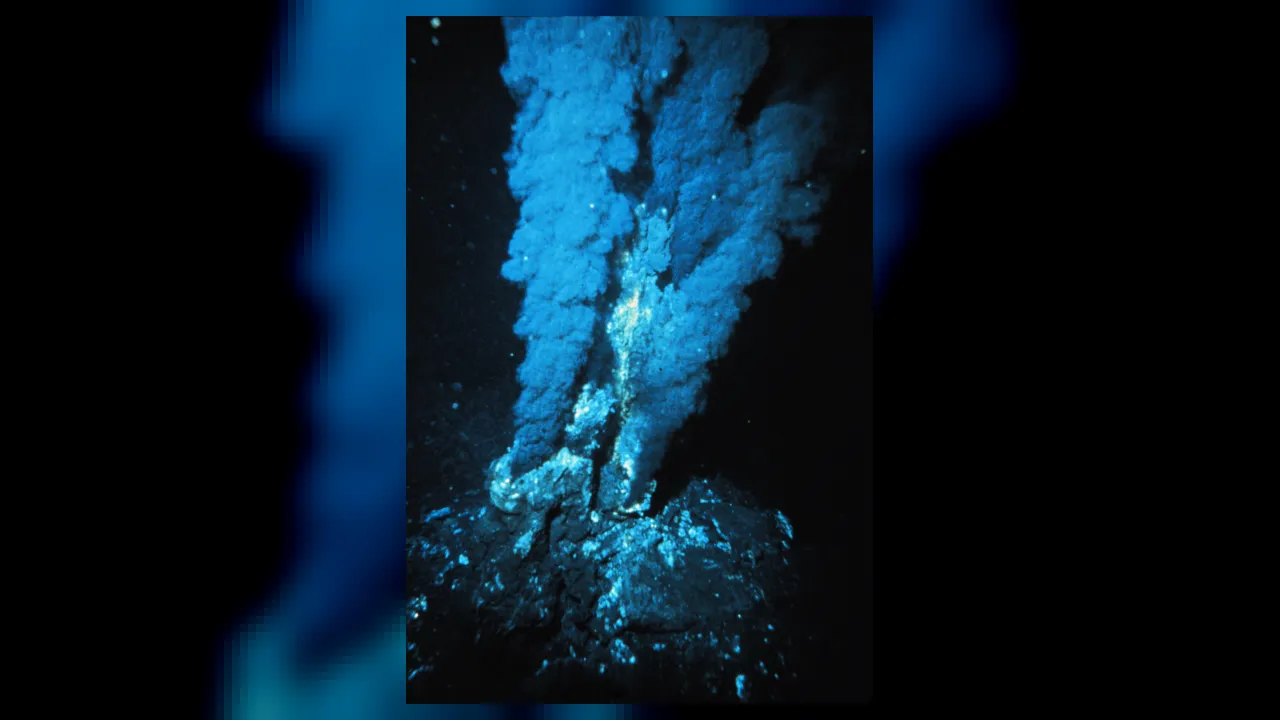
Suddenly, submarine lights shine on tall stone ! Dark, super-hot water pours out like smoke. Scientists call these underwater geysers hydrothermal vents.
3
Busy Deep-Sea Neighbors
Red-tipped tube worms, pale crabs, and shrimp crowd close around the warm for food!
1. How much sunlight reaches deep-sea hydrothermal vents miles underwater?
2. What strange animals with bright red plumes cluster around hydrothermal vents?
🤯 Mind-Blowing Fact • Grade 2
Mineral chimneys at hydrothermal vents can grow a whopping 20 feet taller in a single summer—faster than bamboo!
✨ Word Sparks (Grade 2 Glossary)
Tap 🔊 to hear
black smoker
Deep-sea vent spouting dark, metal-rich hot water.
Alvin
Famous research submarine that discovered hydrothermal vents.
sulfur
Yellowish Earth element used by vent bacteria.
🪝
Why did ocean explorers gasp in amazement when they dove near the Galápagos Islands in 1977?
1
A Shocking 1977 Dive
Before 1977, scientists thought every living neighborhood on Earth depended on green plants and sunlight. Then explorers inside the tiny submarine dove 8,000 feet deep—and spotted bustling gardens of giant clams, ghostly white crabs, and six-foot tube worms!
2
How Black Smokers Build Towers
Cold seawater seeps into cracks along underwater volcanic ridges, gets super-heated near magma, and dissolves dark metals from the rock. When that scalding water blasts back into icy ocean water, minerals harden instantly into tall stone chimneys called .
3
Food From Chemicals, Not Sun
Tiny bacteria eat chemicals pouring from the vents to make energy, feeding the whole deep-sea food web in total darkness!
1. What looks like 'smoke' pouring out of a deep-sea black smoker chimney?
2. What powers the bottom of the food chain around hydrothermal vents instead of sunlight?
🤯 Mind-Blowing Fact • Grade 3
One deep-sea 'Lost City' vent field in the Atlantic builds gleaming white limestone towers 60 meters (200 feet) tall—taller than an 18-story building!
✨ Word Sparks (Grade 3 Glossary)
Tap 🔊 to hear
chemosynthesis
Making food energy from chemicals instead of sunlight.
white smoker
Cooler deep-sea vent spouting pale mineral plumes.
hydrogen sulfide
Sulfur gas fueling microbes at hydrothermal vents.
🪝
How can water shoot out of a black smoker at 400 °C—four times hotter than a boiling kettle—and still stay liquid?
1
Crushing Deep-Sea Pressure
Two thousand five hundred meters down on a mid-ocean ridge, miles of ocean water press down with crushing weight—more than 250 times the air pressure in your classroom! That immense pressure stops 400 °C vent fluid from turning into steam bubbles, keeping it a superheated liquid jet.
2
Black Smokers vs. White Smokers
Hottest vents blast iron, copper, and zinc sulfides that cloud the water black and build towering chimneys up to 18 stories tall! Slightly cooler vents (around 250 °C) release calcium, barium, and silicon minerals that billow pale milky plumes, earning the nickname '.'
3
Chemosynthesis vs. Photosynthesis
On land, plants use photosynthesis to turn sunlight into sugar. Around vents, specialized microbes use —turning gas from Earth's interior into food energy!
4
Life Between Extremes
Remarkably, Pompeii worms rest their tails in hot 80 °C vent water while poking their feathery heads out into chilly 2 °C seawater!
1. Why doesn't 400 °C water turn into steam bubbles at a deep hydrothermal vent?
2. What do scientists call the process where vent microbes turn chemicals into food without any sunlight?
🤯 Mind-Blowing Fact • Grade 4
NASA's Cassini spacecraft detected tiny silica grains and hydrogen gas spraying from Saturn's icy moon Enceladus—evidence of hydrothermal vents beneath its frozen shell!
✨ Word Sparks (Grade 4 Glossary)
Tap 🔊 to hear
symbiosis
Close partnership where two species help each other.
trophosome
Tube worm organ housing food-making symbiotic bacteria.
Enceladus
Icy moon of Saturn with subsurface ocean vents.
🪝
Could deep-sea hydrothermal vents hold clues to how life first began on Earth—and where life might hide on icy moons?
1
Rewriting Biology on the Galápagos Rift
In February 1977, geologists Jack Corliss and Bob Ballard descended 2,500 meters along the Galápagos Rift expecting only hot mineral water near a spreading ridge. Nobody brought a marine biologist aboard Alvin—because textbooks insisted deep seafloors were sparse deserts fed only by 'marine snow' drifting down from sunlit waters! Discovering dense communities of Riftia pachyptila tube worms, blind vent shrimp, and giant white clams powered by chemosynthesis transformed both oceanography and biology overnight.
2
Inside the Hydrothermal Circulation Loop
Hydrothermal vents cluster along divergent mid-ocean ridges and submarine volcanic arcs. Cold two-degree-Celsius seawater percolates kilometers down through fractured basalt crust toward shallow magma chambers. Heated to 350–400 °C, the fluid loses all dissolved oxygen and magnesium, becomes acidic, and leaches iron, copper, zinc, gold, and hydrogen sulfide (`H2S`) out of surrounding rock before buoyantly jetting upward.
3
Symbiosis Inside Giant Tube Worms
Adult Riftia tube worms lack mouths, guts, and digestive tracts altogether! Instead, their bright red hemoglobin-rich plumes absorb oxygen from seawater AND toxic hydrogen sulfide from vent fluids, delivering both to billions of symbiotic chemosynthetic bacteria packed inside a specialized organ called a .
4
Clues to Ocean Worlds Like Europa and Enceladus
NASA's Cassini spacecraft flew straight through icy plumes erupting from Saturn's moon and detected hydrogen and silica nanoparticles—strong evidence of active hydrothermal vents on a subsurface seafloor!
1. Why are bright red plumes at the top of giant Riftia tube worms bright red?
2. Why are astrobiologists studying Earth's hydrothermal vents to prepare for missions to Jupiter's Europa and Saturn's Enceladus?
🤯 Mind-Blowing Fact • Grade 5
Eyeless shrimp swarming around black smokers actually 'see' in pitch darkness using specialized back sensors that detect the faint infrared heat glow of 350 °C water!
✨ Word Sparks (Grade 5 Glossary)
Tap 🔊 to hear
supercritical fluid
Extreme heat-and-pressure phase blending gas and liquid.
serpentinization
Heat-releasing chemical reaction between seawater and mantle rock.
VMS deposit
Ancient seafloor vent minerals preserved as metal ore.
🪝
How does seawater turn into a bizarre 'supercritical fluid' deep beneath Cayman vents—and why do alkaline Lost City towers intrigue origin-of-life chemists?
1
Phase Physics and Supercritical Seawater
Along the Mid-Cayman Rise in the Caribbean, the Beebe (Piccard) Vent Field sits nearly 5,000 meters below sea level—Earth's deepest known black smokers! Under ~500 atmospheres of hydrostatic pressure and temperatures surpassing 400 °C, seawater crosses its thermodynamic critical point (298 bar, 407 °C for salt water), entering a 'supercritical' state that is neither true liquid nor gas. Possessing gas-like diffusivity alongside liquid-like dissolving power, supercritical vent fluid aggressively strips chalcopyrite (`CuFeS2`), sphalerite (`ZnS`), pyrite (`FeS2`), silver, and gold from oceanic crust.
2
VMS Ore Deposits on Dry Land
When buoyant metal-laden jets quench against 2 °C bottom water, massive sulfide chimneys precipitate rapidly. Over geologic time, plate tectonics has accreted ancient seafloor vent mounds onto continents as Volcanogenic Massive Sulfide (VMS) deposits—including the famous copper mines of Cyprus that gave bronze-age civilization its metal!
3
Serpentinization and the Alkaline 'Lost City'
In 2000, researchers exploring 15 kilometers off-axis from the Mid-Atlantic Ridge discovered a completely different system: the Lost City Hydrothermal Field. Driven not by magma heat, but by exothermic chemical reactions between seawater and uplifted mantle peridotite—a process called —Lost City vents warm (40–90 °C), highly alkaline (pH 9–11) fluids rich in hydrogen (`H2`) and methane (`CH4`), constructing 60-meter carbonate monoliths lasting over 100,000 years.
4
Prebiotic Chemistry and Proton Gradients
Biochemists note that microscopic mineral pores inside alkaline Lost City chimneys naturally separate alkaline vent fluid from slightly acidic ancient ocean water—creating natural proton gradients astonishingly similar to how every living cell generates ATP energy today!
5
Thermal Infrared Vision in Total Darkness
Even without sunlight, rimicaris vent shrimp evolved dorsal light-sensing organs tuned to detect the faint 350 °C blackbody thermal glow radiating from scalding black-smoker orifices—steering close enough to graze bacteria without getting cooked!