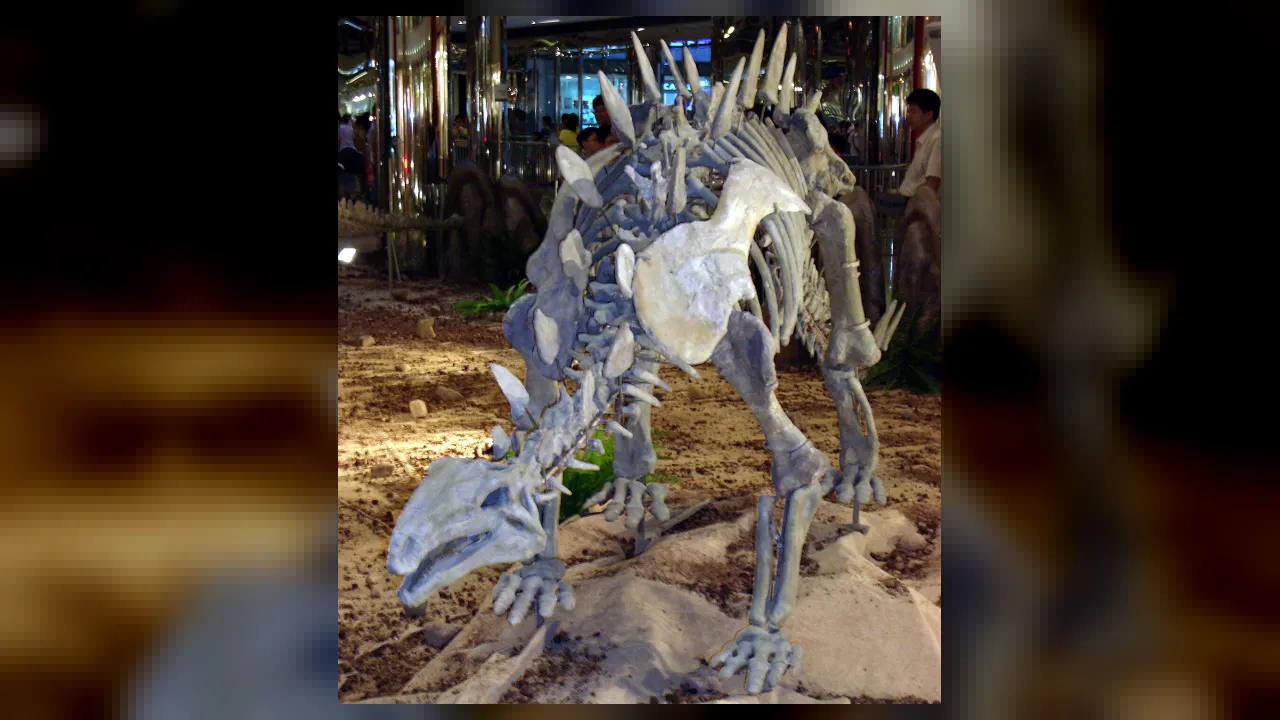
2. Where did Huayangosaurus have extra spikes besides its back and tail?
🤯 Mind-Blowing Fact • Grade 2
Scientists unearthed twelve Huayangosaurus skeletons from the exact same rock quarry in Sichuan, China!
✨ Word Sparks (Grade 2 Glossary)
Tap 🔊 to hear
Quarry
A rocky pit where scientists dig up fossils
Snout
The front nose and mouth of an animal
Herbivore
A creature that eats only plants and leaves
🪝
What did the earliest plated dinosaurs look like before Stegosaurus?
1
An Early Plated Pioneer
Picture a lush river valley in ancient China 165 million years ago. Out from the tree ferns steps Huayangosaurus, one of the oldest plated dinosaurs ever found! It was about as long as a small family car.
2
Teeth in the Front
Later stegosaurs only had a toothless beak at the tip of their . Huayangosaurus still had seven tiny front teeth on each side of its upper jaw, along with cheek teeth for snipping tough plants.
3
Spiky From Front to Back
Two rows of narrow, spike-shaped plates ran down its arched back, and curved spines guarded each shoulder. Four sharp tail spikes helped this gentle plant-eater stay safe from meat-eating neighbors.
1. How was the mouth of Huayangosaurus different from later stegosaurs?
2. In which country were Huayangosaurus fossils discovered?
🤯 Mind-Blowing Fact • Grade 3
Its species name, Huayangosaurus taibaii, honors Li Bai, one of the greatest poets in Chinese history!
✨ Word Sparks (Grade 3 Glossary)
Tap 🔊 to hear
Osteoderm
A bony plate or spike grown inside skin
Thagomizer
The cluster of defensive spikes on a tail
Cycad
A palm-like ancient plant with stiff green fronds
🪝
Why do paleontologists call Huayangosaurus a living blueprint for all stegosaurs?
1
Strolling the Middle Jurassic
Imagine hiking beside a misty Middle Jurassic lake in ancient China 165 million years ago. Moving calmly beneath giant and conifers is Huayangosaurus, one of the earliest and smallest members of the stegosaur family. Measuring about 14 feet long, it weighed roughly half a ton.
2
Clues in a Broad Skull
Unlike the long, narrow heads of later stegosaurs, Huayangosaurus had a wide, boxy skull. Even more surprising, it possessed small front teeth in its premaxilla bone right behind its beak, plus tiny bumps over its eyes. Its front and back legs were also much closer in length.
3
Armor Built for Defense
Narrow, pointed stood in two neat rows along its spine, looking more like upright daggers than wide fans. Large curved spines jutted from its shoulders, and a four-spiked tipped its muscular tail.
4
Named After Sichuan
Paleontologists named this dinosaur after Huayang, an ancient poetic name for Sichuan Province, where a treasure trove of skeletons was excavated from the Shaximiao Formation.
1. How did the back plates of Huayangosaurus differ from those of Stegosaurus?
2. What does the name Huayang refer to?
🤯 Mind-Blowing Fact • Grade 4
Because so many skeletons were found at Dashanpu, Zigong built a museum directly on top of the fossil bonebed!
✨ Word Sparks (Grade 4 Glossary)
Tap 🔊 to hear
Basal
Positioned near the early base of a family tree
Premaxillary
Located at the very front tip of upper jaws
Floodplain
Flat land beside rivers that floods with sediment
🪝
How did a modest 14-foot herbivore reveal the evolutionary roots of giant plated dinosaurs?
1
Life in the Shaximiao Forests
During the Middle Jurassic Period, roughly 165 million years ago, lush covered what is now the Sichuan Basin of China. Towering ginkgoes and horsetail thickets fed giant long-necked sauropods, while hungry theropods like Gasosaurus patrolled the shadows. Keeping low to the ground, Huayangosaurus browsed peacefully on tender undergrowth, relying on an impressive suit of dermal armor rather than speed to survive.
2
Transitional Anatomy
When paleontologists examined Huayangosaurus skeletons, they realized they were looking at a remarkable evolutionary bridge. Later stegosaurs evolved elongated snouts with completely toothless front beaks and towering hind legs that tilted their backs forward. In contrast, Huayangosaurus retained a deep, wedge-shaped skull with seven teeth on each side, small bony eyebrows, and forelimbs nearly as long as its hind limbs.
3
Spikes From Shoulder to Tail
Every region of its body carried specialized osteoderms anchored in thick skin. Two symmetrical rows of tall, triangular plates lined its neck and back, containing fewer blood-vessel grooves than the broad thermal plates of later relatives. Flanking its hips and shoulders were sweeping lateral spines, while four sharp spikes formed a potent tail weapon.
4
Dashanpu Quarry Discovery
In 1979 and 1980, construction work near Zigong exposed the famous Dashanpu dinosaur quarry. Chinese paleontologist Dong Zhiming and his colleagues recovered twelve skeletons there, making Huayangosaurus the best-understood stegosaur in science.
1. Why do scientists classify Huayangosaurus as a basal stegosaur?
2. Why were the back plates of Huayangosaurus less suited for heat control than Stegosaurus plates?
🤯 Mind-Blowing Fact • Grade 5
Detailed re-examination of Huayangosaurus fossils in 2006 revealed small ossified tendons along its spine, proving adults stiffened their backs differently than later stegosaurids!
✨ Word Sparks (Grade 5 Glossary)
Tap 🔊 to hear
Thyreophoran
Any armored dinosaur in the shield-bearer group
Parascapular
Positioned beside or right above the shoulder blade
Fenestra
A natural window-like opening inside a skull bone
🪝
What anatomical clues inside a 165-million-year-old Chinese quarry rewrote the early history of stegosaurian dinosaurs?
1
Beneath the Canopy of Ancient Sichuan
Step back 165 million years to the Bathonian-Callovian stages of the Middle Jurassic Period, where winding rivers carved across the subtropical Sichuan Basin. Amid towering araucarian conifers, cycads, and dense fern meadows, giant sauropods such as Shunosaurus shared the landscape with a compact, bristling herbivore: Huayangosaurus taibaii. Measuring roughly 4.3 meters (14 feet) in length and weighing around 500 kilograms (1,100 pounds), this armored browser occupied the low-tier vegetation niche.
2
Ancestral Skull and Dental Architecture
Scientifically placed at the base of Stegosauria within its own family, Huayangosauridae, this genus preserves crucial ancestral traits inherited from earlier . Whereas Late Jurassic stegosaurids possessed low, tubular skulls with toothless rhamphothecae at the snout tip, Huayangosaurus featured a tall, broad cranium bearing small antorbital fenestrae and seven conical teeth on each premaxilla. Behind those front teeth sat rows of leaf-shaped cheek teeth that sheared fibrous fronds without complex grinding mechanics.
3
Postcranial Proportions and Dermal Armor
Skeletal measurements analyzed by paleontologist Susannah Maidment and colleagues in 2006 confirmed that Huayangosaurus had forelimbs nearly equal in length to its hind limbs, giving it a much flatter posture than high-hipped Stegosaurus. Two paired rows of thick, dagger-shaped osteoderms arched along its vertebral column, transitioning from small cervical plates to taller dorsal spikes. Robust spines projected outward above the shoulders, another small pair guarded the hips, and four lethal spikes armed the distal tail.
4
Surviving Middle Jurassic Predators
Living alongside agile theropods like Gasosaurus and Xuanhanosaurus required active deterrence. Low-slung shoulder spines shielded its vulnerable flanks, while muscular caudal vertebrae swung its spiked thagomizer in wide horizontal arcs whenever a predator pressed too close.
5
Legacy of the Dashanpu Bonebed
Unearthed in 1979 during pipeline excavations at Dashanpu near Zigong and formally described in 1982 by Dong Zhiming, Tang Zilu, and Zhou Shiwu, twelve partial and complete individuals provided an extraordinary anatomical dataset. Today, these specimens anchor our understanding of how armored dinosaurs diversified across Asia millions of years before giant stegosaurids flourished globally.